



Bank bad loans hit 19 trillion won, highest in 8 years as corporate lending defaults rise
Sep 02, 2026, 09:44 am


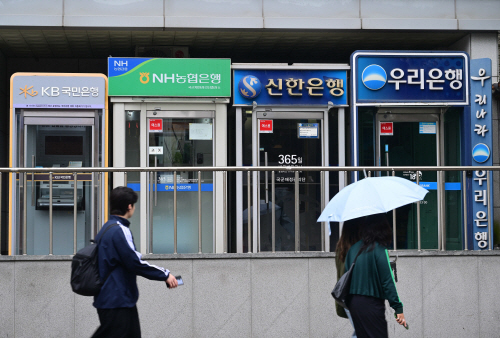 |
| Asia Today reporter Lee Byung-hwa = Bank ATMs installed in downtown Seoul. |
Non-performing loans (NPLs) at domestic banks increased by more than 1 trillion won in the second quarter of this year, reaching the highest level in eight years. The surge was largely driven by a rise in new defaults concentrated in corporate lending. Meanwhile, as provisioning failed to keep pace with the growth of bad debt, the loan-loss coverage ratio fell by 7.5 percentage points in just one quarter.
According to the "Status of Non-Performing Loans at Domestic Banks at the End of June" released by the Financial Supervisory Service (FSS) on the 2nd, the NPL ratio of domestic banks stood at 0.63% at the end of June, up 0.03 percentage points from the end of March. Compared to the end of June last year, the figure rose by 0.04 percentage points.
The volume of bad loans reached 18.9 trillion won, up 1.2 trillion won from the end of the previous quarter (17.7 trillion won). This marks the largest amount in eight years since June 2018 (19.4 trillion won). Corporate credit accounted for the vast majority of total bad loans at 15.2 trillion won, followed by household loans at 3.4 trillion won and credit card receivables at 300 billion won.
While total lending across domestic banks increased by 53 trillion won from 2,958.9 trillion won at the end of March to 3,011.9 trillion won at the end of June, the pace of NPL growth was faster. Consequently, the proportion of bad loans relative to total credit climbed for two consecutive quarters, rising from 0.57% at the end of last year to 0.60% at the end of March and 0.63% at the end of June.
New non-performing loans also expanded rapidly. Newly formed bad loans in the second quarter totaled 7.2 trillion won, an increase of 1.7 trillion won from the first quarter (5.5 trillion won). Compared to the second quarter of last year (6.4 trillion won), this represents an increase of 800 billion won.
The deterioration was particularly noticeable in corporate loans. New non-performing corporate credit stood at 5.7 trillion won, rising by 1.6 trillion won compared to the previous quarter. New bad loans for large corporations increased from 800 billion won to 1.2 trillion won, while those for small and medium-sized enterprises (SMEs) rose by 1.2 trillion won, climbing from 3.3 trillion won to 4.5 trillion won. New non-performing household loans stood at 1.4 trillion won, edging up by 100 billion won from the prior quarter.
As a result, the NPL ratio for corporate credit rose 0.03 percentage points from the previous quarter to 0.77%. The ratio was 0.53% for large corporations and 0.92% for SMEs. The ratio for small and medium corporations rose 0.05 percentage points to 1.08%, while that for sole proprietorships edged up 0.01 percentage points to 0.67%. The household credit NPL ratio stood at 0.33%, an increase of 0.01 percentage points quarter-on-quarter.
Although banks accelerated bad-debt cleanups, the efforts failed to fully offset the surge in new non-performing loans. The volume of resolved NPLs in the second quarter was 6.1 trillion won, up 1.7 trillion won from the previous quarter. Write-offs and sales accounted for 3.9 trillion won—comprising 1.4 trillion won in charge-offs and 2.5 trillion won in debt sales—while loan recoveries through collateral liquidations totaled 1.2 trillion won and normalized loans amounted to 800 billion won.
Along with the expansion of bad debts, the loan-loss coverage ratio, which indicates the banking sector's loss-absorbing capacity, also declined. While the balance of loan-loss reserves stood at 26.9 trillion won at the end of June, up 200 billion won from the prior quarter, the increase in bad loans was steeper. Consequently, the loan-loss coverage ratio fell 7.5 percentage points to 142.9% from 150.4% at the end of the previous quarter. Compared to the same period last year (165.5%), the ratio fell by 22.6 percentage points.
While assessing that overall banking sector soundness currently remains sound, the FSS emphasized proactive risk management, citing lingering uncertainties such as the prolonged Middle East crisis and the delayed impact of domestic and global interest rate hikes. An FSS official stated, "We plan to continuously monitor the soundness conditions of the banking sector and encourage proactive bad-debt charge-offs and sales, as well as the expansion of loss-absorption capacity."
Han Sang-wook
Most Read
-
1
Celltrion nears additional contract with major U.S..

-
2
Putin proposes trilateral U.S.-China-Russia summit..

-
3
U.S. weighs dropping MOAB, world's most powerful n..

-
4
"Aren't those foreigners on welfare?": M..

-
5
Attention centers on APEC for possible Trump-Xi-Pu..

-
6
Saudi Arabia, Iran hold first diplomatic talks to..

-
7
Saudi airport in Riyadh struck again, leaving at l..

PEOPLE







-
Address : In-Young Bldg., 34, Uisadang-daero 1-gil, Yeongdeungpo-gu, Seoul
Copyright by ASIATODAY CO., LTD. All rights resereved