



Labor Ministry allocates 38.9 trillion won for next year's budget for job seekers and AI support
Sep 02, 2026, 09:27 am


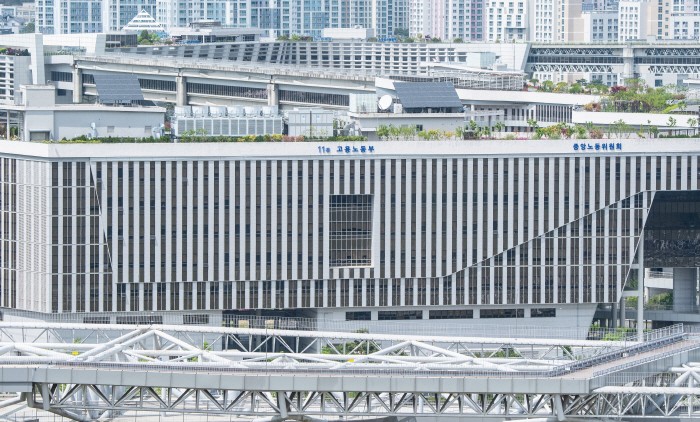 |
| Panoramic view of the Ministry of Employment and Labor / Reporter Park Sung-il |
The Ministry of Employment and Labor has expanded its youth-related budget for next year by more than 700 billion won, setting it at 3.2 trillion won. Financial resources will be focused on reinforcing step-by-step support—ranging from job search preparation, work experience, and establishing a first career to sustained employment after hiring—for youth with no prior employment experience.
The Labor Ministry announced on the 1st that its 2027 budget proposal of 38.9537 trillion won was approved at a Cabinet meeting. This represents an increase of 1.2776 trillion won (3.4%) compared to this year's main budget of 37.6761 trillion won. Centered on three pillars of "Future, Inclusion, and Peace of Mind," the ministry expanded investments to address job transformations resulting from the AI shift, alleviate labor market disparities, and tackle industrial accidents and unpaid wages.
In particular, the youth-related budget saw a substantial increase. The youth employment budget compiled by the Labor Ministry will grow by approximately 700 billion won, rising from 2.6 trillion won this year to 3.3 trillion won next year. A ministry official remarked, "This is likely the first time the scope of youth initiatives has grown by more than 700 billion won," adding, "Looking at youth projects alone, next year's budget reflects the largest rate of increase."
First, the ministry will establish the "Youth First Job Support System" so that youth without prior work experience can also receive state employment assistance services. With an investment of 379.3 billion won, the program will support 160,000 individuals. The job search promotion allowance will be raised from 600,000 won per month this year to 650,000 won next year, linking career exploration, work experience, vocational training, and mock interviews directly to employment.
The "Polytechnic Youth Stepping Stone Campus," where "resting" youth and vocational high school students can receive technical experience and counseling before beginning formal vocational training, will be established across eight regional zones. A total of 56 billion won will be injected into this effort. The ministry will also expand youth work experience programs and newly launch a social-value work experience program for 1,000 participants, enabling young people to build experience in fields they prefer.
Reflecting concerns that corporate hiring thresholds for entry-level workers are rising due to the spread of AI, programs designed to help youth build their "first career" will also be enlarged. The K-New Deal Academy, which began this year with 10,000 participants, will expand to 50,000 next year. In this model, large corporations and other partners provide training in advanced fields such as AI and semiconductors, coupled with corporate on-the-job experience.
The "Youth AI First Career Support" initiative will also be newly launched for 750 participants with an allocation of 14.5 billion won. To help young individuals trained in AI join corporate field operations and build substantive career experience, the ministry will support labor costs and mentoring expenses. Following next year's pilot rollout, expansions will be considered depending on performance outcomes.
A ministry official explained, "Moving one step beyond merely cultivating competencies and offering work experience, this initiative actively provides government backing so that youth can build the very first career they desire most."
The "Youth Playground," designed to support young people who have not found employment even after finishing vocational training, will also be newly created. Through five offline hubs and an online community, it will provide mentoring from working professionals and employment information, managing post-training follow-ups until participants successfully find a job or launch a venture.
The number of beneficiaries under the Youth Job Leap Incentive will increase from 105,000 this year to 130,000 next year. In particular, support for youth hired in non-capital regions will expand to provide up to 18 million won over two years. The budget for K-Digital Training will also rise from 521.3 billion won to 608.9 billion won, with AI training enrollment doubling from 10,000 to 20,000 individuals.
Investments in social safety nets and industrial safety will also be scaled up. The number of beneficiaries under the Duru Nuri program, which subsidizes social insurance premiums for workers at small businesses, will expand from around 1.08 million to roughly 1.8 million. In addition to existing coverage for employment insurance and the national pension, the ministry will provide industrial accident and health insurance premium subsidies for the first time to low-wage workers and platform/gig workers at workplaces with fewer than 10 employees.
An advance guarantee system for industrial accident compensation insurance will also be introduced to pay medical care benefits and temporary disability benefits first to workers whose claims require prolonged approval periods. With a related budget of 43.6 billion won allocated, the goal is to implement the system in the second half of next year following legislative revisions. In the area of industrial safety, 40.1 billion won will be injected into targeted support for workplaces vulnerable to fire and explosion, and an "Industrial Safety AI Assistant" will be built to assist inspectors in workplace risk analysis.
Child care allowances will be provided for the first time to working parents previously caught in blind spots of parental leave benefits, such as sole proprietors, workers in special types of employment, and freelancers. Leave allowances for spouses experiencing miscarriage or stillbirth will also be established. Transfers from the general account to support maternity protection initiatives under employment insurance will increase from 600 billion won this year to 900 billion won next year.
The "once-in-a-lifetime job-seeking benefit" for youth resigning voluntarily, which the Labor Ministry had previously announced intentions to pursue, was not included in this budget proposal. Authorities decided to conduct further reviews addressing concerns that paying job-seeking benefits to voluntary quitters could increase turnover, particularly among small and medium-sized enterprises.
A ministry official stated, "It was concluded that further deliberation is needed to ensure the policy can be rolled out without adverse side effects like increased turnover at small and medium-sized enterprises," adding, "We plan to seek budget allocations once complementary measures are established."
Kim Nam-hyung
Most Read
-
1
Celltrion nears additional contract with major U.S..

-
2
Putin proposes trilateral U.S.-China-Russia summit..

-
3
"Aren't those foreigners on welfare?": M..

-
4
U.S. weighs dropping MOAB, world's most powerful n..

-
5
Houthis launch successive attacks on Saudi airport..

-
6
Saudi Arabia, Iran hold first diplomatic talks to..

-
7
Saudi airport in Riyadh struck again, leaving at l..

PEOPLE





HEADLINE NEWS
- [Exclusive] U.S. military steel frame work at Gwangju Airport casts cloud over planned semiconductor industrial complex
- Momentum grows for mid-next month U.S.-China-Russia summit with mounting is..
- Elon Musk formalizes review of SpaceX-Tesla merger
- [Exclusive] 10 SNUs pledged, but three regional universities take half the..

-
Address : In-Young Bldg., 34, Uisadang-daero 1-gil, Yeongdeungpo-gu, Seoul
Copyright by ASIATODAY CO., LTD. All rights resereved