



Married couples to receive 1 million won in cash support
Sep 02, 2026, 09:23 am


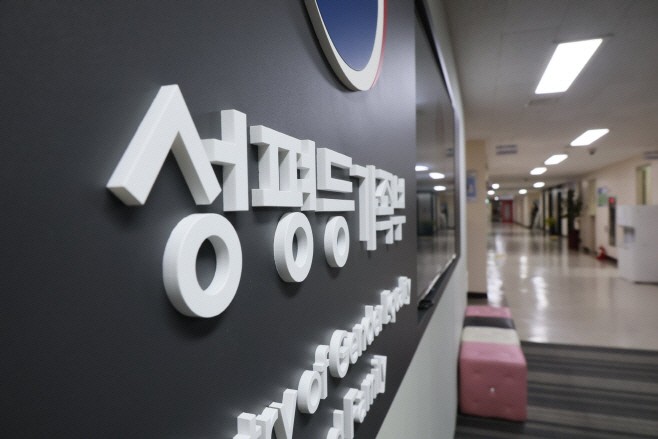 |
| Government Complex Seoul of the Ministry of Gender Equality and Family / Reporter Kim Bo-young |
Starting next year, couples who register their marriage will receive a cash payment of 1 million won per couple, regardless of income or age. With support expanding for various household types such as single-person households and single-parent families, the budget of the Ministry of Gender Equality and Family has surpassed 2.1 trillion won, reaching an all-time high.
The Ministry of Gender Equality and Family announced on the 1st that its 2027 budget proposal of 2.1191 trillion won was approved at a Cabinet meeting. This represents an increase of 110.4 billion won (5.5%) compared to this year's main budget of 2.0087 trillion won.
The most notable program is the newly allocated "marriage subsidy" of 166.3 billion won. Couples who register their marriage after January 1, 2027, will receive 500,000 won per person, amounting to 1 million won per couple. Unlike the existing marriage tax credit, which applied benefits conditionally based on income, this support is available regardless of income level.
The government calculated the scale of support based on the 240,000 marriages recorded in 2025. After establishing the necessary regulations and payment systems, it plans to disburse cash into individual bank accounts starting in the second half of next year. The marriage subsidy will be operated as an ongoing project continuing beyond 2027.
The family policy budget will increase by 104.5 billion won (7.5%) from 1.3999 trillion won this year to 1.5044 trillion won next year. Approximately 95% of the ministry's net budget increase of 110.4 billion won is accounted for by family policy. Family policy also makes up 71.0% of the ministry's total budget.
A ministry official explained, "The budget increase for family policy expanded significantly as child-rearing support for single-parent families rose by 21.4 billion won and the marriage subsidy of 166.3 billion won was newly allocated."
The eligibility threshold for child-rearing benefits for single-parent families will be relaxed from 65% or below of the standard median income to 66% or below. Accordingly, the number of beneficiaries will increase by 13,000 from 257,000 to 270,000. For expectant unmarried and single parents, a new preliminary child-rearing allowance of 230,000 won per month will be provided for three months to help prepare for childbirth and child-rearing.
The existing support program for vulnerable and crisis-hit families will be reorganized into the 28.7 billion won "Everyone's Family" initiative. Moving beyond conventional assistance centered strictly on vulnerable groups, the service will expand to include daily living and education support for single-person households, as well as family relationship education for parents and children. In child care services, the government subsidy rate for households with school-age children will be raised by 5 to 10 percentage points, and tailored regional care initiatives will be piloted in four areas.
In the youth sector, 3.78 billion won will be injected into establishing an integrated telephone consultation system for "Youth Helpline 1388" and founding a central center. Currently, counselors handle consultations and incoming calls concurrently due to the absence of a separate call management system. The new system will enable queue history management, call distribution, and automated line routing. Twelve dedicated staff members will be assigned to the central center to operate a 24-hour consultation framework.
Support institutions for isolated and reclusive youth will expand from 14 to 29 locations, and diagnostic and development programs for youth with borderline intellectual functioning will be newly launched across 15 sites. Staff at out-of-school youth support centers will increase from 706 to 825. In addition, 102 youth after-school academies in agricultural and fishing communities will double their operating hours during vacation periods from 4 to 8 hours daily.
Artificial intelligence (AI) technology will also be utilized in tackling gender violence. The ministry will newly inject 1 billion won into developing an AI-based in-depth analysis system that monitors websites distributing illegal filming materials, while also initiating new research to analyze the causes and progressions of fatalities among victims of intimate partner violence. The unit cost for free legal assistance for violence victims will rise from 1.5 million won to 2.5 million won per case at the investigation and first-instance trial stages.
The "Sanitary Pads for Everyone" project, which was piloted across 12 regions this year, will be expanded nationwide. With 22.8 billion won in state funds allocated, the project will push to provide roughly two sanitary pads per month to women aged 19 to 50 across some 230 basic local governments nationwide. However, while state funds covered 100% of the cost this year, starting next year, state subsidies will account for 30% in Seoul and 50% in other regions, with local governments covering the remainder.
While the overall budget grew, the budget for youth policy declined by 2.4%, and safety and human rights decreased by 4.1%. A ministry official explained, "Although funding appears reduced because the state subsidy rate for certain programs such as child care and safety and human rights was adjusted from 70% to 50%, the overall services received by the public remain largely unchanged or will expand," adding, "Funds secured through expenditure restructuring were reinvested into new projects."
Kim Nam-hyung
Most Read
-
1
Celltrion nears additional contract with major U.S..

-
2
Putin proposes trilateral U.S.-China-Russia summit..

-
3
"Aren't those foreigners on welfare?": M..

-
4
U.S. weighs dropping MOAB, world's most powerful n..

-
5
Houthis launch successive attacks on Saudi airport..

-
6
Saudi Arabia, Iran hold first diplomatic talks to..

-
7
Saudi airport in Riyadh struck again, leaving at l..

PEOPLE





HEADLINE NEWS
- [Exclusive] U.S. military steel frame work at Gwangju Airport casts cloud over planned semiconductor industrial complex
- Momentum grows for mid-next month U.S.-China-Russia summit with mounting is..
- Elon Musk formalizes review of SpaceX-Tesla merger
- [Exclusive] 10 SNUs pledged, but three regional universities take half the..

-
Address : In-Young Bldg., 34, Uisadang-daero 1-gil, Yeongdeungpo-gu, Seoul
Copyright by ASIATODAY CO., LTD. All rights resereved