



Police issue first nationwide special alert amid successive misconduct cases
Sep 02, 2026, 09:16 am


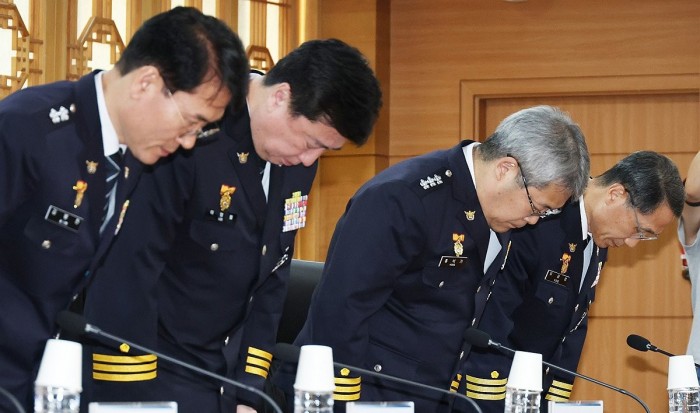 |
| Police leadership, including Acting Commissioner General of the Korean National Police Agency Yoo Jae-sung (from far right) and Head of the National Investigation Office Hong Seok-gi, offer a public apology regarding the falsified closure of a missing person case in Jeju during a police leadership meeting held at the Government Complex Seoul in Jongno-gu, Seoul. / Yonhap News |
Just four months after issuing a nationwide misconduct alert in April, the police have issued a nationwide "Special Alert on Official Discipline" for the first time. Although much of the recent controversy—including the falsified closure of a missing person case in Jeju and the shoddy investigation into the Jang Yoon-ki case—arose during official duties rather than from drinking or team dining, countermeasures have once again focused on banning work dinners, conducting conduct inspections, and convening crisis meetings. Concerns are mounting over whether repeatedly tightening discipline alone can prevent on-the-job misconduct.
According to the Korean National Police Agency and related authorities on the 1st, Acting Commissioner General Yoo Jae-sung issued a special alert on official discipline to police stations nationwide on the 28th of last month. This marks the first time a special alert has been issued to police stations nationwide since the alert system for misconduct was revamped in April of last year.
The nationwide special alert was prompted by a series of recent on-the-job misconduct cases and inadequate case handling. In Jeju, it was revealed that an officer falsely closed a case without directly verifying the missing individual's safety. Controversy over a botched investigation also flared in the Jang Yoon-ki case. With leaks of investigative information and inappropriate conduct compounding the problem, trust in the police organization has once again been called into question.
During the special alert period, the police banned work dinners and instructed personnel to refrain from drinking. Unnecessary events are also being postponed or discouraged. The Korean National Police Agency and provincial and metropolitan police agencies are required to convene at least one countermeasure meeting, while frontline police stations and mobile units must hold daily meetings presided over by their station chiefs. In addition, training to prevent breach-of-duty infractions and service inspections will be tightened, with managers also being held accountable if misconduct occurs.
The problem is that a similar prescription was rolled out just four months ago. The police issued a misconduct alert to all police stations nationwide for two weeks starting April 20. At that time, meetings presided over by station chiefs and preventive education sessions were likewise conducted. Because on-the-job misconduct and negligent case handling persisted nonetheless, this time only the alert level was elevated to a special alert.
In its internal evaluation last year, the Korean National Police Agency cited the misconduct alert system as a major achievement in managing public service discipline. It stated that it issued 26 standard alerts and 17 special alerts last year, uncovering 82 infractions through three special inspections conducted during vulnerable periods. Yet, despite promoting these achievements, there was no noticeable decrease in the number of disciplinary actions. The number of disciplined officers stood at 536 in 2024 and 528 last year. Over the past five years, the annual average number of disciplined officers reached 503. So far this year through May, 224 officers have been disciplined, with 102 of them receiving heavy disciplinary measures of suspension or higher.
Critics point out that misconduct occurring in the course of duty, such as falsely closing a missing person case or conducting a shoddy investigation, has little direct connection to banning work dinners or refraining from drinking. Voices within the police organization have also pushed back, arguing that uniformly restricting group dinners for all officers nationwide due to misconduct by a few essentially amounts to collective punishment.
Experts analyzed that the management approach of evaluating misconduct policies solely by the number of alerts issued, inspections conducted, or violations caught must change. They argue that authorities should measure how much misconduct actually decreases before and after alerts, while addressing recurring duty-related infractions by overhauling operational procedures and supervisory frameworks.
Lee Kun-soo, a professor in the Department of Police Science at Konkuk University, stated, "The misconduct of just one or two officers is perceived by the public as an issue of trust in the police organization as a whole, meaning measures to signal gravity internally through alerts may be necessary." He added, "Rather than relying strictly on internal management, authorities should consider expanding external participation in the hearing and audit processes."
Seol So-young
Most Read
-
1
Celltrion nears additional contract with major U.S..

-
2
Putin proposes trilateral U.S.-China-Russia summit..

-
3
"Aren't those foreigners on welfare?": M..

-
4
U.S. weighs dropping MOAB, world's most powerful n..

-
5
Houthis launch successive attacks on Saudi airport..

-
6
Saudi Arabia, Iran hold first diplomatic talks to..

-
7
Saudi airport in Riyadh struck again, leaving at l..

PEOPLE





HEADLINE NEWS
- [Exclusive] U.S. military steel frame work at Gwangju Airport casts cloud over planned semiconductor industrial complex
- Momentum grows for mid-next month U.S.-China-Russia summit with mounting is..
- Elon Musk formalizes review of SpaceX-Tesla merger
- [Exclusive] 10 SNUs pledged, but three regional universities take half the..

-
Address : In-Young Bldg., 34, Uisadang-daero 1-gil, Yeongdeungpo-gu, Seoul
Copyright by ASIATODAY CO., LTD. All rights resereved