



German constitutional research officers visit South Korea
Sep 02, 2026, 09:12 am


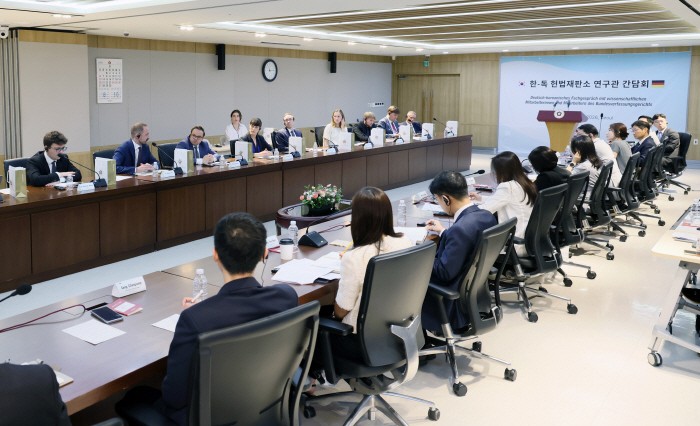 |
| On the 1st, in the Grand Conference Room of the Constitutional Court, German constitutional research officers answered a series of questions raised by South Korean constitutional research officers regarding constitutional complaints against court decisions. / Constitutional Court |
The Constitutional Court of Korea met with constitutional research officers from the Federal Constitutional Court of Germany to exchange views on review standards and operational practices regarding constitutional complaints against court decisions.
On the 1st, the Constitutional Court held a roundtable discussion with a delegation of constitutional research officers from the Federal Constitutional Court of Germany at the Constitutional Court in Jongno-gu, Seoul. This meeting was arranged to deepen understanding of South Korea's constitutional order and legal system, as well as to share experiences regarding the roles and constitutional adjudication systems of both institutions. Held in two separate groups, the discussion brought together 32 participants from the German side, including current and former German constitutional research officers, and around 40 South Korean participants, including constitutional research officers.
In his welcoming remarks, President of the Constitutional Court Kim Sang-hwan stated, "As the Constitutional Court faces new constitutional tasks, Germany's extensive experience will serve as an invaluable reference." He added, "I hope this roundtable extends beyond a forum for discussion to become an opportunity to further advance exchanges between the constitutional courts of our two nations."
Regarding the constitutional complaint system against court decisions implemented since March, discussions during the roundtable centered on responses from the German side based on a wealth of practical cases accumulated by the Federal Constitutional Court of Germany since operating the system in 1951.
Research officers from the German Federal Constitutional Court noted that the intensity of review for constitutional complaints against judicial decisions varies depending on the nature of the case and the fundamental rights at issue. For instance, high-intensity review is applied in matters that directly and significantly restrict fundamental rights, such as criminal trials.
The threshold for constitutional complaints against judicial decisions was also high. The German side explained, "For a complainant to assert a violation of the right to a fair hearing (Recht auf rechtliches Gehör), it is insufficient merely to claim that 'the court did not grant my argument'; the assertion must reach the level that the court completely failed to consider an issue central to the determination of the constitutional complaint."
Germany's practical experiences addressing issues that emerged as key points of contention during South Korea's implementation of the system were also presented. Ahead of the system's enforcement, controversies had persisted in South Korea over whether this mechanism effectively functioned as a "fourth-instance trial," given that it permits constitutional complaints against final and conclusive judgments of the Supreme Court.
In response to a query from the South Korean Constitutional Court regarding "how specialized courts (ordinary courts in South Korea) apply decisions upholding constitutional complaints and whether the Federal Constitutional Court monitors this," the German side responded, "The Federal Constitutional Court no longer intervenes in the case, and will only review the matter again if a new constitutional complaint is filed."
Discussions also addressed the transmission of trial records, which had been identified as an operational task to resolve. The Federal Constitutional Court of Germany receives records from specialized courts either as physical paper documents or in electronic formats. In the case of older paper records that have not been digitized, the court receives the original files, preserves them for the duration of the case processing, and returns them to the specialized court once proceedings conclude.
The constitutional courts of South Korea and Germany have maintained ongoing exchanges since 2015. Last month, Justices Ma Eun-hyuk and Oh Young-joon visited the Federal Constitutional Court of Germany to discuss practical operations regarding constitutional complaints against court decisions. Next year, a South Korean delegation led by President Kim is scheduled to pay a return visit.
Son Seung-hyun
Most Read
-
1
Celltrion nears additional contract with major U.S..

-
2
Putin proposes trilateral U.S.-China-Russia summit..

-
3
"Aren't those foreigners on welfare?": M..

-
4
U.S. weighs dropping MOAB, world's most powerful n..

-
5
Houthis launch successive attacks on Saudi airport..

-
6
Saudi Arabia, Iran hold first diplomatic talks to..

-
7
Saudi airport in Riyadh struck again, leaving at l..

PEOPLE






HEADLINE NEWS
- [Exclusive] U.S. military steel frame work at Gwangju Airport casts cloud over planned semiconductor industrial complex
- Momentum grows for mid-next month U.S.-China-Russia summit with mounting is..
- Elon Musk formalizes review of SpaceX-Tesla merger
- [Exclusive] 10 SNUs pledged, but three regional universities take half the..

-
Address : In-Young Bldg., 34, Uisadang-daero 1-gil, Yeongdeungpo-gu, Seoul
Copyright by ASIATODAY CO., LTD. All rights resereved