



One in two youth suicides linked to fatal falls
Sep 02, 2026, 09:10 am


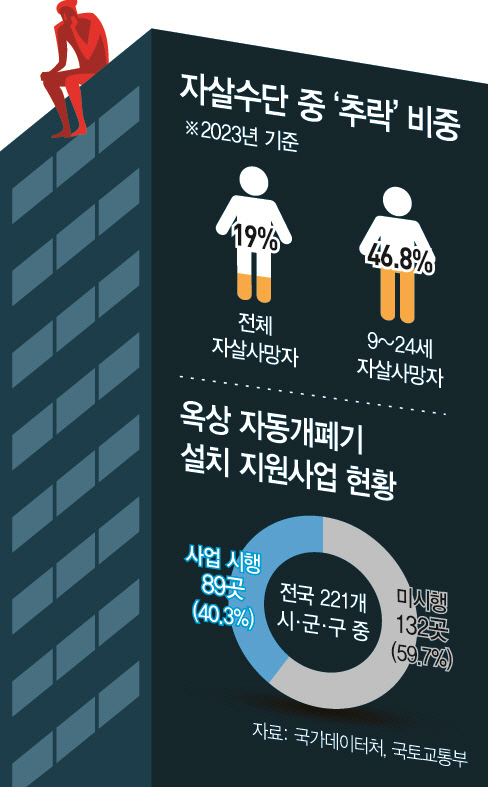 |
While fatal falls account for nearly half of suicide deaths among adolescents and young adults, buildings approved or permitted prior to the 2016 revision of the Regulations on Housing Construction Standards and Other Matters are not subject to the mandatory installation of rooftop safety devices. Less than half of the local governments surveyed provide installation subsidies for buildings constructed prior to the regulatory revision. Concerns are emerging that disparities in physical safety nets for suicide prevention may arise depending on building age and region.
According to the Ministry of Data and Statistics on the 1st, fatal falls accounted for 19.0% of all suicide deaths in 2023. Among individuals aged 9 to 24, the figure reached 46.8%.
One of the primary countermeasures cited for preventing fatal falls is restricting access to high-risk locations. The government has developed relevant systems to secure emergency evacuation routes while controlling rooftop access. In 2016, the government revised the Regulations on Housing Construction Standards and Other Matters to require the installation of automatic emergency door release systems on the rooftop access doors of each building within residential complexes. In 2021, the mandatory installation was expanded through an amendment to the Enforcement Decree of the Building Act. An automatic emergency door release system keeps the rooftop access door locked under normal conditions and automatically unlocks it in coordination with firefighting systems during emergencies such as fires.
The issue lies with existing buildings permitted before the regulatory revision. Because the revised regulations do not apply retroactively, buildings constructed prior to the amendment remain exempt from the installation mandate. The categories of buildings subject to installation are also limited. This structure creates a divide in whether rooftop safety devices are installed based on the timing of implementation.
Institutional gaps regarding existing buildings are effectively being bridged by subsidy projects from local governments. According to the Ministry of Land, Infrastructure and Transport, only 89 out of the 221 cities, counties, and districts that submitted data are implementing projects to install automatic rooftop door release devices. The remaining 132 jurisdictions have not implemented related projects. Even among jurisdictions carrying out such projects, the scope of support varied significantly by local government, ranging from as few as one multi-family residential complex to as many as 60 complexes. Ultimately, whether rooftop safety devices are installed in existing buildings hinges on the budget and scale of support provided by individual local governments.
In response, the government announced a plan in July to centrally manage locations with recurring suicides at the national level. In March, an amendment to the Building Act was introduced in the National Assembly. Its core objective is to allow the installation of safety facilities, including automatic emergency door release systems, on the rooftops of existing buildings where repeated accidents occur, while establishing legal grounds for the national and local governments to subsidize the costs.
However, critics point out that concrete measures to guarantee the effectiveness of these policies remain insufficient. This is because both the budget and the managing entities required for installing safety facilities in existing buildings remain unclear. Furthermore, the measures fail to address the fact that the level of safety facility installation can vary depending on the fiscal conditions and policy resolve of each local government.
Lee Hae-woo, a psychiatry professor at Dongguk University Ilsan Hospital, stated, "Restricting access methods such as rooftops can be seen as having some effect on preventing suicide by falling," but added, "If fundamental measures for suicide prevention do not accompany this, the means may simply shift to alternative methods." Professor Lee further emphasized, "A comprehensive suicide prevention strategy is necessary alongside physical environmental improvements."
Kim Tae-hoon
Most Read
-
1
Celltrion nears additional contract with major U.S..

-
2
Putin proposes trilateral U.S.-China-Russia summit..

-
3
"Aren't those foreigners on welfare?": M..

-
4
U.S. weighs dropping MOAB, world's most powerful n..

-
5
Houthis launch successive attacks on Saudi airport..

-
6
Saudi Arabia, Iran hold first diplomatic talks to..

-
7
Saudi airport in Riyadh struck again, leaving at l..

PEOPLE






HEADLINE NEWS
- [Exclusive] U.S. military steel frame work at Gwangju Airport casts cloud over planned semiconductor industrial complex
- Momentum grows for mid-next month U.S.-China-Russia summit with mounting is..
- Elon Musk formalizes review of SpaceX-Tesla merger
- [Exclusive] 10 SNUs pledged, but three regional universities take half the..

-
Address : In-Young Bldg., 34, Uisadang-daero 1-gil, Yeongdeungpo-gu, Seoul
Copyright by ASIATODAY CO., LTD. All rights resereved