



AI-driven job reshuffling begins, with accounting and office jobs declining and junior roles shrinking
Sep 01, 2026, 09:56 am


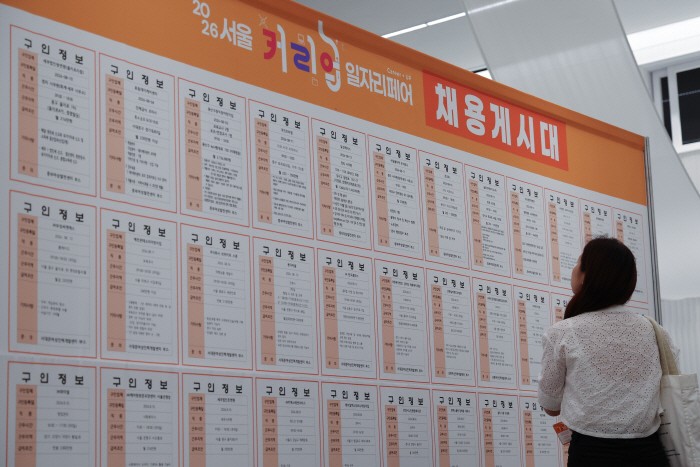 |
| Job seekers check recruitment information at the 2026 Seoul Career Up Job Fair held at the Seoul Women's Plaza in Dongjak District, Seoul, on the 27th. / Yonhap News |
Coupled with the spread of artificial intelligence (AI), signs of change are emerging in the labor market's job landscape. The number of employment insurance subscribers has decreased in several occupations with high AI exposure—such as accounting/bookkeeping and accounting/tax/appraisal—while office jobs like customer service and secretarial work have also turned downward. Looking ahead, possibilities are being raised that shifts in entry-level hiring and junior roles will grow more pronounced.
According to the summer 2026 issue of Employment Issues published by the Korea Employment Information Service on the 31st, among high AI-exposure occupations, employment insurance subscribers for accounting and bookkeeping clerks decreased by 4,000 in 2023, 7,000 in 2024, and 4,000 in 2025. The reduction over the three-year period totaled 15,000. Professionals in accounting, tax, and appraisal also declined by 1,000 each year from 2022 to 2025.
The service calculated AI exposure by occupation by linking the Korea Occupational Information Survey of incumbent workers with the employment insurance database. Seventeen occupations were categorized into the high-exposure group, including legal clerks, journalists and media professionals, government administration experts and related workers, telemarketers, accounting/tax/appraisal experts, management support clerks, software developers, and accounting/bookkeeping clerks.
Yoon Jeong-hye, head of the Employment Trends Analysis Team at the Korea Employment Information Service, analyzed, "Accounting/tax/appraisal experts and accounting/bookkeeping clerks have shown a sustained downward trend in employment insurance subscribers recently, suggesting the possibility of employment contraction in tasks involving standardized, quantitative data processing." She added, "Except for management support clerks, the top occupations with high AI exposure do not have a large pool of insured workers, so the impact on overall employment fluctuations is judged to be limited."
Employment shifts tied to AI are not confined to the accounting sector. For information/customer service/statistics/secretarial and other office clerks—classified as a medium AI-exposure group—employment insurance subscribers had shown a modest upward trend, but turned into a decrease of 1,000 in 2025. Customer inquiry and consultation is an area where generative AI and large language model (LLM)-based agent technologies are rapidly being deployed, making it an occupation widely seen as having high potential for structural employment changes going forward.
However, it is difficult to conclude that the employment slowdown observed so far is entirely due to AI. Since 2023, new employment insurance acquisitions have declined across all occupations regardless of AI exposure level. Decomposing the subscriber growth rate by contributing factor revealed that labor supply side factors—such as the shrinking youth population and reduced economic participation—had a larger impact than the spread of AI.
Changes are likely to become more distinct in future recruitment and organizational roles. A survey of 305 workers in IT development, visual/digital design, and general administration—fields sensitive to the AI transition—showed that the outlook for "strengthening the role of PM-level and intermediate-or-higher skilled workers" rose by 0.75 points three years from now compared to the present, while the outlook for "reducing the role of junior-level staff" also increased by 0.61 points. The analysis suggests that as AI supports simple, repetitive tasks alongside entry-level analysis and drafting, tasks handled by junior staff will decrease, while the role of mid-level and senior personnel in managing, reviewing, and coordinating work may expand.
Changes in human resources management also showed a pronounced impact on entry-level recruits. The expected degree of reduction in entry-level hiring was projected to rise from 1.84 points at present to 2.65 points in three years. The weight given to AI utilization competency when hiring entry-level workers increased from 2.33 points to 3.20 points, and the reflection of AI utilization skills in performance evaluations rose from 2.09 points to 2.96 points.
AI proficiency may also establish itself as a standard job competency in future recruitment and evaluation. Three years from now, methods incorporating AI capability and performance into entry-level hiring and HR reviews are expected to spread, while demand for specialized personnel responsible for adopting and operating AI is projected to increase.
Kim Dong-gyu, a research fellow at the Future Careers Research Team of the Korea Employment Information Service, remarked, "If AI replaces or automates parts of entry-level duties, the pathway through which young people build up skills via foundational tasks in the workplace could weaken." He added, "Youth employment policy in the AI era must go beyond simple job placement and strengthen practical work experience opportunities where they can utilize AI and build expertise within real job contexts."
Kim Nam-hyung
Most Read
-
1
Celltrion nears additional contract with major U.S..

-
2
"Aren't those foreigners on welfare?": M..

-
3
U.S. weighs dropping MOAB, world's most powerful n..

-
4
Houthis launch successive attacks on Saudi airport..

-
5
Saudi Arabia, Iran hold first diplomatic talks to..

-
6
Saudi airport in Riyadh struck again, leaving at l..

-
7
Five ASEAN countries welcome Myanmar coup leader

PEOPLE






HEADLINE NEWS

-
Address : In-Young Bldg., 34, Uisadang-daero 1-gil, Yeongdeungpo-gu, Seoul
Copyright by ASIATODAY CO., LTD. All rights resereved