



Annual Jaseng Academic International Conference held in U.S. for first time
Aug 31, 2026, 02:55 pm


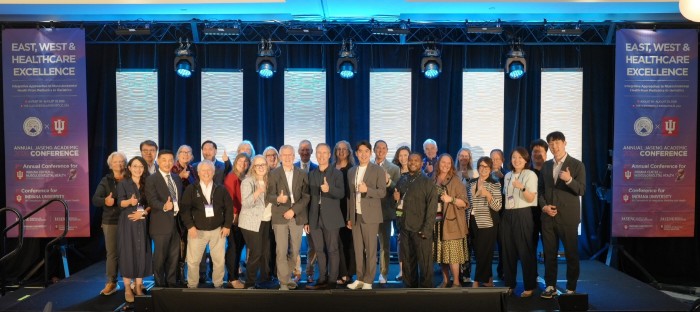 |
| Medical Director Lee Jin-ho of Jaseng Hospital of Korean Medicine (eighth from left in front row) and speakers participating in the academic conference pose for a commemorative photo. / Jaseng Hospital of Korean Medicine |
Can integrative medicine treatments such as acupuncture, pharmacopuncture, and manual therapy, where practitioner experience is critical, be objectively measured and standardized? Jaseng Hospital of Korean Medicine held the Annual Jaseng Academic (AJA) International Conference in the U.S. for the first time to discuss scientific validation methods with the international medical community.
Jaseng Hospital of Korean Medicine announced on the 31st that it co-hosted the "2026 AJA International Conference" with the Indiana University School of Medicine in Indianapolis, U.S., on the 28th and 29th.
Marking its sixth edition, this year's event was themed "East Meets West: An Integrative Approach to Musculoskeletal Health Across the Lifespan from Pediatrics to Geriatrics." Fifty domestic and international experts from institutions including Indiana University, Harvard University, and the University of California, Irvine (UCI) participated as key speakers, and around 200 medical professionals from various countries attended the venue. Co-host Indiana University School of Medicine operates nine campuses across Indiana and more than 400 clinical education partner institutions.
At this year's conference, methods for measuring the effects of integrative medicine treatments with objective data were addressed as a primary agenda item. This represents an effort to quantify treatment procedures—ranging from the placement of acupuncture needles to pharmacopuncture application sites and the force transmitted to patients during manual therapy—and to unify standards that can otherwise vary among researchers.
Lee Jin-ho, Medical Director of Jaseng Hospital of Korean Medicine, introduced ultrasound-guided pharmacopuncture to identify the cause of pain and determine treatment sites. He explained that along with lesions identified on imaging tests, areas arising from compensatory physical mechanisms—such as faulty gait or fascial tension—can also contribute to pain, requiring comprehensive evaluation.
A data platform designed to unify research standards for acupuncture was also introduced. Presented by Richard Harris, Endowed Professor at UCI, the "Topological Atlas and Repository for Acupoint research" (TARA) models human acupoints in 3D and aggregates physiological responses triggered by acupoint stimulation. Its goal is to establish a foundation for comparing disparate study results by standardizing the names and locations of acupoints that may differ across researchers.
Research is also underway to objectively quantify practitioner force in manual therapy. M. Terry Loghmani, Professor at the Indiana University School of Health & Human Sciences, presented the "Force-Based Manipulation" (FBM) model, which connects and analyzes the magnitude of force applied during treatment alongside treatment settings and human body responses. The aim is to verify treatment efficacy and mechanisms of action more consistently by standardizing manual therapy protocols and assessment criteria.
Efforts to expand the scope of integrative medicine research also continued. Lifespan-specific study findings were shared, covering musculoskeletal changes as well as functional recovery in postmenopausal women and cancer survivors.
Melissa A. Kacena, Endowed Professor of Orthopaedic Surgery at the Indiana University School of Medicine, introduced research observing bone formation and fracture healing in mice aboard the International Space Station (ISS). This research analyzes skeletal changes under the unique environment of microgravity to find clues for treating bone diseases.
Lisa J. Taylor-Swanson, Associate Professor at the University of Utah College of Nursing, introduced "postmenopausal musculoskeletal syndrome," where conditions like joint pain and sarcopenia co-occur after menopause, sharing research on the effects of acupuncture on pain and physical function. Peter Wayne, Associate Professor at Harvard Medical School, proposed utilizing combined interventions such as exercise and acupuncture to manage pain as well as declines in muscle strength and mobility in cancer survivors and older patients.
Using artificial intelligence (AI) as a tool to rapidly accumulate evidence in integrative medicine was also discussed. Jeremy Y. Ng, Assistant Professor at McMaster University, explained that generative AI can enhance efficiency in evidence synthesis, from literature searching to study screening and data extraction in traditional, complementary, and integrative medicine.
In addition, adoption cases of acupuncture in U.S. medical institutions, brain health, prosthetic and fascial therapies, and exercise regimens related to cancer and aging were discussed. The overall program comprised four keynote speeches and 11 sessions.
"We will continue academic exchanges and research collaborations with researchers worldwide to build scientific evidence for integrative medicine, translating this into improved health and quality of life for patients in clinical settings," said Park Byung-mo, Chairman of the Jaseng Medical Foundation.
Bae Da-hyun
Most Read
-
1
Celltrion nears additional contract with major U.S..

-
2
Putin proposes trilateral U.S.-China-Russia summit..

-
3
U.S. weighs dropping MOAB, world's most powerful n..

-
4
"Aren't those foreigners on welfare?": M..

-
5
Attention centers on APEC for possible Trump-Xi-Pu..

-
6
Saudi Arabia, Iran hold first diplomatic talks to..

-
7
China tightens grip on boosting domestic demand an..

PEOPLE







-
Address : In-Young Bldg., 34, Uisadang-daero 1-gil, Yeongdeungpo-gu, Seoul
Copyright by ASIATODAY CO., LTD. All rights resereved