



U.S. secures control over Venezuelan crude oil, but execution remains unclear
Aug 31, 2026, 10:04 am


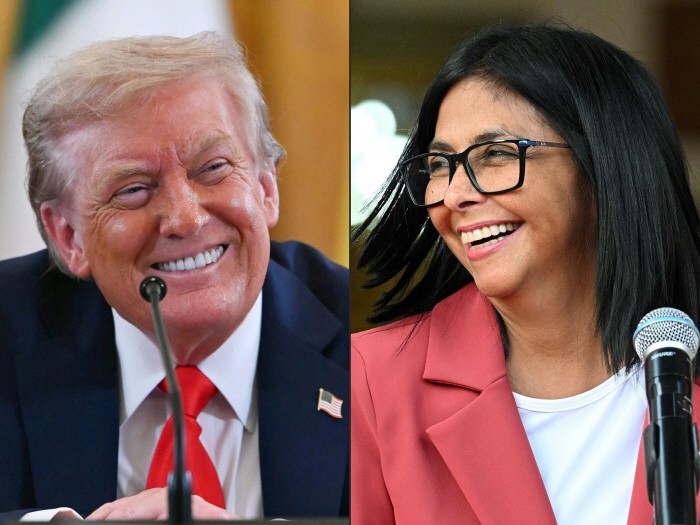 |
| U.S. President Donald Trump (left) and Venezuelan Interim President Delcy Rodriguez. / AFP Yonhap |
The U.S. administration has signed an agreement securing control over Venezuela's crude oil reserves. While the move is seen as an effort to lower domestic oil prices in the U.S., analysts suggest that actual investment and implementation remain uncertain due to legal hurdles within Venezuela, among other issues.
According to reports from the Wall Street Journal (WSJ) and Reuters on the 29th (local time), U.S. President Donald Trump posted on the social media platform Truth Social that day: "The United States of America has just entered into an Agreement with the Country of Venezuela on, THE BIGGEST OIL DEAL IN WORLD HISTORY!"
He added, "At my direction, Secretary of State Marco Rubio, and Secretary of War Pete Hegseth, working closely with Highly Respected Interim President of Venezuela, Delcy Rodriguez, and, through a partnership with private business, have secured majority U.S. control of more than 65 BILLION BARRELS of proven Oil Reserves in Venezuela, AT NO COST TO THE AMERICAN TAXPAYER".
Secretary Rubio also posted on X (formerly Twitter) that day, stating, "Through this agreement, nearly $100 billion in private investment will flow into Venezuela," adding that it will "create thousands of high-paying jobs and inject momentum into rebuilding the Venezuelan economy".
In a statement, Interim President Rodriguez described the agreement as "historic," saying it would have "a significant impact on the rebirth of our nation". She added, "These investments will contribute not only to modernizing and recovering our industry, but also to economic growth, economic security in the Western Hemisphere, and strengthening balance in international markets."
The U.S. explained that the agreement aims to enable American companies to revive Venezuela's energy industry and stabilize gasoline prices within the U.S. President Trump reiterated that the pact would substantially lower gasoline prices in the U.S.
However, the actual impact on investment and production expansion remains uncertain due to legal constraints in Venezuela, as well as a lack of financing and infrastructure.
The WSJ pointed out that under the Venezuelan constitution, it is illegal for an unelected interim government to transfer rights over state-owned oil assets to a foreign government. Venezuelan opposition figures also pushed back, arguing that the agreement violates the constitution.
Ricardo Hausmann, a Harvard University economist and former Venezuelan government official, posted on X that day: "An illegal interim government entered into an unconstitutional agreement," adding, "It will be a failure for everyone."
Venezuela's oil industry had been in a state of collapse due to mismanagement under former President Nicolas Maduro's regime. Following the ouster of former President Maduro in January, President Trump encouraged American companies to invest, but many firms have hesitated to step forward due to legal and security uncertainties. As a result, Venezuela's daily oil production remains at around 1.1 million barrels, similar to last year's level.
Park Jin-sook
Most Read
-
1
Celltrion nears additional contract with major U.S..

-
2
"Aren't those foreigners on welfare?": M..

-
3
U.S. weighs dropping MOAB, world's most powerful n..

-
4
Houthis launch successive attacks on Saudi airport..

-
5
Saudi Arabia, Iran hold first diplomatic talks to..

-
6
Saudi airport in Riyadh struck again, leaving at l..

-
7
Five ASEAN countries welcome Myanmar coup leader

PEOPLE






HEADLINE NEWS

-
Address : In-Young Bldg., 34, Uisadang-daero 1-gil, Yeongdeungpo-gu, Seoul
Copyright by ASIATODAY CO., LTD. All rights resereved