



Police develop AI-based investigative data analysis system
Aug 31, 2026, 09:34 am


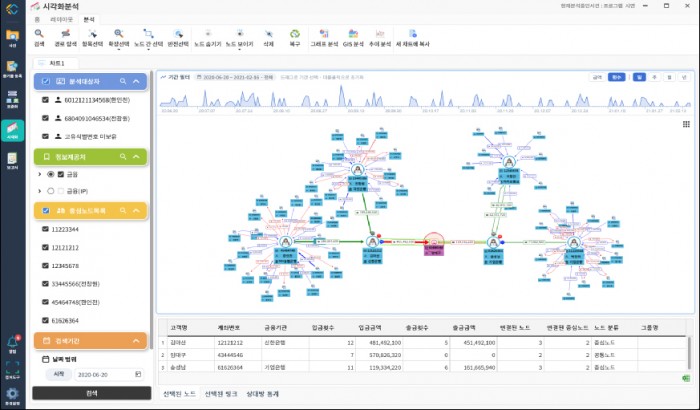 |
| Example of automated visualization analysis under the Next-Generation Intelligent Investigative Data Analysis Solution. / Korean National Police Agency |
Police have developed an artificial intelligence-based investigative data analysis system and plan to deploy it to frontline investigation sites in the near future.
The Korean National Police Agency announced on the 30th that it has completed development of the AI-based Next-Generation Intelligent Investigative Data Analysis Solution. Police will begin rolling it out in earnest to frontline investigation sites starting on the 31st.
The Next-Generation Intelligent Investigative Data Analysis System was developed to analyze vast and complex police investigative data more swiftly and accurately using artificial intelligence.
Previously, frontline investigators had to manually cross-reference and compare massive volumes of spreadsheet data across disparate formats, such as financial accounts and telecommunications records. This led to drawbacks, including substantial time spent on data analysis.
To address these issues, the Scientific Investigation Analysis Division planned the initiative as a research and development (R&D) project and has carried out the Police Lab 2.0 Customized Public Safety R&D Project over four years since 2022 in partnership with the Ministry of Science and ICT.
The Scientific Investigation Analysis Division conducted the R&D alongside the Future Public Safety Policy Bureau and the lead research institution, Noah Ventures, incorporating frontline feedback through 12 field opinion-gathering sessions and 30 validation runs with peer instructors in investigative data analysis over four years.
As a result, the system was implemented using AI technology so that frontline investigators can easily perform customized investigative analyses with simple operations. Key features include automated standardization, visualization and analytical tools, social network and Geographic Information System (GIS) analysis, statistical and graph analysis, automated generation of analysis reports, and personal dashboards.
By utilizing AI, the system standardizes investigative data tailored to specific crime categories and visualizes criminal connections across relationship networks, timelines, and spatial data. Once the analysis is complete, it automatically produces a findings report.
The Korean National Police Agency expects that this development will go beyond simply speeding up accurate data analysis and reducing processing time, enabling comprehensive analysis and report generation in a single pass while providing leads for combined investigations and uncovering additional offenses.
Lee Mi-kyung, Scientific Investigation Review Officer at the Korean National Police Agency, said, "We hope the development of this solution will serve as a solid stepping stone to help victims receive timely protection by ensuring that every single police investigation is carried out accurately, fairly, and swiftly," adding, "Scientific forensics will continue to lead the way in safeguarding South Korea from crime and preserving the peaceful daily lives of our citizens by tirelessly enhancing the objectivity, thoroughness, and speed of police investigations."
Lee Ha-eun
Most Read
-
1
Celltrion nears additional contract with major U.S..

-
2
Putin proposes trilateral U.S.-China-Russia summit..

-
3
"Aren't those foreigners on welfare?": M..

-
4
U.S. weighs dropping MOAB, world's most powerful n..

-
5
Houthis launch successive attacks on Saudi airport..

-
6
Saudi Arabia, Iran hold first diplomatic talks to..

-
7
Saudi airport in Riyadh struck again, leaving at l..

PEOPLE






HEADLINE NEWS
- [Exclusive] U.S. military steel frame work at Gwangju Airport casts cloud over planned semiconductor industrial complex
- Momentum grows for mid-next month U.S.-China-Russia summit with mounting is..
- Elon Musk formalizes review of SpaceX-Tesla merger
- [Exclusive] 10 SNUs pledged, but three regional universities take half the..

-
Address : In-Young Bldg., 34, Uisadang-daero 1-gil, Yeongdeungpo-gu, Seoul
Copyright by ASIATODAY CO., LTD. All rights resereved