



Free tuition for regional national university freshmen starting next year
Aug 31, 2026, 09:41 am


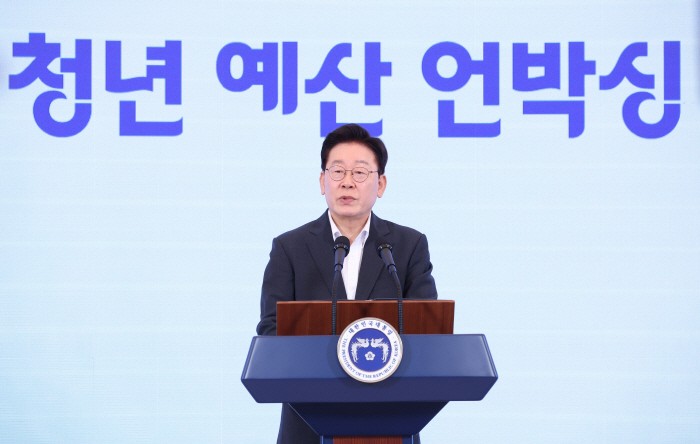 |
| President Lee Jae-myung speaks during the 'Youth Budget Unboxing 2027' event held at the Blue House on the 28th. The event was organized to outline youth-related budgets and key initiatives ahead of the announcement of the government's budget proposal for next year. / Yonhap |
Under the "5 Megaregions and 3 Special Autonomous Provinces" initiative, the government will provide full scholarships to incoming freshmen at regional national universities starting next year to support their academic pursuits and local settlement. The measure is also aimed at overcoming the risk of regional university extinction driven by a declining school-age population. However, regional private universities have immediately pushed back, criticizing the policy as discriminatory against students based on university establishment type.
The Ministry of Education unveiled these key youth support initiatives for 2027 at the "Youth Budget Unboxing 2027" event held at the Blue House on the 28th. Central to the plan is the allocation of 328 billion won next year for regional balanced development scholarships, which encompass full scholarships for regional national universities and regional talent scholarships.
Under the full scholarship program for regional national universities, any incoming freshman across 30 regional national universities—excluding medical, dental, pharmacy, and veterinary schools—who applies for a national scholarship will receive full tuition coverage, regardless of their household income bracket.
Beginning with first-year students next year, eligibility will expand step-by-step to include first- and second-year students in 2028, first- through third-year students in 2029, and all undergraduate years from first through fourth by 2030. Next year's budget stands at 213 billion won, with support standards aligned with the existing national scholarship framework.
To prevent an increase in students re-taking college entrance exams while enrolled solely to benefit from full tuition support, the government will mandate full clawbacks of funds if a student drops out or leaves school mid-term. Any additional support received beyond the basic unit amount of Type I National Scholarships must be reimbursed in full.
A Ministry of Education official emphasized, "The general principle is to reclaim funds before academic status changes, such as voluntary withdrawal, occur," adding, "While there may be instances where recovery proves difficult, the Korea Student Aid Foundation will ensure collections are pursued to completion."
Regional talent scholarships for students at regional private universities will also be revamped in parallel. The quota for newly selected recipients will increase from the current 4,000 to 10,000 students, with the budget expanding from 80 billion won to 115 billion won.
Education Minister Choi Kyo-jin said, "Amid worries over tuition and employment, what young people truly need is practical help that changes their everyday lives," adding, "We will provide full support to advance these youth projects so they serve as a solid growth ladder helping our youth realize their dreams in the regions and stride confidently into society."
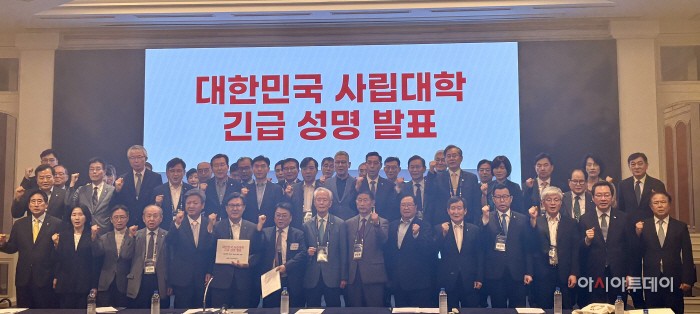 |
| The Korean Association of Private University Presidents held an emergency meeting and issued a statement opposing the government's full tuition scholarship policy for regional national universities ahead of the opening of the 2026 Korean Council for University Education Summer Seminar for University Presidents at Lotte Hotel Jeju on the afternoon of the 28th. / Reporter Park Ji-sook |
Private universities protest distinction between national and private institutions as discriminatory
However, critics point out that an impact on regional private universities—which face the same crisis from a declining school-age population—remains inevitable.
The Korean Association of Private University Presidents held an emergency meeting and issued a statement ahead of the opening of the 2026 Korean Council for University Education Summer Seminar for University Presidents at Lotte Hotel Jeju on the afternoon of the same day, stating, "Discretion must be exercised when applying student support systems such as full national scholarships differently depending on a university's establishment type."
The association criticized, "Even though students study in the same region, providing full tuition support regardless of income solely on the grounds of attending a national university while excluding private university students makes it difficult for students and parents to accept this as a fair system."
The association also cited the financial gap between national and private universities as grounds for its argument. As of 2025, tuition at non-capital national and public universities stood at about 54% of that at private universities, while the ratio of scholarship funds per enrolled student relative to tuition was over 20 percentage points higher at national and public universities than at private institutions. Given that private institutions account for about 80% of higher education in South Korea, the association expressed concern that implementing full tuition coverage exclusively for national universities ahead of early admissions for the 2027 academic year will inevitably deal a direct blow to student recruitment at regional private universities.
The association drew a line, however, adding, "We do not oppose support for national universities," but emphasized, "National scholarships must not be reduced to a tool that merely boosts recruitment competitiveness for universities of a specific establishment type." While positively evaluating the government's direction to invest in higher education by converting funds from reorganized local education fiscal grants into a future response fund, the association urged, "The principles guiding the allocation of newly prepared financial resources are critical," and called for redesigning regional balanced scholarships based on students and regions rather than university establishment types.
The government presented the heavy tilt toward capital area universities during the college entry stage as the background for promoting this policy. On the grounds that the proportion of students attending universities in the capital area has steadily increased despite the falling school-age population, authorities maintain that unconventional support for regional university admissions is necessary for balanced national development.
In contrast, the association argues that excluding regional private university students could worsen polarization among universities within the same region, suggesting that debates surrounding whether to expand the beneficiary pool will likely continue throughout future budget review processes.
Park Ji-sook
Most Read
-
1
Celltrion nears additional contract with major U.S..

-
2
Putin proposes trilateral U.S.-China-Russia summit..

-
3
"Aren't those foreigners on welfare?": M..

-
4
U.S. weighs dropping MOAB, world's most powerful n..

-
5
Houthis launch successive attacks on Saudi airport..

-
6
Saudi Arabia, Iran hold first diplomatic talks to..

-
7
Saudi airport in Riyadh struck again, leaving at l..

PEOPLE






HEADLINE NEWS
- [Exclusive] U.S. military steel frame work at Gwangju Airport casts cloud over planned semiconductor industrial complex
- Momentum grows for mid-next month U.S.-China-Russia summit with mounting is..
- Elon Musk formalizes review of SpaceX-Tesla merger
- [Exclusive] 10 SNUs pledged, but three regional universities take half the..

-
Address : In-Young Bldg., 34, Uisadang-daero 1-gil, Yeongdeungpo-gu, Seoul
Copyright by ASIATODAY CO., LTD. All rights resereved