



354 police disciplinary measures overturned over 5 years
Aug 31, 2026, 09:18 am


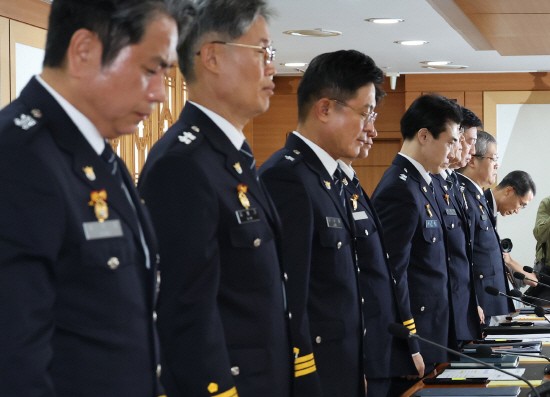 |
| Senior police leadership, including Acting Commissioner General of the Korean National Police Agency Yoo Jae-sung (far right) and National Investigation Headquarters Chief Hong Seok-ki, bow in a public apology over the fabricated closure of missing persons cases in Jeju during a police leadership meeting at the Government Complex Seoul in Jongno-gu, Seoul, on the 26th. / Yonhap |
Amid a succession of police misconduct incidents, disciplinary actions against 354 police officers over the past five years have been mitigated, canceled, or nullified through administrative appeals, data showed. Observers point out that while the police leadership has repeatedly pledged strict action whenever misconduct occurs, instances of disciplinary decisions being overturned continue to recur every year.
According to data submitted by the Korean National Police Agency to People Power Party Lawmaker Park Sang-woong on the 30th, 331 police officers had their disciplinary punishments reduced through appeals reviews between 2021 and last year. The administrative appeals system is a special review process available to civil servants challenging unfavorable actions taken against their will, such as disciplinary penalties.
By year, the number of reductions stood at 73 in 2021, 59 in 2022, and 48 in 2023, before rising again to 76 in 2024 and 75 in 2025. Over the same period, 23 officers had their disciplinary dispositions entirely canceled or invalidated.
Combining reductions, cancellations, and invalidations, a total of 354 disciplinary actions were modified during the review process over the five-year period. By year, this accounted for 78 officers in 2021, 63 in 2022, 55 in 2023, 79 in 2024, and 79 in 2025.
Cases overturned through administrative litigation beyond administrative appeals reached 28 officers. The number of personnel whose penalties were canceled due to the police losing disciplinary-related administrative lawsuits, or who faced re-discipline following cancellations, totaled 4 in 2021, 11 in 2022, 5 in 2023, 6 in 2024, and 2 in 2025.
Consequently, critics argue that the police must examine whether initial disciplinary actions correspond proportionally to actual misconduct. Rather than merely reiterating pledges of strict penalties, the police need to secure policy effectiveness by enhancing both appropriateness and consistency in disciplinary decisions.
Lawmaker Park emphasized, "The ceaseless occurrence of misconduct indicates that lax discipline within the police force has reached a grave level," adding, "Before demanding adherence to law and principles from the public, the police must first establish internal discipline and strictly hold officers accountable for misconduct, regardless of rank."
Kim Hong-chan
Most Read
-
1
Celltrion nears additional contract with major U.S..

-
2
Putin proposes trilateral U.S.-China-Russia summit..

-
3
U.S. weighs dropping MOAB, world's most powerful n..

-
4
"Aren't those foreigners on welfare?": M..

-
5
Attention centers on APEC for possible Trump-Xi-Pu..

-
6
Saudi Arabia, Iran hold first diplomatic talks to..

-
7
China tightens grip on boosting domestic demand an..

PEOPLE







-
Address : In-Young Bldg., 34, Uisadang-daero 1-gil, Yeongdeungpo-gu, Seoul
Copyright by ASIATODAY CO., LTD. All rights resereved