



Defense Minister nominee Kang Shin-chul places focus on organizational stabilization
Aug 31, 2026, 09:10 am


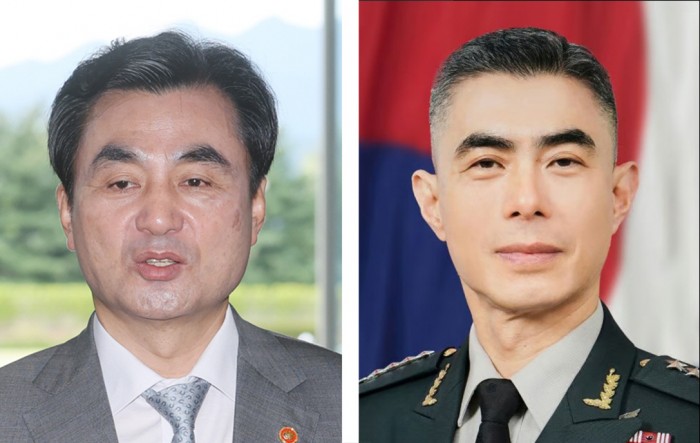 |
| As President Lee Jae-myung nominated former ROK-U.S. Combined Forces Command Deputy Commander Kang Shin-chul (right) as the nominee for Minister of National Defense on the 30th, the replacement process for Defense Minister Ahn Gyu-back got underway. / Courtesy of Yonhap, Blue House |
As Kang Shin-chul, Ambassador to Saudi Arabia and former Deputy Commander of the ROK-U.S. Combined Forces Command, was nominated as the new Minister of National Defense on the 30th, keen attention is focusing on the future direction of defense reform. With a four-star general from the Korea Military Academy (KMA) tapped to head the defense ministry, all eyes are on how he will navigate major pending issues, including the transfer of wartime operational control (OPCON) and the consolidation of military academies.
In a personnel briefing that day, Presidential Chief of Staff Kang Hoon-sik said of nominee Kang, "He is a former four-star general who served in key posts such as Director of Operations at the Joint Chiefs of Staff," adding, "We expect him to bolster self-reliant defense capabilities for future warfare on the foundation of a robust South Korea-U.S. alliance and boldly forge a new path for defense innovation, including the integration of service academies."
The first test facing nominee Kang is the consolidation of service academies. The Ministry of National Defense is currently pursuing a plan to merge the Army, Naval, and Air Force academies into a four-year Armed Forces Academy at Jaundae in Daejeon; however, severe friction persists, with fierce pushback voiced by alumni and cadets at a recent public hearing.
Accordingly, attention centers on whether Kang will push through the existing integration blueprint as planned, refine it to reflect the specialized needs of each service branch, or moderate the pace. Within and outside the military, observers interpret the appointment of a KMA-educated four-star general following a civilian minister as a move intended to confront and push through internal military issues, including academy consolidation. At the same time, some view his KMA background as a potential liability when mediating the conflicting interests of each military branch during the integration process.
The OPCON transition also stands as a core task. Having worked directly alongside senior U.S. military leadership during his tenure as CFC Deputy Commander, Kang is expected to stably guide communication and coordination between South Korea and the U.S. throughout the transition process. Because the OPCON transition requires deep political and diplomatic trust between the two allies in addition to military readiness, his background in combined operations is seen as a distinct strength.
If Kang clears the National Assembly confirmation hearings, the tenure of Minister Ahn Gyu-back—the nation's first civilian defense chief in 64 years—will come to a close after roughly one year. Under the banner of normalizing the military in the wake of the emergency martial law decree, Minister Ahn pushed aggressive defense reforms: replacing four-star flag officers, disbanding the Defense Counterintelligence Command, reorganizing the Drone Operations Command, advancing OPCON transfer, establishing a basic plan for nuclear-powered submarines, and creating the Armed Forces Academy.
However, Ahn met with stiff resistance both within and outside the military amid desertion allegations, controversies over ROK-U.S. coordination, and opposition to the academy consolidation. A National Assembly public petition seeking Ahn's impeachment garnered hundreds of thousands of signatures. Kang now faces the dual challenge of sustaining key reform initiatives pursued by Ahn while minimizing internal military backlash and securing organizational stability.
Nominee Kang, a graduate of the KMA 46th class, previously served as Secretary for Security and Defense Strategy in the National Security Office, Deputy Commander of Ground Operations Command, and Director of Operations at the JCS. During the Dec. 3 martial law declaration, he served as Deputy Commander of the CFC. Chief of Staff Kang stated, "Audits by the Constitution Respect Task Force and the Defense Ministry confirmed that he had no involvement in the martial law event."
Lee Han-sol
Most Read
-
1
Celltrion nears additional contract with major U.S..

-
2
U.S. weighs dropping MOAB, world's most powerful n..

-
3
"Aren't those foreigners on welfare?": M..

-
4
Houthis launch successive attacks on Saudi airport..

-
5
Putin proposes trilateral U.S.-China-Russia summit..

-
6
Saudi Arabia, Iran hold first diplomatic talks to..

-
7
Saudi airport in Riyadh struck again, leaving at l..

PEOPLE






HEADLINE NEWS

-
Address : In-Young Bldg., 34, Uisadang-daero 1-gil, Yeongdeungpo-gu, Seoul
Copyright by ASIATODAY CO., LTD. All rights resereved