



Global warming is root cause of 'catastrophic' massive floods
Aug 28, 2026, 01:28 pm


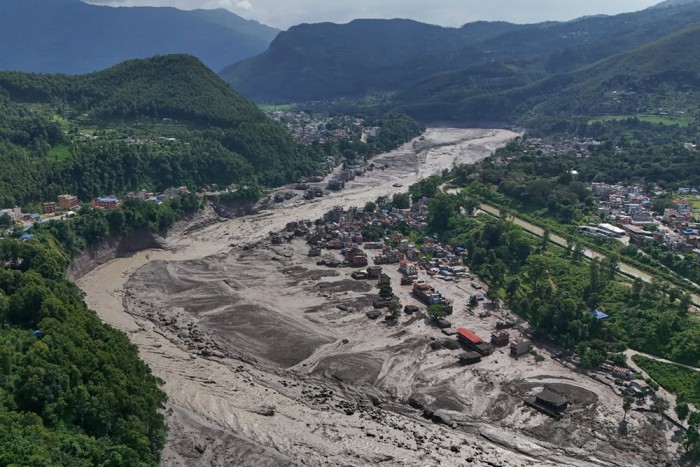 |
| Floodwaters and sediment accumulate in a residential area along the Trishuli River in Nuwakot, Nepal, on the 26th local time. / AP, Yonhap |
A massive collapse of Himalayan glaciers and rocks has been identified as the cause of catastrophic floods that struck north-central Nepal and China's Tibet Autonomous Region.
With Himalayan glaciers melting rapidly due to global warming, instability in high-altitude mountain regions is growing, prompting warnings that similar disasters could recur.
According to CNN and other sources on the 27th local time, Eos, a scientific publication of the American Geophysical Union (AGU), analyzed that the disaster was caused by a rock-ice avalanche rather than an earthquake.
Geologist Dave Petley confirmed traces of large-scale collapses of high-altitude glaciers and bedrock through satellite image analysis.
The U.S. Geological Survey (USGS) also corrected its initial assessment of a magnitude 4.4 earthquake, concluding after further analysis that the tremors were generated by a massive collapse of ice and rock.
In this process, melted ice mixed with moisture-laden sediments from the monsoon season and river water, forming an enormous debris flow that swept downstream.
The International Centre for Integrated Mountain Development (ICIMOD), headquartered in Kathmandu, also raised the possibility that ice and rock falling from glaciers on the Nepalese side temporarily dammed the river before bursting, sending massive torrents cascading downstream.
With the possibility that areas blocked by ice and rock remain upstream, the risk of additional flooding cannot be ruled out.
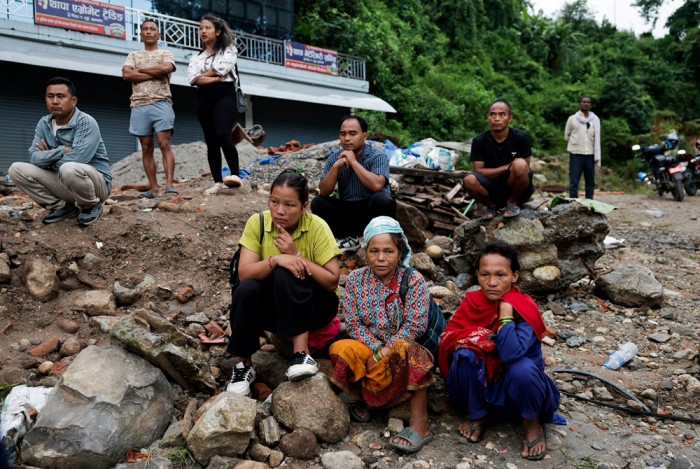 |
| Flood survivors sit on debris in Trishuli, Nuwakot district, Nepal, on the 27th local time, waiting for the road home to be cleared. / Reuters, Yonhap |
Analysis suggests that rapid warming in the Himalayas lies behind this disaster.
The Himalayas in Nepal, home to thousands of glaciers, serve as a vital water source for approximately 2 billion people across Asia, with research indicating that the rate of glacier melt has more than doubled since the 21st century began.
The thickness of the glaciers decreased by an annual average of 34 cm prior to 2000, but the rate of loss accelerated to an annual average of 73 cm after 2000. Rapid glacier melt can also affect the structural stability of mountain terrain.
Dan Shugar, a geoscientist at the University of Calgary in Canada, analyzed that melted snow and water driven by rising temperatures likely seeped into fissures within glaciers and mountain rocks, weakening both ice and bedrock and potentially catalyzing a large-scale collapse like this one.
CNN also reported that the melting of glaciers and the resulting instability of rocky slopes in the Himalayas are increasing the risk of climate-related disasters.
Glacial retreat is also escalating another hazard. As meltwater collects in mountain areas, glacial lakes are formed; when the so-called "natural dams" made of ice and rock that hold them back fail, a glacial lake outburst flood can occur, unleashing massive volumes of water downstream all at once.
Indeed, with rising temperatures and continuous glacier retreat, both the number and size of glacial lakes across high-altitude regions, including the Himalayas, have been increasing since the 1990s.
However, scientists maintain that further investigation is required before definitively concluding that climate change directly triggered this rock-ice collapse.
Professor Shugar projected that identifying the exact cause of this collapse could take weeks to months.
Kim Hyun-min
Most Read
-
1
Celltrion nears additional contract with major U.S..

-
2
Putin proposes trilateral U.S.-China-Russia summit..

-
3
U.S. weighs dropping MOAB, world's most powerful n..

-
4
"Aren't those foreigners on welfare?": M..

-
5
Attention centers on APEC for possible Trump-Xi-Pu..

-
6
Saudi Arabia, Iran hold first diplomatic talks to..

-
7
China tightens grip on boosting domestic demand an..

PEOPLE







-
Address : In-Young Bldg., 34, Uisadang-daero 1-gil, Yeongdeungpo-gu, Seoul
Copyright by ASIATODAY CO., LTD. All rights resereved