



Massacres surge in Colombia despite 10 years of peace accord
Aug 28, 2026, 10:15 am


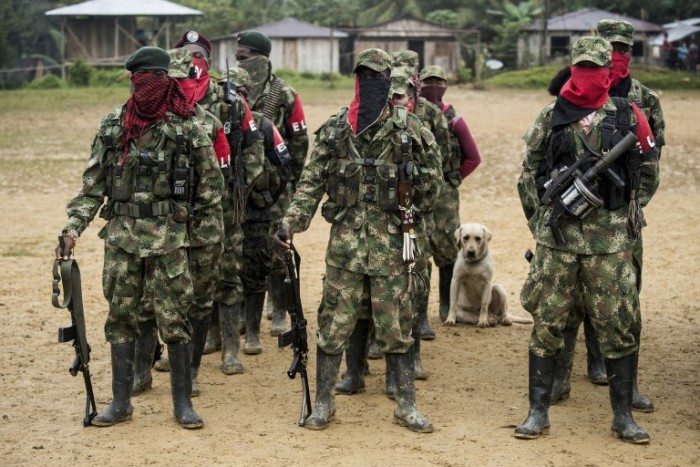 |
| Members of the National Liberation Army (ELN), Colombia's largest leftist guerrilla group. / AFP, Yonhap |
Violence by armed groups has persisted unabated in Colombia even after the signing of a peace agreement, following more than half a century of civil war. Although the Revolutionary Armed Forces of Colombia (FARC), once the country's largest armed guerrilla organization, signed a peace agreement with the government in 2016 and officially dissolved, dissident factions that opposed the accord have continued their activities while expanding their presence nationwide.
Citing a report by the Ombudsman's Office on the 25th local time, local daily El Colombiano reported that FARC dissident factions are operating across 372 municipalities nationwide. This represents one-third of the country's total 1,123 municipalities.
According to the Ombudsman's report, a total of 651 massacres occurred in Colombia from 2019 to the 18th of last month, claiming 2,380 lives.
The year with the highest number of fatalities was 2020 with 378 deaths, while the highest number of massacres was recorded in 2021 with 96 cases.
Although casualties showed a downward trend from 2024 to 2025, they surged again this year, resulting in 282 deaths across 71 massacres as of last month. This figure has already surpassed the annual death tolls of last year (256 deaths) and 2024 (257 deaths).
Behind the violence lies not only the presence of FARC dissidents but also the expansion of drug cartels. Cartels with paramilitary wings, such as the Gulf Clan (Clan del Golfo) and the Conquering Self-Defense Forces of the Sierra Nevada (ACSN), have committed atrocities without hesitation, including the slaughter of entire families of residents who refuse to cooperate. As of this year, the number of municipalities they control or operate in has reached 509.
Confinement incidents, where guerrilla groups or drug cartels completely seize control of villages or communities and cut off residents' access to the outside world, have also spiked. The number of victims grew explosively from 19,434 in 2019 to 66,730 in 2024 and 65,074 in 2025.
The area of coca cultivation used to produce cocaine has likewise expanded. Coca fields grew from 142,783 hectares in 2020 to 261,386 hectares in 2024, nearly doubling in four years.
Analysts point out that in Colombia, the world's largest producer of cocaine, the illicit drug trade serves as a financial lifeline for armed groups, deepening the vulnerability of rural communities.
Son Young-sik
Most Read
-
1
Celltrion nears additional contract with major U.S..

-
2
Putin proposes trilateral U.S.-China-Russia summit..

-
3
U.S. weighs dropping MOAB, world's most powerful n..

-
4
"Aren't those foreigners on welfare?": M..

-
5
Attention centers on APEC for possible Trump-Xi-Pu..

-
6
Saudi Arabia, Iran hold first diplomatic talks to..

-
7
China tightens grip on boosting domestic demand an..

PEOPLE







-
Address : In-Young Bldg., 34, Uisadang-daero 1-gil, Yeongdeungpo-gu, Seoul
Copyright by ASIATODAY CO., LTD. All rights resereved