



Labor Minister Kim Young-hoon pledges to nurture 10,000 field-ready AI talents
Aug 28, 2026, 09:57 am


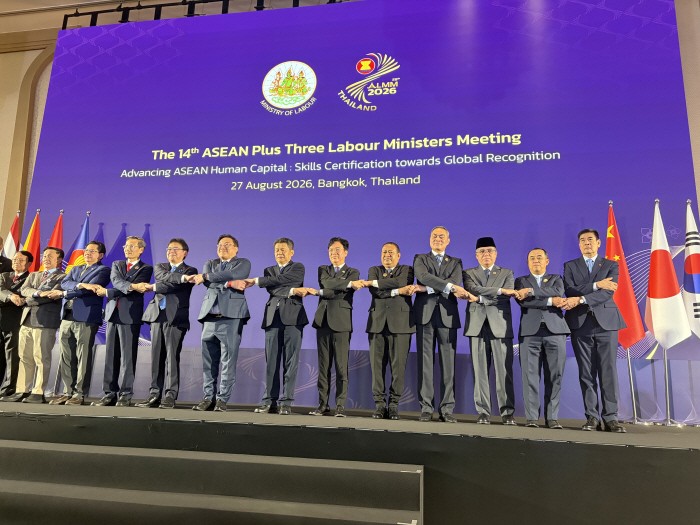 |
| Minister of Employment and Labor Kim Young-hoon attends the 14th ASEAN+3 Labour Ministers Meeting held in Bangkok, Thailand, on the 27th local time. / Ministry of Employment and Labor |
Minister of Employment and Labor Kim Young-hoon introduced South Korea's policy of "Industrial Transformation with Labor" to support stable employment and a fresh leap forward for citizens in the era of digital transitions such as artificial intelligence (AI), delivering a keynote address as chief delegate at the 14th ASEAN+3 Labour Ministers Meeting held in Bangkok, Thailand, on the 27th local time. In particular, he stated, "In the field of AI, we plan to nurture 10,000 field-ready practical talents who can be deployed immediately through K-Digital Training support via the Tomorrow Learning Card."
The meeting serves as a biennial forum where employment and labor representatives from 11 ASEAN nations (Thailand, the Philippines, Indonesia, Vietnam, Cambodia, Laos, Myanmar, Malaysia, Singapore, Brunei, and Timor-Leste) and South Korea, China, and Japan discuss cooperation measures. Under the agenda "Developing ASEAN’s Human Resources: Competency Certification towards Global Recognition," delegates shared policies and discussed cooperation measures to achieve mutual growth amid digital transformations, including AI, and green transitions driven by carbon neutrality.
In his speech that day, Minister Kim detailed key policies aimed at supporting stable employment and second leaps for citizens amid industrial transitions in the AI era. These included formulating the Basic Plan for Employment Stability in Industrial Transition—encompassing employment impact monitoring, vocational training to foster AI competency, and strengthening lifelong learning—as well as expanding support for youths' first employment, corporate-led on-site training, and re-employment support services for middle-aged and older adults.
Regarding human resource development in particular, he stated, "By establishing the Smart Technical and Vocational Education and Training Platform (STEP), which allows all citizens to receive training free from constraints of time and space, we are supporting the enhancement of AI utilization capabilities across various industrial sectors such as design, machinery, and electricity."
Based on the discussion outcomes, chief delegates from member states adopted a joint declaration reaffirming cooperation in the employment and labor sectors among ASEAN+3 countries. The declaration contained agreements to strengthen cooperation in areas including quality full employment, human resource development encompassing green and digital skills, and inclusive social security systems, alongside expressions of appreciation for South Korea's sustained support regarding vocational training, labor market information, and the future of work.
In response, Minister Kim remarked, "I find ASEAN's expression of gratitude deeply meaningful and will continue close solidarity by expanding exchanges with ASEAN going forward. In accordance with the agreed terms, the Republic of Korea will also actively support the development and implementation of related policies, including inclusive employment policies for ASEAN nations."
Minister Kim also held bilateral meetings on the same day. With Thai Labor Minister Julapun Amornvivat, he discussed AI-related employment and vocational training policies as well as cooperation on the Employment Permit System (EPS). With Japanese Minister of Health, Labour and Welfare Kenichiro Ueno, he discussed social dialogue measures concerning retirement age extension, and exchanged views with ILO Director-General Gilbert Houngbo on the progress of major ILO employment and labor agendas as well as South Korea-ILO cooperation.
On the following day, the 28th, Minister Kim will hold a roundtable meeting with young Koreans who secured employment in Thailand through overseas employment support projects. At the event, he plans to introduce new youth policies such as "K-Youth Guarantee" and the tentative "Playground," which support initial employment, while also providing guidance on "K-Move School" for overseas job placement and domestic re-employment support. He will listen to the local experiences, difficulties, and suggestions of the youth to incorporate them into policy.
Park Ji-sook
Most Read
-
1
Celltrion nears additional contract with major U.S..

-
2
Putin proposes trilateral U.S.-China-Russia summit..

-
3
U.S. weighs dropping MOAB, world's most powerful n..

-
4
"Aren't those foreigners on welfare?": M..

-
5
Attention centers on APEC for possible Trump-Xi-Pu..

-
6
Saudi Arabia, Iran hold first diplomatic talks to..

-
7
China tightens grip on boosting domestic demand an..

PEOPLE







-
Address : In-Young Bldg., 34, Uisadang-daero 1-gil, Yeongdeungpo-gu, Seoul
Copyright by ASIATODAY CO., LTD. All rights resereved