



Inflation eats away at wages as real income drops for third straight month
Aug 28, 2026, 09:48 am


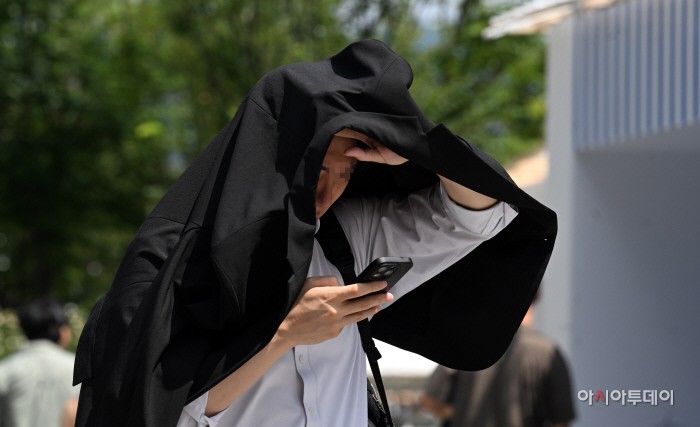 |
| An office worker walks across Gwanghwamun Square in Jongno-gu, Seoul, on the 3rd amid extreme heat waves. / Reporter Park Sung-il |
As the pace of price increases outpaced wage growth, the real value of money workers take home has shrunk for three consecutive months.
According to results of the July Labor Force Survey at Establishments released by the Ministry of Employment and Labor on the 27th, the average monthly real wage for workers at businesses with one or more regular employees stood at 3,412,000 won in June, down 2,000 won (0.1%) from 3,414,000 won in the same month of the previous year. The downward trend that began in April has now persisted for three straight months.
This marks the first time real wages have trended downward for more than three months since a five-month consecutive decline from April to August 2023. Earlier, a 10-month consecutive decline was recorded from April 2022 to January 2023 in the aftermath of the COVID-19 spread and the Russia-Ukraine war, which drove prices sharply higher.
Real wages represent the actual purchasing power of money by adjusting nominal wages received by workers for inflation. Even if nominal wages increase, real wages can drop if prices rise faster.
During the second quarter of this year (April to June), when the decline continued, real wages stood at 3,370,000 won, down 28,000 won (0.8%) from 3,398,000 won during the same period of the previous year. Over the same period, nominal wages rose 83,000 won (2.1%) to 4,036,000 won, but the consumer price inflation rate reached 3.0%, outpacing wage gains.
"We are currently in a 'triple-high' phase where the exchange rate, oil prices, and consumer prices are all climbing, with inflation hitting its highest level since 2022," said Jeong Hyang-sook, head of the labor market survey division. "Because inflation is so high compared to moderate wage growth, real wages are posting negative growth."
As of June, working hours per employee stood at 157.6 hours, up 10.4 hours (7.1%) from the same month of the previous year. The labor ministry explained that this was due to working days on the calendar increasing by two days from 19 to 21.
As of July, the number of employees at businesses with one or more workers stood at 20,718,000, an increase of 226,000 (1.1%) from a year earlier. The health and social work services sector led the growth, adding 119,000 employees (4.6%), while financial and insurance activities (27,000) and professional, scientific, and technical services (25,000) also rose.
Manufacturing and construction, which had suffered slumps, also posted modest gains. Manufacturing, which accounts for the largest share of employment, stood at 3.77 million workers, up 14,000 (0.4%). Construction employment stood at 1,402,000, up 3,000 (0.2%), rebounding for two straight months following a 23-month downward trend.
However, the labor ministry views it as premature to consider this a signal of full-fledged recovery. "Since it is merely a two-month rise after declining for 23 consecutive months, there is a possibility it might be a temporary rebound," Jeong explained.
Conversely, wholesale and retail trade employment decreased by 28,000 (1.2%), extending its decline for 28 consecutive months. The recent closures of Homeplus stores are analyzed to have had an impact. Arts, sports, and recreation-related services also lost 9,000 workers (2.7%). By employment status, regular workers increased by 78,000 (0.5%), while temporary and daily workers grew by 147,000 (7.6%).
The number of job openings in July reached 158,000, up 0.7% from the same period last year. Hires totaled 1,143,000 (up 18.3%) and separations totaled 1,127,000 (up 18.8%), with new hires among them climbing 19.6% to 1,029,000.
Park Ji-sook
Most Read
-
1
Celltrion nears additional contract with major U.S..

-
2
Putin proposes trilateral U.S.-China-Russia summit..

-
3
U.S. weighs dropping MOAB, world's most powerful n..

-
4
"Aren't those foreigners on welfare?": M..

-
5
Attention centers on APEC for possible Trump-Xi-Pu..

-
6
Saudi Arabia, Iran hold first diplomatic talks to..

-
7
China tightens grip on boosting domestic demand an..

PEOPLE






-
Address : In-Young Bldg., 34, Uisadang-daero 1-gil, Yeongdeungpo-gu, Seoul
Copyright by ASIATODAY CO., LTD. All rights resereved