



Constitutional Court rules Military Service Act provision mandating dismissal of draft objectors unconstitutional
Aug 28, 2026, 09:30 am


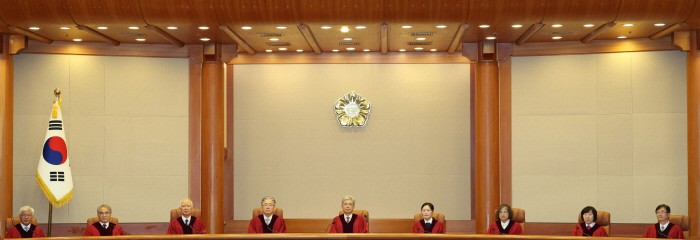 |
| Constitutional Court President Kim Sang-hwan and constitutional justices sit in their seats ahead of delivering rulings on constitutional petitions at the Constitutional Court in Jongno-gu, Seoul, on the 27th. / Yonhap News |
The Constitutional Court has ruled unconstitutional a provision in the current Military Service Act that mandates employers to dismiss draft objectors outright without examining whether justifiable grounds exist.
On the 27th, the Constitutional Court upheld a constitutional petition filed by Person A, a conscientious objector, challenging the constitutionality of Article 76, Paragraph 1 of the Military Service Act, and issued a decision of non-conformity to the Constitution. A decision of non-conformity to the Constitution is a ruling in which the court finds a statutory provision unconstitutional but temporarily maintains its validity to prevent social disruption that could arise if it were invalidated immediately. Accordingly, the National Assembly must revise the relevant provision by February 29, 2028.
Among the nine justices, five (Kim Sang-hwan, Kim Hyung-doo, Jeong Hyeong-sik, Jeong Gye-seon, and Oh Young-joon) delivered the non-conformity opinion, while two (Kim Bok-hyung and Ma Eun-hyuk) issued a simple unconstitutionality opinion. Justices Jeong Jeong-mi and Cho Han-chang offered a constitutional opinion.
Person A was put on trial in 2015 for refusing military service but was acquitted by the Supreme Court in 2020. However, an appellate trial is currently underway after the Incheon Regional Military Manpower Administration filed a new complaint alleging violations of the Military Service Act.
During this process, Person A was also dismissed from the company where he worked. Person A argued that his dismissal resulted from the Incheon Regional Military Manpower Administration demanding his resignation based on Article 76 of the Military Service Act while warning of criminal charges.
Article 76, Paragraph 1, Subparagraph 2 of the Military Service Act stipulates that heads of state agencies, heads of local governments, or employers may not recruit individuals evading enlistment or call-up as public officials, executives, or employees, and must dismiss them if currently employed.
Person A filed the constitutional petition, asserting that the current statutory provision violates the freedom of occupational choice.
The Constitutional Court stated, "Even if the dismissal of draft evaders is inevitable to secure the effectiveness of fulfilling military service obligations and realize fairness in military affairs, the provision under review fails to establish institutional safeguards to minimize the infringement on basic rights, offering no opportunity whatsoever for individuals liable for military service to present justifications."
Justices Kim Bok-hyung and Ma Eun-hyuk, who issued the simple unconstitutionality opinion, determined that the dismissal system infringes on the freedom of occupational choice, stating, "The Military Service Act already provides criminal punishment for draft evaders, the scope of dismissal under the contested provision is overly broad, and it leaves no room to take into account the personal circumstances of draft evaders."
Justices Jeong Jeong-mi and Cho Han-chang, who delivered the dissenting opinion to dismiss the petition, noted, "The possibility of dismissal occurring when justifiable reasons exist for failing to fulfill military service is extremely low, and allowing the Military Manpower Administration to discretionary judge dismissal targets based on individual circumstances could raise significant questions regarding the fairness of the dismissal system."
Meanwhile, according to the Current Status of Recent Constitutional Court Decisions and Statutes Requiring Revision published by the Legal Affairs Bureau of the National Assembly Secretariat, 27 statutes were subject to revision as of the 27th of last month, with 12 of them being decisions of non-conformity to the Constitution. Among them, six statutes have passed their revision deadlines, including the non-conformity decision on abortion laws. In April, a decision of non-conformity to the Constitution was also rendered regarding a provision in the Patent Attorney Act that required all registered patent attorneys to mandatory join the Korea Patent Attorneys Association.
Son Seung-hyun
Most Read
-
1
Celltrion nears additional contract with major U.S..

-
2
Putin proposes trilateral U.S.-China-Russia summit..

-
3
U.S. weighs dropping MOAB, world's most powerful n..

-
4
"Aren't those foreigners on welfare?": M..

-
5
Attention centers on APEC for possible Trump-Xi-Pu..

-
6
Saudi Arabia, Iran hold first diplomatic talks to..

-
7
China tightens grip on boosting domestic demand an..

PEOPLE







-
Address : In-Young Bldg., 34, Uisadang-daero 1-gil, Yeongdeungpo-gu, Seoul
Copyright by ASIATODAY CO., LTD. All rights resereved