



South Korean government reexamines accession to CPTPP
Aug 27, 2026, 09:52 am


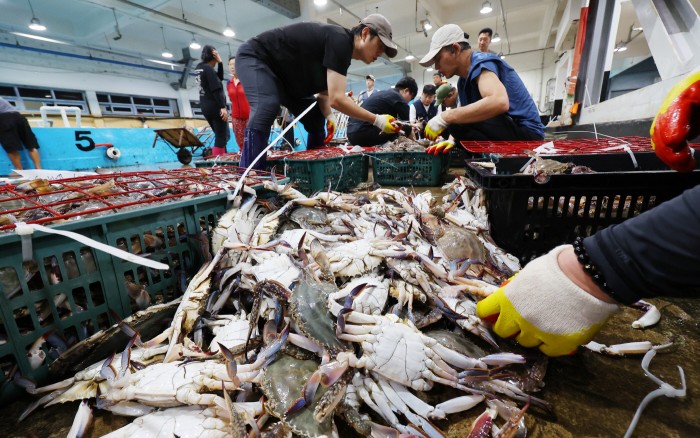 |
| Amid the start of the autumn blue crab season, fishermen sort blue crabs at the Gyeongin Seobu Fisheries Cooperative auction market in Jemulpo-gu, Incheon, on the morning of the 26th. / Yonhap |
As the government announced it would review joining the Comprehensive and Progressive Agreement for Trans-Pacific Partnership (CPTPP)—often referred to as a "mega FTA"—amid global supply chain uncertainties, the fisheries industry is pushing back.
While industrial sectors such as automobiles and semiconductors strongly demand accession to expand market access and ease non-tariff barriers among like-minded nations, primary industries including fisheries are raising concerns over a surge in cheap imported seafood and a decline in food self-sufficiency.
According to the Ministry of Oceans and Fisheries (MOF) on the 26th, the review of CPTPP accession is currently overseen by the Ministry of Trade, Industry and Energy (MOTIE). The government is internally exploring measures to support and minimize damage to primary industries to sustain the industrial structure, based on various scenarios such as 100% and 97% market opening rates.
An MOF official explained, "Accession has not yet been formalized," adding, "We are considering how to help sustain the industry by providing support to affected fishermen if CPTPP accession takes place." The official continued, "Once accession is formalized, policy measures regarding damage to agriculture and fisheries, as primary industries, and measures applicable from an industrial structure perspective can also be discussed with fiscal authorities."
The biggest reason the fisheries industry fears CPTPP accession is the already entrenched structural trade deficit. This is because the domestic seafood industry could contract significantly if tariffs are eliminated near 100%.
Domestic trade in fish and shellfish saw export volumes (451,000 tons) outpace import volumes (409,000 tons) until the 1990s. However, entering the 2010s, average imports surged to 1.373 million tons while exports remained at 582,000 tons, resulting in a trade deficit of $3.8 billion in 2021 alone.
According to Korea Maritime Institute (KMI) indicators, global seafood imports in 2025 are estimated at approximately $6.16 billion (up 7.8% year-on-year), and exports at approximately $3.3 billion (up 9.6%). Although the export growth rate outpaced that of imports, the import volume is already double the size of exports. As a result, concerns are mounting that if tariff thresholds disappear, cheap imported seafood from countries like Japan will flood the market, causing fishermen to lose their sales outlets.
Another point of concern for fishermen is the provision on the elimination of fisheries subsidies. According to a 2022 survey by the National Federation of Fisheries Cooperatives (Suhyup) Fisheries Economic Research Institute, fishermen cited "tax-free fuel for fishing (43.2%)" as the most helpful subsidy for fishing operations. This was followed by interest subsidies on fisheries policy funds (35.6%) and fisheries policy insurance (7.2%).
A Suhyup official pointed out, "The CPTPP text contains provisions prohibiting subsidies for overfishing and illegal fishing, but the lack of clear criteria for 'overfishing' is concerning," adding, "If essential subsidies like tax-free fuel disappear, it will deal a critical blow to fishermen."
In response, the MOF explained, "While it is true that the agreement text contains subsidy restrictions, there are no actual cases among CPTPP member states where fisheries subsidies such as tax-free fuel were eliminated or applied," noting that the government can respond actively even when detailed criteria are established later.
Fishermen on the ground are voicing that rather than unconditional opposition, accurate damage assessment and the establishment of a solid compensation system by the government must come first.
Kim Seong-ho, head of the Guryongpo Suhyup, pointed out, "At the time of concluding previous FTAs, the government promised to create a 1 trillion won Agricultural and Fishing Villages Cooperation Fund with 100 billion won annually for 10 years, but fundraising only reached 300 billion won, and even then, almost no benefits returned to fishermen." He stressed, "While large corporations, the automotive sector, and the IT industry will enjoy a major boom from CPTPP accession, primary industries will bear the full brunt of the damage," emphasizing, "If this is an inevitable choice for the national economy, the government should enable benefiting companies to contribute to the fund, conduct an accurate research study on ecological changes in fisheries, and legalize direct compensation as well as measures to boost non-fishing income before pursuing accession."
Lee Jeong-yeon
Most Read
-
1
Celltrion nears additional contract with major U.S..

-
2
Putin proposes trilateral U.S.-China-Russia summit..

-
3
U.S. weighs dropping MOAB, world's most powerful n..

-
4
"Aren't those foreigners on welfare?": M..

-
5
Attention centers on APEC for possible Trump-Xi-Pu..

-
6
Saudi Arabia, Iran hold first diplomatic talks to..

-
7
China tightens grip on boosting domestic demand an..

PEOPLE







-
Address : In-Young Bldg., 34, Uisadang-daero 1-gil, Yeongdeungpo-gu, Seoul
Copyright by ASIATODAY CO., LTD. All rights resereved