



UN warns Myanmar human rights face dire threat
Aug 27, 2026, 10:17 am


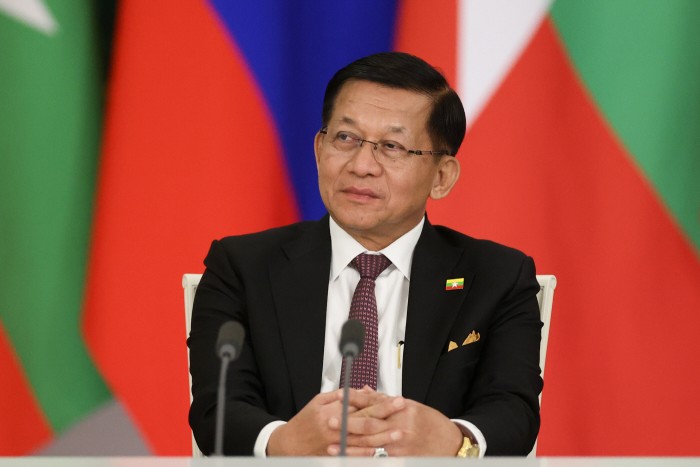 |
| Myanmar President Min Aung Hlaing on a visit to Russia on the 18th (local time). President Hlaing overthrew the democratically elected government in a military coup in February 2021 and maintained a state of emergency before assuming the presidency in April. / AP, Yonhap News |
The United Nations (UN) has officially warned that the devastation caused by human rights abuses and illegal rare earth mining in Myanmar has reached an all-time low. However, major member states of the Association of Southeast Asian Nations (ASEAN), including Vietnam, are showing a contrasting approach by resuming diplomatic engagement with the military junta.
In a report released on the 25th (local time) covering investigations from June 2025 to May 2026, the Office of the United Nations High Commissioner for Human Rights (OHCHR) stated that both the Myanmar military and the rebel Arakan Army (AA), which controls Rakhine State, committed systematic and widespread human rights violations against civilians, including the Rohingya. According to the report, both sides perpetrated killings of civilians, torture, forced conscription and labor, arbitrary detention, and forced displacement.
The military has continued a reign of terror for more than five years since the 2021 coup through airstrikes, arson, and the blocking of humanitarian aid. Civilian deaths officially verified by the UN have reached at least 8,075, including 1,774 women and 1,074 children, with the actual scale of casualties estimated to be substantially higher. Currently, internally displaced persons in Myanmar reach 3.6 million, and 12.4 million people face severe acute hunger. Mothers and children suffering from acute malnutrition also approach nearly 400,000.
The Arakan Army, which has seized control of northern Rakhine, is likewise forcibly repressing the Rohingya. Satellite analysis revealed that approximately 2,000 acres (about 8.1 square kilometers) of land have been forcibly expropriated, along with evidence of children as young as six being mobilized for forced labor. The Arakan Army is blocking the return of displaced Rohingya while forcibly resettling non-Rohingya residents in the area.
Illegal rare earth mining, exploiting the breakdown of the rule of law, has also devolved into a funding pipeline for the "conflict economy," exacerbating civilian suffering. In Kachin State, 302 new mining sites have been identified since the coup, while in Shan State, mining sites surged from 12 to 85. The UN analyzed that trade in Myanmar rare earths reached $1.4 billion (about 1.9 trillion won) as of 2023, with most smuggled into China. Toxic wastewater resulting from reckless mining has contaminated farmland and rivers, causing miscarriages and chronic illnesses among residents, and pollutants have flowed into rivers along the Thai border where heavy metals including arsenic, lead, and mercury were detected.
Despite international condemnation, engagement with the military junta by regional Southeast Asian countries is expanding. Vietnamese Foreign Minister Le Hoai Trung makes an official visit to Myanmar on the 26th to hold a bilateral cooperation meeting. This marks the first visit to Myanmar by a Vietnamese foreign minister since the outbreak of the 2021 coup. The two nations exchanged ambassadors last month. Earlier, Myanmar Commander-in-Chief Min Aung Hlaing, who extended his rule through military-led elections, visited Laos in July and Thailand in August in succession, attempting to break out of diplomatic isolation.
Jeong Ri-na
Most Read
-
1
Celltrion nears additional contract with major U.S..

-
2
Putin proposes trilateral U.S.-China-Russia summit..

-
3
U.S. weighs dropping MOAB, world's most powerful n..

-
4
"Aren't those foreigners on welfare?": M..

-
5
Attention centers on APEC for possible Trump-Xi-Pu..

-
6
Saudi Arabia, Iran hold first diplomatic talks to..

-
7
China tightens grip on boosting domestic demand an..

PEOPLE






-
Address : In-Young Bldg., 34, Uisadang-daero 1-gil, Yeongdeungpo-gu, Seoul
Copyright by ASIATODAY CO., LTD. All rights resereved