



Cornered Iran weighs military response
Aug 27, 2026, 10:19 am


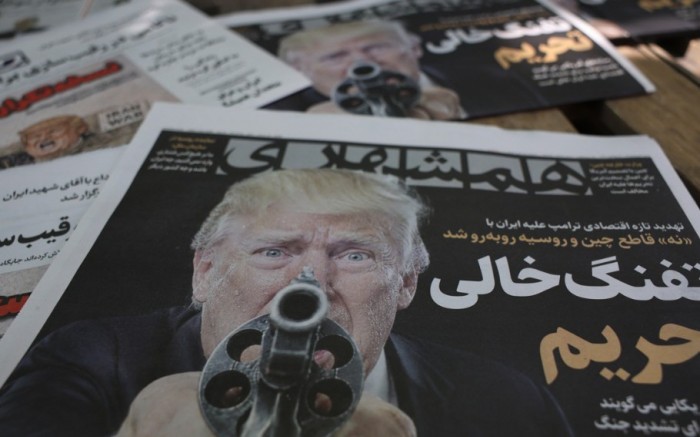 |
| A daily newspaper placed in the Iranian capital of Tehran on the 22nd features the face of U.S. President Donald Trump alongside an article titled "The Empty Gun of Sanctions" in Persian. / AP, Yonhap |
As the U.S. shifts the focus of its strategy toward Iran to economic sanctions and intensifies pressure, concerns over unexpected blowback are mounting. This comes as Iran, finding its economic escape routes narrowed, is seen as likely to launch a fresh military response targeting regional energy infrastructure rather than capitulate.
Iran has already foreshadowed a hard-line response to the tightening of U.S. economic sanctions. Mohsen Rezaee, Secretary of Iran's Supreme National Security Council (SNSC), warned on state television on the 22nd (local time) that "any country participating in the economic war waged by the U.S. will be regarded as an enemy," vowing that not a single drop of oil will be allowed out of the Persian Gulf.
Sayyed Majid Ebn Al-Reza, Iran's acting defense minister, also effectively characterized the economic pressure as warfare. He stated, "Any pressure that threatens the livelihood and security of our people is part of a war," adding, "To protect our people, we will expand the battlefield."
Iran warns of expanding the battlefield with potential strikes on energy facilities
The expansion of the battlefield warned by Iran could potentially lead to strikes on regional energy infrastructure. The U.S.-based Institute for the Study of War (ISW) analyzed on the 25th that Iran appears to be considering targeting regional energy facilities to impose political costs on the U.S. and its partners. The intent is to pressure the U.S. to halt its economic campaign before achieving its objectives.
The ISW noted that while Iran has struggled to accurately strike moving vessels, it retains the capability to detect and hit fixed infrastructure. Consequently, it raised the possibility that Iran could directly launch attacks or cyber strikes against regional energy installations or U.S. civilian infrastructure to place burdens on the U.S. and global energy markets.
Behind the talk of possible military retaliation lies Iran's worsening economic distress. The New York Times (NYT) reported that day that although the U.S. is attempting to pivot its confrontation with Iran from armed warfare to economic sanctions, analysts say that for a cornered Iran, there is little left to lose even by returning to war.
Iran's oil exports, the backbone of its economy, have reportedly shrunk to near-zero levels due to the recent U.S. naval blockade. The Iranian rial has depreciated by an additional 41% since nationwide antigovernment protests erupted in December of last year, while the prices of certain pharmaceuticals have surged by up to 500%. Soaring inflation has left a large number of Iranians unable to afford even basic necessities, the NYT reported.
Sina Toossi, an Iran expert at the Center for International Policy, told the NYT, "The more pressure the U.S. puts on third countries to cut off Iran's remaining lifelines, the more Iran will want to demonstrate forcefully that such measures come with a cost."
Iran and Oman consult on Hormuz navigation amid risks of military action
Amid escalating military tensions, consultations between Iran and Oman regarding vessel transit through the Strait of Hormuz are also underway. Qatar's Al Jazeera network reported that day that the two nations have agreed to establish a temporary joint maritime corridor in the Strait of Hormuz and pursue joint projects for mine removal.
The two countries also agreed to continue technical negotiations to establish permanent route passage and strait management protocols. They plan to discuss establishing frameworks for intelligence exchange, vessel traffic management, and the provision of navigation and security services.
Nam Mi-kyung
Most Read
-
1
Celltrion nears additional contract with major U.S..

-
2
Putin proposes trilateral U.S.-China-Russia summit..

-
3
U.S. weighs dropping MOAB, world's most powerful n..

-
4
"Aren't those foreigners on welfare?": M..

-
5
Attention centers on APEC for possible Trump-Xi-Pu..

-
6
Saudi Arabia, Iran hold first diplomatic talks to..

-
7
China tightens grip on boosting domestic demand an..

PEOPLE







-
Address : In-Young Bldg., 34, Uisadang-daero 1-gil, Yeongdeungpo-gu, Seoul
Copyright by ASIATODAY CO., LTD. All rights resereved