



Zombie cities mushroom across China as property bubble bursts
Aug 27, 2026, 03:21 pm


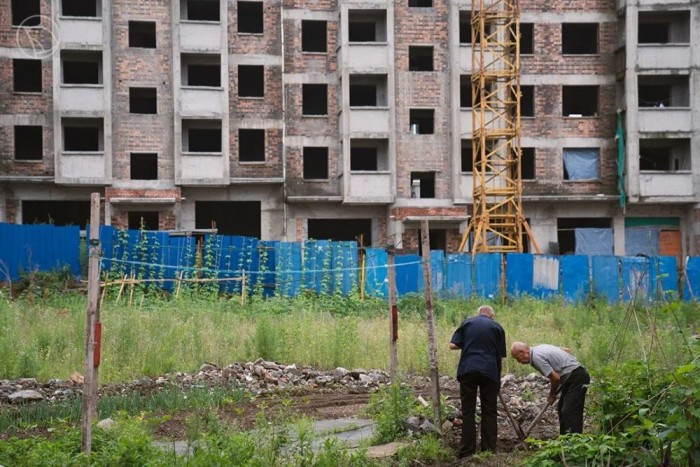 |
| A residential complex in Zhangjiakou, Hebei Province, near Beijing. Unfinished apartment buildings stand as an eyesore, perfectly reflecting the reality that zombie cities are mushrooming across China following the collapse of the property bubble. / Economic Daily |
China is locked in a fierce struggle amid the mushrooming of zombie cities, which began emerging following the collapse of its property sector that had underpinned the entire economy amidst a heavy bubble since the turn of the century. Given that the property market is virtually beyond near-term recovery, this ordeal is projected to continue at least until 2030. It is also certain to place a substantial burden on the Chinese economy, which is already in a difficult phase.
Comprehensive reports from media outlets including the Economic Daily indicate that just five years ago, the real estate sector accounted for an overwhelming share of China's overall economy. This was natural given the widely accepted view that it made up 25% of gross domestic product (GDP). In short, it was a flagship pillar industry. Because demand generated by the vast population appeared to outstrip supply, it was widely assumed that this momentum would last indefinitely.
However, the situation changed completely in the second half of 2021 when Evergrande, China's largest property developer, defaulted while shouldering an astronomical debt of no less than 2.4 trillion yuan (about 496.8 trillion won). This clearly confirmed that the entire industry had been wandering in sweet delusions amid a massive bubble.
The subsequent fallout was nothing short of devastating. The complete collapse of the entire industry sent shockwaves through the national economy. Far from remaining a pillar of growth, it became a major liability. Plunging property prices and the ensuing financial distress across some 700 local cities nationwide were natural consequences. The catastrophe faced by provincial cities that heavily relied on the real estate sector was far worse than a financial tsunami.
This reality is clearly illustrated by the dishonorable fate suffered by the city of Hegang in Heilongjiang Province. Little further explanation is needed given that it became the first city since the founding of the republic in 1949 to declare a moratorium on debt payments after failing to withstand debt pressure.
The real concern is that about five years after the Evergrande crisis erupted, zombie cities facing bankruptcy like Hegang now proliferate nationwide. They are estimated to number around 95, or roughly 13% of all cities in China. Among them are relatively well-known cities including Zhangjiakou in Hebei Province near Beijing, Xianyang in Shaanxi Province, and Jilin in Jilin Province. In these areas, it is commonplace for the average price of a 100-square-meter apartment to fall below 300,000 to 400,000 yuan (62.1 million to 82.8 million won).
Furthermore, countless apartments are estimated to be priced below 100,000 yuan, less than the cost of a compact car. It is by no means an exaggeration that media outlets refer to these properties not just as "cabbage-priced apartments" but even as "onion-priced apartments." Despairing reports by state-run media warning that cities across the country are undergoing "Hegang-ization" stem from the same context. Describing them as zombie cities certainly hits the mark.
As of late August 2026, the number of vacant homes and apartments across China is estimated at between 100 million and 150 million units. This figure speaks volumes about the ongoing nature of the real estate bubble collapse. It would be fair to conclude that the mushrooming of zombie cities across China is no longer a surprising phenomenon.
Hong Soon-do
Most Read
-
1
Celltrion nears additional contract with major U.S..

-
2
Putin proposes trilateral U.S.-China-Russia summit..

-
3
U.S. weighs dropping MOAB, world's most powerful n..

-
4
"Aren't those foreigners on welfare?": M..

-
5
Attention centers on APEC for possible Trump-Xi-Pu..

-
6
Saudi Arabia, Iran hold first diplomatic talks to..

-
7
China tightens grip on boosting domestic demand an..

PEOPLE







-
Address : In-Young Bldg., 34, Uisadang-daero 1-gil, Yeongdeungpo-gu, Seoul
Copyright by ASIATODAY CO., LTD. All rights resereved