



Marine heat waves quadrupled over past decade in Korean Peninsula
Aug 27, 2026, 09:39 am


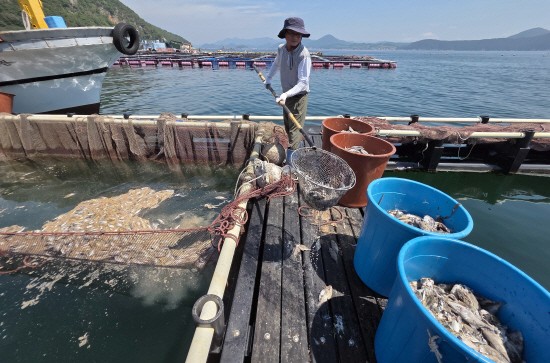 |
| A fisherman collects threadsail filefish killed by high water temperatures at a cage farm off Sanyang-eup, Tongyeong, South Gyeongsang Province, on the 26th. / Yonhap |
Along with the upward trend in sea surface temperatures around the Korean Peninsula, the frequency of marine heat waves—often dubbed "ocean heat waves"—has been found to be surging rapidly. Marine heat waves not only devastate marine ecosystems but also serve as a driver making extreme weather events, such as heat waves and torrential rains, more frequent. Even if efforts to slow climate change continue, prevailing projections indicate that the occurrence of marine heat waves will become even more frequent through the end of this century.
The Korea Meteorological Administration (KMA) released the results of its analysis on climate characteristics and future projections for the sea areas surrounding South Korea on the 26th. According to the KMA, the average sea surface temperature in the seas around the country over the past decade (2016–2025) stood at 18.1°C, up 0.7°C from the 1991–2020 period (17.4°C). While temperatures rose at an average rate of 0.3°C per decade over the past 35 years (1991–2025), the rate of increase reached 1.2°C per decade when looking exclusively at the most recent 10-year period.
Over the past decade, the average annual occurrence of marine heat waves reached 83.3 days, expanding nearly fourfold compared to the climatological normal (22.6 days). A marine heat wave refers to a phenomenon where daily average sea surface temperatures exceed the 90th percentile of the climatological distribution for five consecutive days or more.
Sea surface temperatures and marine heat waves exert a direct impact on marine ecosystems and the fisheries industry. Furthermore, rising sea surface temperatures reinforce the high-pressure systems that cause summer heat waves and strengthen rain cloud bands fed by increased moisture levels. The top four years with the highest annual average sea surface temperatures in South Korea's recorded history are all concentrated after 2021, and years marked by high sea surface temperatures mostly rank within the top five across metrics related to summer heat waves as well.
The recent increase in the number of heat wave days in South Korea is also not unrelated to rising sea surface temperatures and marine heat waves. Abnormal climate patterns in the waters surrounding the Korean Peninsula are progressing faster than the global average. While global sea surface temperatures rose 0.3°C above normal, South Korea exhibited an increase more than double that rate. The increase in ocean heat content (heat accumulated in the ocean) compared to normal was also larger in South Korea at 0.31×10⁹ J/m² than the global level of 0.23×10⁹ J/m².
The problem is that even if greenhouse gas emissions are curtailed moving forward, the waters around the Korean Peninsula will continue to warm through 2100. When applying the "SSP1-2.6" low-carbon scenario from the Intergovernmental Panel on Climate Change (IPCC), the KMA projected that in the late 21st century (2081–2100), sea surface temperatures in the sea areas around South Korea will rise 1.5°C compared to the past decade, and the number of marine heat wave days will reach 304 days—equivalent to about 83% of the year.
Kim Hong-chan
Most Read
-
1
Celltrion nears additional contract with major U.S..

-
2
Putin proposes trilateral U.S.-China-Russia summit..

-
3
U.S. weighs dropping MOAB, world's most powerful n..

-
4
"Aren't those foreigners on welfare?": M..

-
5
Attention centers on APEC for possible Trump-Xi-Pu..

-
6
Saudi Arabia, Iran hold first diplomatic talks to..

-
7
China tightens grip on boosting domestic demand an..

PEOPLE







-
Address : In-Young Bldg., 34, Uisadang-daero 1-gil, Yeongdeungpo-gu, Seoul
Copyright by ASIATODAY CO., LTD. All rights resereved