



Thailand enacts political amnesty law, excluding royal insult cases
Aug 25, 2026, 02:35 pm


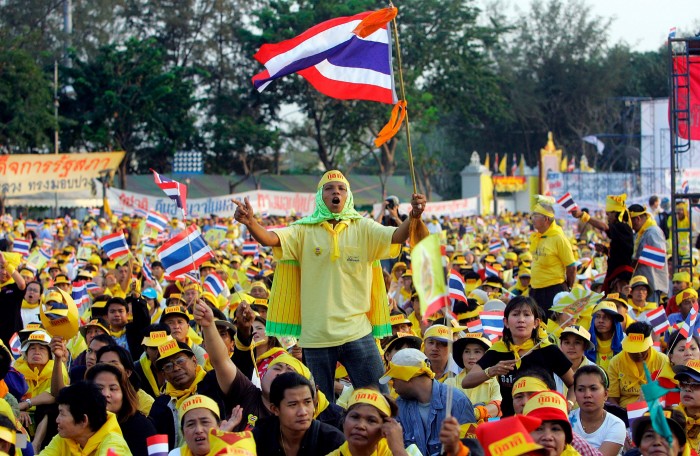 |
| Anti-government protesters waving flags and chanting slogans demand the resignation of then Prime Minister Thaksin Shinawatra at the Royal Plaza in Bangkok, Thailand, in February 2006. / AP, Yonhap News |
A special amnesty law aimed at granting relief to individuals involved in political conflicts over the past two decades has officially taken effect in Thailand. However, because the royal insult offense (Section 112 of the Criminal Code)—a key provision used to punish progressive activists calling for monarchy reform—was completely excluded from the amnesty, criticism has erupted that it amounts to only a half-hearted pardon.
According to the Bangkok Post and the Associated Press on the 25th (local time), the amnesty law, officially named the "Act to Promote a Peaceful Society," covers crimes related to political assemblies, demonstrations, and acts of expression occurring between January 1, 2005, and July 15, 2025. It applies retroactively not only to suspending sentences and granting releases, but also to dropping investigations and indictments, dismissing pending trials, and expunging criminal records. The Thai Parliament estimated that approximately 6,000 individuals would benefit from the measure.
The bill, which passed parliament in July, was published in the Royal Gazette on the 23rd and took effect the following day. A nine-member screening committee chaired by the prime minister will select the eligible beneficiaries and must convene its first meeting within 30 days, though completing the final review is expected to take considerable time.
The issue lies in the exclusion clauses. Corruption offenses and violent acts causing death or grievous bodily harm were fundamentally barred from amnesty, and royal insult charges were also included among these exceptions.
According to Thai Lawyers for Human Rights (TLHR), a local human rights group, the majority of the at least 54 individuals incarcerated for political cases as of last month are serving sentences on royal defamation charges, meaning the number of detainees actually eligible for release is expected to be around ten.
Section 112 of the Thai Criminal Code stipulates prison terms of up to 15 years for defaming or insulting the king or royal family members. Critics have pointed out that the military and conservative royalists have abused the law to suppress dissidents and political rivals, particularly because third parties—not just royals or law enforcement—can file complaints. TLHR stated that more than 290 individuals have been indicted under this provision since 2020 alone.
Thailand's political turmoil intensified into bloody confrontations between the rural and working-class "Red Shirts" and the urban elite, royalist, and military-aligned "Yellow Shirts" following the 2006 military coup that ousted former Prime Minister Thaksin Shinawatra. The current legislation was pursued under the pretext of mending past wounds on both sides, including the 2008 airport occupation and the 2010 downtown Bangkok bloodshed.
However, young and student pro-democracy activists who took to the streets starting in 2020 to demand royal insult law reforms and limits on the monarchy were entirely excluded from relief. Human rights groups and the opposition have criticized the move, calling it a "half-hearted amnesty that is nothing more than collusion between the ruling elite and past political forces."
Jeong Ri-na
Most Read
-
1
Celltrion nears additional contract with major U.S..

-
2
Putin proposes trilateral U.S.-China-Russia summit..

-
3
U.S. weighs dropping MOAB, world's most powerful n..

-
4
"Aren't those foreigners on welfare?": M..

-
5
Attention centers on APEC for possible Trump-Xi-Pu..

-
6
Saudi Arabia, Iran hold first diplomatic talks to..

-
7
China tightens grip on boosting domestic demand an..

PEOPLE







-
Address : In-Young Bldg., 34, Uisadang-daero 1-gil, Yeongdeungpo-gu, Seoul
Copyright by ASIATODAY CO., LTD. All rights resereved