



Xi Jinping expected to visit India for first time in 7 years
Aug 25, 2026, 10:13 am


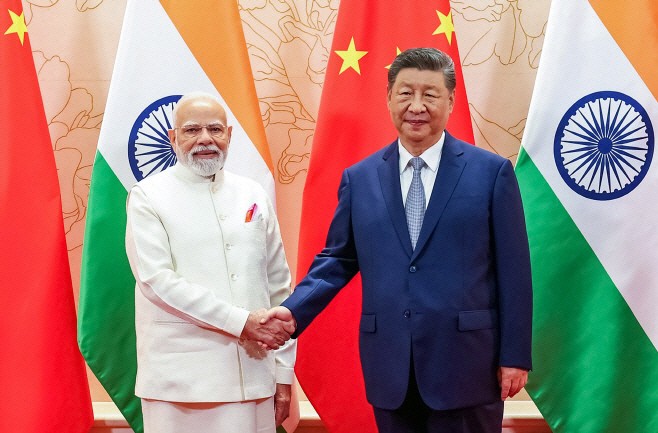 |
| Indian Prime Minister Narendra Modi (left) and China's President Xi Jinping shake hands ahead of a bilateral meeting during the Shanghai Cooperation Organisation (SCO) summit held in Tianjin, China, in August last year. / AFP, Yonhap News |
Chinese President Xi Jinping is expected to visit India for the first time in seven years to attend the BRICS summit held in New Delhi next month. The bilateral relationship, which went through a cooling-off period following the deadly 2020 border clash, is anticipated to reach a major watershed.
According to Reuters on the 24th (local time), multiple senior Indian government sources reported that President Xi is highly likely to attend the BRICS summit scheduled for September 12–13 in New Delhi. One source stated, "Chinese working-level officials are coordinating details regarding local accommodations and security arrangements." Other sources also stated, "A mammoth delegation of around 400 people is expected to accompany him." This scale is more than double the size of the delegation (under 200 people) during his last visit to India in 2019.
If this visit takes place, it is expected to serve as the biggest barometer of the improvement in China-India relations that has been underway since the 2020 border clash. The two countries share the Line of Actual Control (LAC) spanning approximately 3,800 kilometers in the Himalayas. Following the 2020 Galwan Valley clash, in which 20 Indian soldiers and four Chinese soldiers were killed, the two nations maintained a sharp military standoff for four years before reaching a dramatic agreement on front-line troop disengagement only in October 2024.
The normalization of bilateral relations still stands on thin ice. Although a thaw emerged last year when Indian Prime Minister Narendra Modi made a reciprocal visit to China for the first time in seven years, recent friction resurfaced along the border region, causing diplomatic friction. Shortly after observations emerged late last month that patrol units from both countries faced off again in the Himalayan border area, the Indian Ministry of External Affairs issued a cautionary message on the 12th, stating that "peace and tranquility on the border is a prerequisite for bilateral relations."
High-level contacts to resolve tensions are also taking place rapidly. Indian National Security Advisor (NSA) Ajit Doval visited China on the 24th to begin consultations with Wang Yi, Member of the Political Bureau of the CPC Central Committee and Minister of Foreign Affairs, regarding pending border issues. The two sides are reportedly coordinating ways to pursue the normalization of exchanges on the occasion of the upcoming summit while stably managing border and regional security risks.
President Xi's detailed itinerary and the agenda for a bilateral summit have not yet been finalized. The Chinese Ministry of Foreign Affairs maintained a cautious stance regarding President Xi's specific schedule, stating that it "has no information to provide," while adding that it "attaches high importance to BRICS cooperation and supports host country India in successfully holding the meeting."
Experts analyze that trade pressure from the U.S. serves as a key driving force bringing the two nations together. With trade pressure from the Donald Trump U.S. administration emerging as a major external variable for both countries, interpretations suggest that their mutual interests aligned on the need to demonstrate the strategic solidarity of BRICS despite lingering sparks of border tension.
Jeong Ri-na
Most Read
-
1
Celltrion nears additional contract with major U.S..

-
2
Putin proposes trilateral U.S.-China-Russia summit..

-
3
U.S. weighs dropping MOAB, world's most powerful n..

-
4
"Aren't those foreigners on welfare?": M..

-
5
Attention centers on APEC for possible Trump-Xi-Pu..

-
6
Saudi Arabia, Iran hold first diplomatic talks to..

-
7
China tightens grip on boosting domestic demand an..

PEOPLE







-
Address : In-Young Bldg., 34, Uisadang-daero 1-gil, Yeongdeungpo-gu, Seoul
Copyright by ASIATODAY CO., LTD. All rights resereved