



Next year's budget to top 800 trillion won as tax revenue surges on chip boom
Aug 25, 2026, 10:04 am


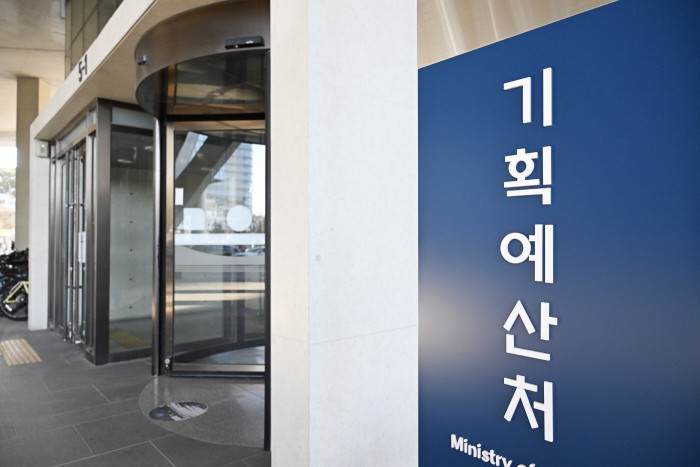 |
| Signboard of the Ministry of Planning and Budget / Yonhap |
Driven by a boom in semiconductor exports, the likelihood is growing that next year's budget proposal will become a "super budget" exceeding 800 trillion won. Projections also suggest that national tax revenue will surpass 600 trillion won thanks to rising chip demand and a buoyant domestic stock market.
According to related government ministries on the 25th, the Ministry of Planning and Budget is finalizing next year's budget proposal.
Earlier, the Ministry proposed at last month's National Fiscal Strategy Meeting that next year's total expenditure growth rate be set at 10% or higher compared to this year's main budget. Considering that this year's main budget stands at 729.9 trillion won, next year's budget is set to exceed 800 trillion won.
This marks the first time total expenditure growth has reached double digits since a 10.9% increase in 2009 during the global financial crisis.
The major budget expansion that changes the leading digit of total expenditure for a second consecutive year is attributed to an export boom led by the semiconductor industry. Tax revenue conditions have improved due to higher corporate tax payments resulting from increased chip exports. The bullish KOSPI has also lifted securities transaction tax revenues.
Previously, Minister of Planning and Budget Park Hong-geun stated that under the National Fiscal Management Plan (2025–2029), next year's national tax revenue would exceed the projected 421.1 trillion won by more than 100 trillion won, reaching "500 trillion won plus alpha." Furthermore, voices inside and outside the government are mentioning the possibility of national tax revenue surpassing 600 trillion won in light of the recent chip boom.
In this scenario, the volume of "excess tax revenue," which serves as the primary initial funding source for the Future Response Fund, will also grow substantially. The Ministry plans to define tax revenue exceeding the trend line—calculated by applying the past decade's compound annual growth rate of about 6% to internal taxes—as excess tax revenue, deposit it into the Future Response Fund, and utilize it for necessary projects.
According to the fund creation method outlined by the government, next year's internal tax trend line is estimated at around 370 trillion won. Considering that internal taxes have accounted for roughly 88% to 89% of national tax revenue over the past several years, internal taxes are projected to reach around 530 trillion won if national tax revenue expands to 600 trillion won. Consequently, analyses indicate that excess tax revenue could reach a scale of 160 trillion won.
Seo Byung-joo
Most Read
-
1
Celltrion nears additional contract with major U.S..

-
2
Putin proposes trilateral U.S.-China-Russia summit..

-
3
U.S. weighs dropping MOAB, world's most powerful n..

-
4
"Aren't those foreigners on welfare?": M..

-
5
Attention centers on APEC for possible Trump-Xi-Pu..

-
6
Saudi Arabia, Iran hold first diplomatic talks to..

-
7
China tightens grip on boosting domestic demand an..

PEOPLE







-
Address : In-Young Bldg., 34, Uisadang-daero 1-gil, Yeongdeungpo-gu, Seoul
Copyright by ASIATODAY CO., LTD. All rights resereved