



[Behind the story] Controversies over fairness in police investigations
Aug 25, 2026, 09:27 am


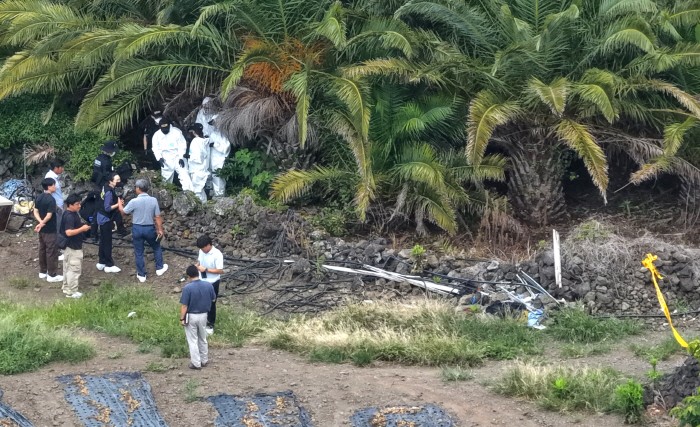 |
| Police conduct forensic analysis on the scene after discovering the body of Jang Mi-ran, who went missing several months ago, at a palm tree farm in Suwon-ri, Hallim-eup, Jeju City, on the 24th. / Yonhap News |
A series of recent revelations exposing cases of police covering up and downplaying investigations has caused widespread repercussions. With the expansion of police investigative authority under the revised Criminal Procedure Act granting them exclusive jurisdiction over certain crimes, these issues are raising growing questions about whether the police possess sufficient investigative capability and fairness. Experts advise that there is a need to strengthen reporting systems for case details and establish institutional safeguards to prevent individual police officers from arbitrarily closing cases.
On the 24th, a body presumed to be Jang Mi-ran (37), who went missing in Jeju last May, was found near Hallim-eup, Jeju. Jang's partner and family had anxiously awaited news, but the assigned officer falsely closed the case, missing the golden time and prolonging the missing state, which ultimately led to this tragic outcome.
Senior Police Constable A of Jeju Seobu Police Station, the officer in charge, also falsely closed another missing person case, in which a missing man was found dead on the 22nd, 51 days after disappearing. The police are currently conducting a comprehensive inspection of over 200 missing person cases previously handled by Senior Constable A.
This case has exposed the vulnerabilities of police missing person investigations, where a single officer can entirely bury an investigation. Senior Constable A deceived Jang's partner and family with a lie claiming to have established contact with Jang and that she did not want to reveal her location, subsequently closing the case falsely. The officer also deleted Jang's records from the missing persons profiling management system and left a note instructing not to disclose contact information, thereby preventing the case from being re-registered.
Although Jang's partner and family continued trying to search for her, the officer's actions rendered it impossible. A reinvestigation was finally able to begin only after a relative of Jang filed a missing person report in Seoul last month rather than in Jeju. The intention of a single assigned officer halted the investigation and search, effectively blocking any avenue for the probe to restart in the same region.
Experts point out that police officers hold excessive discretion in missing person investigations and that field-level oversight mechanisms have failed to function. Consequently, critics emphasize that specific case details must be systematically computerized rather than merely reported, and that unauthorized modifications must be prevented.
Lee Yoon-ho, professor of police administration at Dongguk University, explained, "Detailed progress throughout the case processing must be entered into the network, requiring supervisor approval for any modifications," adding, "Rather than simply adding approval lines for routine rubber-stamping, approvers must be made fully aware of the overall facts of the case."
Oh Yoon-sung, professor of police administration at Soonchunhyang University, also emphasized, "There must be a concrete system established to record and verify whether actual contact was made with the missing person, to secure and log details such as call recordings if contact occurred, and to share that information with the reporting party or family members."
Concerns are mounting as this incident surfaced ahead of the implementation of the revised Criminal Procedure Act, which completely abolishes direct investigative authority for prosecutors and grants police exclusive authority over substantial areas of criminal investigations. Doubts have deepened regarding whether the police possess the expertise and fairness required to independently handle and investigate crimes. The concern is that if a police force with such vulnerable internal systems holds exclusive control over criminal investigations, even more cases could be buried. Criticism against the police is intensifying further in tandem with the Jang Yoon-ki case, in which an investigation was nearly downplayed by the suspect's father—a serving police officer—and officials at the precinct involved.
While the ruling party, which led the revision of the Criminal Procedure Act, maintains that it will prepare supplementary measures, critical public sentiment shows no signs of abating, with figures across the opposition as well as within the ruling party, including Representative Lee Un-ju, raising questions about police investigative capabilities.
In criminal investigations, the passage of time can lead to the loss of evidence, making proof difficult. This is particularly crucial for search operations immediately following initial reports in missing person cases. In fact, all CCTV footage that could have traced Jang's movements had already been deleted by the 19th when police made their request. This serves as proof that stalling by the police can result in the disappearance of key case evidence.
Furthermore, most criminal cases involve wrongful victims. If covering up cases remains easy, anyone among the public can fall victim at any time. Becoming a victim of crime is distressing enough, but facing a situation where one cannot have damages substantiated due to dereliction of duty by investigative authorities only forces victims to swallow further anguish.
Kwak Dae-kyung, professor of police administration at Dongguk University, pointed out, "CCTV footage and biological evidence often disappear or lose their value over time. Such occurrences will only increase if initial investigations are not properly conducted or if inquiries are delayed," adding, "As situations where crimes are obvious yet cannot be proven due to lack of evidence occur frequently on the ground, cases of victim grievance will inevitably rise."
Tracing and controlling 140,000 police officers and countless cases individually is indeed challenging. Therefore, along with internal system reforms to prevent individual officers or precincts from arbitrarily concealing cases, filtering mechanisms and external checks and balances will also be necessary to prepare for instances where the police fail to process cases properly.
Lee Ha-eun
Most Read
-
1
Celltrion nears additional contract with major U.S..

-
2
Putin proposes trilateral U.S.-China-Russia summit..

-
3
U.S. weighs dropping MOAB, world's most powerful n..

-
4
"Aren't those foreigners on welfare?": M..

-
5
Attention centers on APEC for possible Trump-Xi-Pu..

-
6
Saudi Arabia, Iran hold first diplomatic talks to..

-
7
China tightens grip on boosting domestic demand an..

PEOPLE







-
Address : In-Young Bldg., 34, Uisadang-daero 1-gil, Yeongdeungpo-gu, Seoul
Copyright by ASIATODAY CO., LTD. All rights resereved