



Turn signal violations to carry 10-point penalty, but can't be enforced via video reports
Aug 24, 2026, 09:39 am


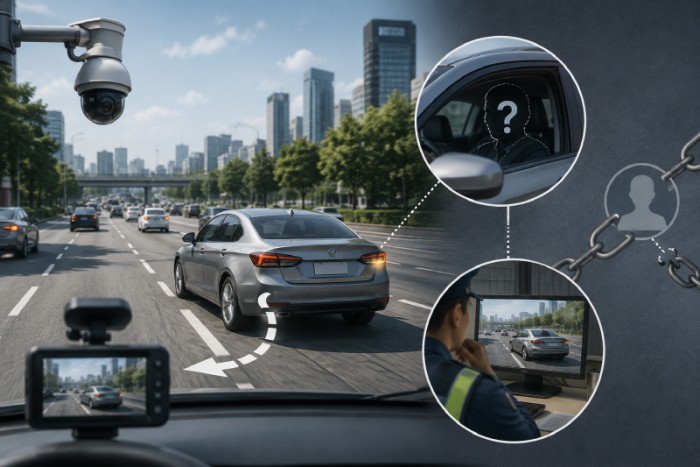 |
| This image was generated by AI. |
Police are pursuing a plan to impose a 10-point penalty on drivers who fail to signal when turning, but it turns out enforcing this penalty is difficult through video-based reports unless the actual driver at the time of the violation can be identified. That's because while a fine can be imposed on a vehicle's registered owner once the vehicle and violation are confirmed, penalty points must be assessed against the actual driver who committed the violation. This means the same violation could face different levels of sanction depending on how it's detected.
According to a "Status of Reception and Processing of Traffic Violation Reports Over the Past Three Years" document the National Police Agency submitted to this paper on the 23rd, a total of 1,497,280 reports of failure to use turn signals were filed from 2023 to 2025. Of these, 462,721 (30.9%) resulted in fines, while 1,034,559 (69.1%) were handled through education or warnings. The annual share handled through education or warnings was 65.4% in 2023, 72.6% in 2024, and 69.8% in 2025.
Reports of failure to use turn signals declined from 548,890 in 2023 to 495,229 in 2024 and 453,161 in 2025. Their share of total traffic violation reports also fell, from 15.0% to 13.7% to 13.1%. While overall traffic violation reports fell 5.4% between 2023 and 2025, reports specifically involving failure to signal fell 17.4% over the same period. Of the 10,744,714 total traffic violation reports filed over the three years, failure to signal accounted for 13.9%.
To strengthen enforcement against failure to signal, police issued a legislative notice in August for a partial amendment to the enforcement rules of the Road Traffic Act that would impose a 10-point penalty on drivers who fail to use their turn signal when turning or changing lanes. Under the current system, a fine applies to failure to signal, but no separate penalty points are assessed.
However, even after the amendment takes effect, whether penalty points actually apply may depend on the enforcement method. If police directly catch a violating vehicle on-site, the actual driver can be identified, allowing both a fine and the 10-point penalty to be imposed together. In video-based reports using dashcam or CCTV footage, by contrast, even if the vehicle and the violation itself are confirmed, the driver at the time may not be identifiable.
Since July 12, 2022, if a failure to signal violation is confirmed via video footage, an administrative fine can be imposed on the vehicle's owner or similar party. This expansion of the categories eligible for administrative fines, including failure to signal, was introduced to address the limitation of video-based reports, where the actual driver often could not be identified, making it difficult to issue a fine tied to the individual.
The Anti-Corruption and Civil Rights Commission had previously investigated a case in 2019 in which a vehicle that changed lanes without signaling was reported through a public interest complaint, but the vehicle owner failed to respond to a police request to appear, leaving the case unresolved for an extended period without any fine issued. Following the introduction of the administrative fine provision, monetary sanctions became possible even for video-based reports where only the vehicle could be identified — but the newly added penalty points once again require identifying the actual driver.
Ultimately, the same failure-to-signal violation could result in both a fine and penalty points when caught by on-site enforcement, but only a fine when reported via video if the driver cannot be identified. Separate from the introduction of the 10-point penalty itself, how broadly the strengthened sanctions can actually be applied to video-based reports is likely to be the key factor determining the system's real-world effectiveness.
A National Police Agency official explained, "The administrative fine provision for failure to use turn signals was introduced on July 12, 2022, and a fine is imposed when the violation is reported as a public interest complaint," adding, "At the time, the number of categories eligible for administrative fines expanded from 13 to 26."
Seol So-young
Most Read
-
1
Celltrion nears additional contract with major U.S..

-
2
Putin proposes trilateral U.S.-China-Russia summit..

-
3
U.S. weighs dropping MOAB, world's most powerful n..

-
4
"Aren't those foreigners on welfare?": M..

-
5
Attention centers on APEC for possible Trump-Xi-Pu..

-
6
Saudi Arabia, Iran hold first diplomatic talks to..

-
7
China tightens grip on boosting domestic demand an..

PEOPLE







-
Address : In-Young Bldg., 34, Uisadang-daero 1-gil, Yeongdeungpo-gu, Seoul
Copyright by ASIATODAY CO., LTD. All rights resereved