



Hyundai Motor union stages full walkout, first in 10 years
Aug 23, 2026, 09:35 am


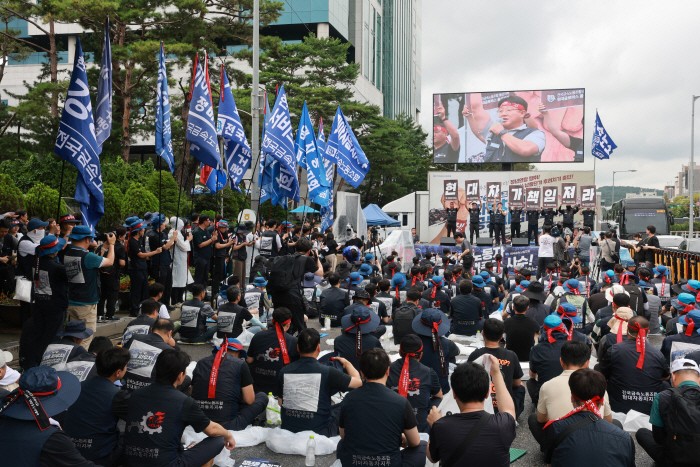 |
| Members of the Korean Metal Workers' Union (KMWU) auto sector hold a joint strike rally in front of Hyundai Motor's headquarters in Seocho-gu, Seoul, on the 21st, the day the Hyundai Motor union (KMWU's Hyundai Motor branch) launched a full-scale strike amid a breakdown in this year's wage negotiations. / Yonhap |
Hyundai Motor's union has launched its first full-scale strike in 10 years, demanding adjustments to component supply prices for parts suppliers and an extension of the retirement age.
The Korean Metal Workers' Union (KMWU), part of the Korean Confederation of Trade Unions (KCTU) and the umbrella union covering the Hyundai Motor union, held a strike rally at 2 p.m. on the 21st in front of Hyundai's headquarters in Seocho-gu, Seoul. The rally drew union branch heads from across the country, as well as members from auto parts suppliers and Hyundai Motor Group affiliate unions nationwide, with organizers estimating turnout at around 3,000 and police unofficially estimating 2,500.
This marks Hyundai Motor's first full eight-hour strike in a decade, since a similar single-day walkout on September 26, 2016, during that year's wage negotiations. The union has held partial strikes of 2-6 hours on various occasions this year, but this marks the first full eight-hour strike.
Hyundai's domestic plants operate on a two-shift system (morning and afternoon), meaning production lines will actually be halted for 16 hours as a result of the strike. Under the union's full strike directive that day, both the morning shift of technical (production) workers, who normally start work at 6:45 a.m., and the afternoon shift, who start at 3:30 p.m., did not report to work, halting all production lines at the Ulsan, Jeonju, and Asan plants.
Earlier, after the 15th round of negotiations broke down without agreement, labor and management resumed talks on the 18th, some 40 days later, but again failed to reach a deal. Beyond the wage increase under this year's wage negotiations, the union has made three separate demands: a 50% increase in bonuses, reinstatement of union members previously dismissed over past union activities deemed illegal, and an extension of the retirement age. Management has maintained that it cannot accept the union's demands without legal basis or a reasonable standard.
If the company does not present a new proposal, the union plans to hold a Central Strike Committee meeting on the 25th to discuss further strike action.
Meanwhile, strikes have recently spread across the country in the auto manufacturing and parts industry, with workers demanding original equipment manufacturer (OEM)-level negotiations and price adjustments.
According to the KMWU, 12,000 workers went on strike the previous day at locations including Gyeongju, South Chungcheong, and the Daejeon-North Chungcheong branch — areas dense with parts suppliers — along with some Hyundai Mobis production plants and Glovis parts and logistics operations in Ulsan. The union said the strike's scale grew to 50,000 that day as all 38,000 members of the Hyundai Motor union joined in.
The KMWU claims Hyundai and other automakers have engaged in unfair practices toward parts suppliers, such as forcing down supply prices, and argues that this makes adjusting supply prices, extending the retirement age, and holding OEM-level negotiations necessary.
At the rally that day, attendees held picket signs reading slogans like "Extend retirement age, raise supply prices" and chanted phrases such as "Win the retirement age extension!" and "Win OEM-level negotiations!"
The KMWU warned that if its demands are not met, it will launch a general strike on the 26th.
KMWU Chairman Park Sang-man said in his address, "Our work stoppage today is a minimal line of defense to save the roots of Korea's auto industry, which is on the brink of collapse due to large corporations' ruthless cost-shifting," stressing that OEM-level negotiations under the so-called "Yellow Envelope Act" are not a special privilege but common-sense law, and that at this moment of massive transformation, when AI and robots threaten jobs, job security and retirement age extension are the way to establish employment justice for the next generation and protect every worker's right to work with human dignity. He added, "Let's break down the unequal supply chain, completely root out the structure of irresponsible original manufacturers, and win a sustainable future for Korea's auto industry with our own hands."
Lee Ha-eun
Most Read
-
1
Celltrion nears additional contract with major U.S..

-
2
Putin proposes trilateral U.S.-China-Russia summit..

-
3
U.S. weighs dropping MOAB, world's most powerful n..

-
4
"Aren't those foreigners on welfare?": M..

-
5
Attention centers on APEC for possible Trump-Xi-Pu..

-
6
Saudi Arabia, Iran hold first diplomatic talks to..

-
7
China tightens grip on boosting domestic demand an..

PEOPLE





-
Address : In-Young Bldg., 34, Uisadang-daero 1-gil, Yeongdeungpo-gu, Seoul
Copyright by ASIATODAY CO., LTD. All rights resereved