



Chung Dong-young says Northeast Asia's tectonic plates are shifting, calling the past year a time of frustration
Aug 23, 2026, 09:10 am


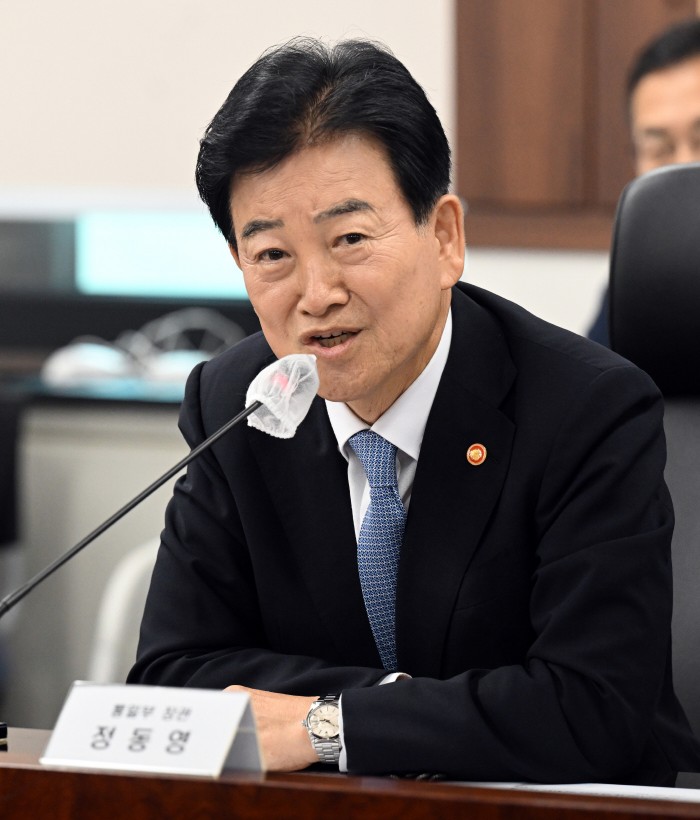 |
| AsiaToday reporter Park Seong-il = Unification Minister Chung Dong-young delivers opening remarks at the second joint council meeting on peace and safety in border regions, held at the Government Complex Seoul in Jongno-gu, Seoul on the morning of the 27th. Attendees included Minister Chung along with border-region local leaders such as Gyeonggi Governor Chu Mi-ae, Gangwon Governor Woo Sang-ho, and Incheon Mayor Park Chan-dae. |
Unification Minister Chung Dong-young shared his reflections on the past year, during which the North Korea issue saw no breakthrough, while assessing that the security landscape across the Korean Peninsula and broader Northeast Asia is now shifting.
At a briefing with reporters from the Unification Ministry press corps that day, Minister Chung said, "It's too early to make any firm predictions, but I feel that it's not just a spark stirring — Northeast Asia's tectonic plates themselves are shifting."
Reflecting on the roughly one year since he took office amid frozen inter-Korean relations, Chung said, "As unification minister, it's been genuinely frustrating," adding, "I took on this role — my second time serving as unification minister, by my own choice — determined to somehow break through the entrenched status quo, but it proved beyond my reach, and it's been a period of frustration."
The Unification Ministry has recently expressed hope that President Trump's repeated conciliatory gestures toward North Korea could lead to U.S.-North Korea dialogue, becoming an opportunity to resolve inter-Korean relations and the North Korean nuclear issue.
A senior Unification Ministry official told reporters, "The clock around the Korean Peninsula and its surroundings, stopped for seven years, has begun ticking again," adding, "Right now, the busiest places are probably Pyongyang and Washington. This is a moment for the U.S. and North Korea."
Regarding Kim Yo-jong's recent series of statements, the official assessed that they came because Trump had responded, to some degree, to North Korea's demands — including recognition of its nuclear-state status and the scrapping of hostile U.S. policy toward the North.
Earlier, Trump said North Korea possesses 57 nuclear weapons while avoiding any mention of denuclearization — a signal analysts believe North Korea responded positively to.
The senior official said, "If Kim were to meet with Trump, it would effectively — even if somewhat forcibly — result in his nuclear status being acknowledged, and North Korea could secure guarantees for its survival and development," stressing that North Korea has ample strategic incentive to pursue dialogue with the U.S.
Regarding criticism that U.S.-North Korea talks could effectively amount to accepting North Korea as a de facto nuclear state, the official said, "Please focus not on 'acceptance' but on 'halting' further nuclear buildup," adding that prioritizing a freeze on North Korea's nuclear program is the most realistic option — simply opening the door to dialogue for now. The official also posed the question, "If a car powered by nuclear weapons is racing forward, don't you first need to stop it before you can put it in reverse?"
The official added, "Even Trump referred to North Korea not as a legally recognized 'Nuclear Weapon State' but as a 'Nuclear Power,'" noting that North Korea sits somewhere in between, and that whether to formally recognize it as a nuclear state isn't really the essential question.
The official also addressed concerns that South Korea could be sidelined if U.S.-North Korea talks proceed, emphasizing a pragmatic view: that the U.S. and North Korea need to meet first to halt North Korea's nuclear buildup. The official said, "Given the reality of 'hostile two states,' it's a strategic choice, since changing the status quo is difficult without U.S.-North Korea dialogue happening first," stressing that only once U.S.-North Korea dialogue gets underway can the current stalemate be transformed.
On the prospect of sanctions relief appearing on the agenda in U.S.-North Korea talks, the official characterized existing sanctions as "a history of failure," adding, "North Korea's nuclear and missile capabilities advanced even during the period sanctions were in place," and asking rhetorically, "Realistically, are Russia and China even properly enforcing the sanctions?"
Mok Yong-jae
Most Read
-
1
Celltrion nears additional contract with major U.S..

-
2
"Aren't those foreigners on welfare?": M..

-
3
U.S. weighs dropping MOAB, world's most powerful n..

-
4
Houthis launch successive attacks on Saudi airport..

-
5
Saudi Arabia, Iran hold first diplomatic talks to..

-
6
Saudi airport in Riyadh struck again, leaving at l..

-
7
Five ASEAN countries welcome Myanmar coup leader

PEOPLE






HEADLINE NEWS

-
Address : In-Young Bldg., 34, Uisadang-daero 1-gil, Yeongdeungpo-gu, Seoul
Copyright by ASIATODAY CO., LTD. All rights resereved