



Hanmi Pharmaceutical ahead of launching anti-obesity drug EPPE
Aug 20, 2026, 10:45 am


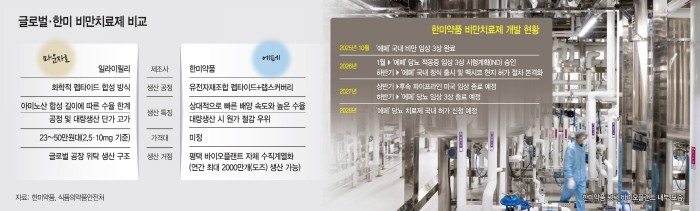 |
For GLP-1 peptide obesity treatments such as Wegovy and Mounjaro, process optimization and yield securing during mass production are considered key factors determining commercial success. Attention is focusing on whether Hanmi Pharmaceutical's obesity drug "EPPE," which is set to launch in the second half of this year, can catch two birds with one stone—securing yield and reducing costs—to prove the manufacturing competitiveness of its Pyeongtaek Bio Plant.
According to industry sources on August 19, Hanmi Pharmaceutical plans to obtain product approval from the Ministry of Food and Drug Safety for its anti-obesity drug "EPPE (ingredient name: efpeglenatide)" as early as October and officially roll it out in the domestic market within this year. EPPE has been designated for the Ministry's Global Innovative Product on Fast Track (GIFT) program, accelerating its commercialization procedures.
The commercialization of EPPE represents the first fruition of Hanmi Pharmaceutical's "H.O.P (Hanmi Obesity Pipeline)" project, an obesity whole-lifecycle project tailored to Koreans. Hanmi Pharmaceutical plans to unveil its strategy spanning from research and development (R&D) to commercialization of EPPE at the "K-Bio Deal Summit 2026" held on September 9. Beginning with EPPE, the company will also present a mid- to long-term growth roadmap leading to subsequent pipelines, including the muscle-increasing obesity treatment "HM17321" and the triple agonist "HM15275."
Hanmi Pharmaceutical presented a sales guidance of around 100 billion won for EPPE in 2027. Positive outlooks are also emerging from securities firms. Shin Ji-hoon, an analyst at KB Securities, analyzed, "Considering the steep growth of the domestic obesity drug market, outperforming the guidance will be possible," adding, "In the first half of 2027, when Phase 1 clinical trials for HM17321 and Phase 2 trials for HM15275 conclude, expectations for global technology transfers will also rise significantly."
The crux lies in productivity and cost competitiveness to support domestic supply. Hanmi Pharmaceutical has established a vertically integrated system that independently executes the entire process from new drug development to finished drug manufacturing. Its key production base, the Pyeongtaek Bio Plant, can produce up to 20 million pre-filled syringes annually on a finished drug basis, and also possesses microbial fermenters with a capacity of up to 25,000 liters. It is currently manufacturing drugs including the neutropenia treatment "Rolontis (U.S. brand name Rolvedon)," which obtained approval from the U.S. Food and Drug Administration (FDA).
EPPE's production method is also a factor that will govern price competitiveness. Developed as a once-weekly dosing formulation, EPPE incorporates Hanmi Pharmaceutical's proprietary long-acting platform "LAPSCOVERY." In particular, because it is produced via a recombinant method based on microbial culture, Hanmi Pharmaceutical expects to boost production efficiency and lower manufacturing costs during mass production. Ultimately, whether it can secure stable yields at commercial production scale is projected to determine its real-world cost competitiveness.
There is also the challenge of having to prove production technical prowess and economic viability through full-scale commercial manufacturing. This comes as French pharmaceutical firm Sanofi previously returned global rights for efpeglenatide in 2020. While changes in managerial strategy, such as Sanofi's withdrawal from the diabetes business, were cited as the primary backdrop at the time, Hanmi Pharmaceutical must now demonstrate the product's economic viability at the mass-production stage since it is pursuing direct commercialization.
Securing an appropriate profit margin and maximizing the utilization rate of the Pyeongtaek Bio Plant are also critical. While the final drug price is still under internal review, the company must secure profitability while maintaining price competitiveness against global obesity treatments. The more it prices the drug to reduce patient burdens, the more crucial cost reduction through production volume expansion and process optimization inevitably becomes.
Overseas expansion serves as another pillar toward this end. Hanmi Pharmaceutical signed an exclusive distribution agreement for EPPE with Mexican partner "Sanfer" and is pursuing local regulatory approval procedures based on the clearance from Korea's Ministry of Food and Drug Safety. It is also reviewing plans to expand its target regions to Latin America, the Middle East, and Southeast Asia. If overseas sales expand, economies of scale through increased production volume can also be expected. Efficiently allocating production volumes between existing Rolvedon and EPPE at the Pyeongtaek Bio Plant to drive up utilization rates is projected to dictate cost competitiveness and profitability. It is a structure where the pace of sales following EPPE's domestic launch and global market expansion are interlinked with the production efficiency of the Pyeongtaek plant.
An industry official stated, "With the high cost of global obesity treatments even driving patients to make cross-border purchases, the decisive edge clearly lies in price competitiveness. Whether Hanmi can raise the utilization rate of the Pyeongtaek Bio Plant to prove its mass-production cost-cutting capabilities and broaden global markets to demonstrate earnings momentum will serve as the key benchmark for re-evaluating corporate value going forward."
Moon Jeong-woo
Most Read
-
1
Alteogen secures European patent for Keytruda SC,..

-
2
Trump shares map on social media labeling Strait o..

-
3
Celltrion seeks rheumatoid arthritis indication ex..

-
4
Kia Sportage outperforms Mazda CX-5 in German auto..

-
5
Chinese e-commerce giants AliExpress, Temu and She..

-
6
China expels No. 2 military official Zhang Youxia..

-
7
U.S. deploys carrier, 10,000 more troops to Middle..

PEOPLE







-
Address : In-Young Bldg., 34, Uisadang-daero 1-gil, Yeongdeungpo-gu, Seoul
Copyright by ASIATODAY CO., LTD. All rights resereved