



Semiconductor jobs to grow 5.1 percent fueled by AI boom
Aug 20, 2026, 10:16 am


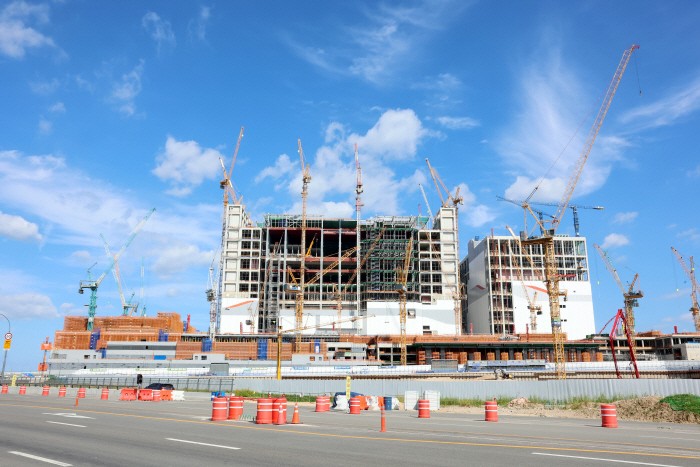 |
| SK Hynix semiconductor fab under construction in Wonsam-myeon, Cheoin-gu, Yongin, Gyeonggi Province. / National Assembly Press Photographers Corps |
Jobs in the semiconductor industry are projected to increase by more than 5 percent in the second half of this year, driven by the expansion of the artificial intelligence (AI) market and growing investments in data centers. Shipbuilding employment is also expected to rise on the back of strong order volumes, whereas the textile sector is anticipated to see job cuts due to China's low-price offensive and trade uncertainties.
According to the "Job Outlook for Major Industries in the Second Half of 2026," released on August 19 by the Korea Employment Information Service and the Korea Institute for the Advancement of Technology, among nine key domestic manufacturing sectors, employment in semiconductors and shipbuilding is projected to grow compared to the second half of last year, while textiles will see a decline. Machinery, electronics, displays, steel, automobiles, metal fabrication, petroleum, and chemicals are expected to remain at levels similar to the previous year.
Semiconductors are expected to record the highest rate of job growth. In the second half, semiconductor employment is projected to climb 5.1 percent year-on-year, adding about 8,000 workers. In the first half of this year, the number of semiconductor workers reached 157,000, up 4.2 percent, or 6,000, compared to the same period last year.
This growth is driven by expanding investments in AI servers and data centers, which have spurred demand for high-value-added memory products, such as High Bandwidth Memory (HBM), server DRAM, and Solid State Drives (SSDs). The Korea Employment Information Service forecasts the global semiconductor market will grow by approximately 9.4 percent this year, while capital expenditures are expected to increase 17 percent, led by advanced process nodes.
Shipbuilding employment is also projected to grow 2.7 percent, or by about 3,000 workers, compared to the second half of last year. As of May, domestic shipyards secured an order backlog of 38.5 million compensated gross tonnage (CGT), equivalent to over three years of work. With deliveries of high-value vessels ordered between 2022 and 2023—such as LNG carriers and ultra-large container ships—ramping up, ship exports this year are projected to reach $33.91 billion, an 8.3 percent increase from the previous year.
In contrast, the textile industry is expected to face a continued decline in employment. In the second half, textile jobs are forecast to decrease 3.5 percent year-on-year, dropping by roughly 5,000. In the first half of this year, the workforce stood at 142,000, down 3.0 percent, or 4,000, from a year earlier.
Despite positive factors such as expanded production of advanced materials and a rebound in apparel consumption, recovery in exports and output is analyzed to be constrained by rising raw material and logistics costs from Middle Eastern supply chain disruptions, U.S. trade regulations, and market encroachment by low-priced Chinese products.
Employment in the remaining key manufacturing sectors is projected to remain mostly flat. Machinery employment is expected to rise 0.8 percent year-on-year, adding around 4,000 jobs, but is categorized as "maintaining" under the outlook criteria. Electronics and displays are forecast to decrease by 0.1 percent (1,000 jobs), steel by 0.3 percent (400 jobs), automobiles by 0.5 percent (2,000 jobs), metal fabrication by 0.3 percent (1,000 jobs), and petroleum and chemicals by 0.6 percent (3,000 jobs), though all fall within the range of maintaining prior-year levels.
Notably, automobile employment is projected to decline by 0.5 percent despite new vehicle launches and increasing eco-friendly car exports. While domestic demand in the second half is forecast to rise 3.9 percent year-on-year, burdens include expanding market share by Chinese electric vehicle makers both domestically and abroad, as well as the localization of EV production.
Steel exports are also projected to decline due to sluggish demand in downstream industries like construction and rising protectionism in key markets, including the European Union. However, the decline in employment is expected to be limited due to base effects in domestic demand and maintained production levels.
Kim Nam-hyung
Most Read
-
1
Celltrion nears additional contract with major U.S..

-
2
"Aren't those foreigners on welfare?": M..

-
3
Houthis launch successive attacks on Saudi airport..

-
4
Saudi Arabia, Iran hold first diplomatic talks to..

-
5
Saudi airport in Riyadh struck again, leaving at l..

-
6
Five ASEAN countries welcome Myanmar coup leader

-
7
32 Western nations condemn Iran over terror plot t..

PEOPLE






HEADLINE NEWS

-
Address : In-Young Bldg., 34, Uisadang-daero 1-gil, Yeongdeungpo-gu, Seoul
Copyright by ASIATODAY CO., LTD. All rights resereved