



Heavy rain brings only limited drought relief
Aug 20, 2026, 10:10 am


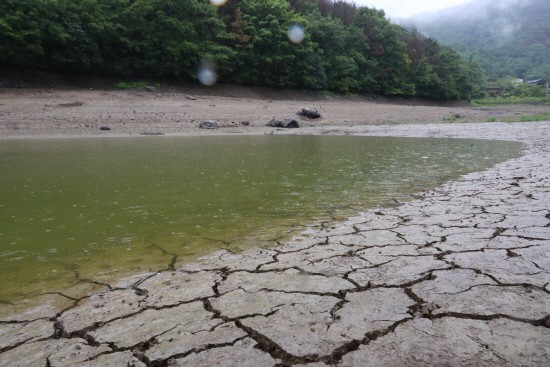 |
| Long-awaited welcome rain falls over Baekan Reservoir in Muan-myeon, Miryang, South Gyeongsang Province, on August 16 during the Liberation Day holiday. / Yonhap |
Although disastrous downpours struck during the Liberation Day holiday, they brought only limited drought relief. Only areas that suffered severe torrential rain damage found partial respite, while reservoir storage rates nationwide remain far from recovering. Amid this, as the ongoing El Niño is projected to reach record-high levels, observations suggest precipitation could remain subdued through September.
According to the Agricultural Drought Management System (ADMS) of the Korea Rural Community Corporation on August 19, the reservoir storage rate in South Gyeongsang Province rose to 51.6 percent as of that day. Compared to the 32.2 percent recorded on August 14, recent heavy rain appears to have had a substantial impact. However, considering the region's average year storage rate of 69.2 percent, the drought can hardly be considered completely resolved. So far, the only areas where drought warnings have been fully lifted are a few locations that suffered heavy damage from record-breaking torrential rains, such as Geoje.
Moreover, conditions in other drought-stricken regions, including North Jeolla Province, are actually worsening. While drought alert levels across most of South Gyeongsang Province were downgraded to "caution" or "alert," Gimje and Jeongeup in North Jeolla Province still remain under "severe" warnings. Nationwide reservoir storage currently stands at 45.9 percent, more than 20 percentage points lower than the average year level of 68 percent. It edged up just 1 percentage point compared to August 14. In particular, North Jeolla Province's reservoir storage rate sits at 33.8 percent—less than half its historical average—and continued to decline even through the Liberation Day holiday.
Against this backdrop, the intensifying El Niño is also cited as a negative factor. In South Korea, heavy downpours typically occur between September and October at the end of summer when cold air flowing from the northwest meets the existing North Pacific High. Some academics refer to this as the "autumn monsoon." However, research shows that when El Niño develops—characterized by higher-than-usual water temperatures in the eastern Pacific—precipitation on the Korean Peninsula tends to decrease in September. The U.S. National Oceanic and Atmospheric Administration (NOAA) recently forecast a 69 percent probability that one of the strongest El Niño events since 1950 will develop by year-end.
Kug Jong-seong, a professor in the School of Earth and Environmental Sciences at Seoul National University, explained, "With water temperature rises in the eastern Pacific being very intense, we must closely monitor the potential signals of declining precipitation on the Korean Peninsula. If September precipitation decreases as previous studies suggest, the drought in the southern regions could worsen, necessitating proactive measures such as securing agricultural water."
Kim Hong-chan
Most Read
-
1
Celltrion nears additional contract with major U.S..

-
2
"Aren't those foreigners on welfare?": M..

-
3
Houthis launch successive attacks on Saudi airport..

-
4
Saudi Arabia, Iran hold first diplomatic talks to..

-
5
Saudi airport in Riyadh struck again, leaving at l..

-
6
Five ASEAN countries welcome Myanmar coup leader

-
7
32 Western nations condemn Iran over terror plot t..

PEOPLE





HEADLINE NEWS

-
Address : In-Young Bldg., 34, Uisadang-daero 1-gil, Yeongdeungpo-gu, Seoul
Copyright by ASIATODAY CO., LTD. All rights resereved