



Trump pauses planned 50% tariffs on Canada for three days
Aug 19, 2026, 04:16 pm


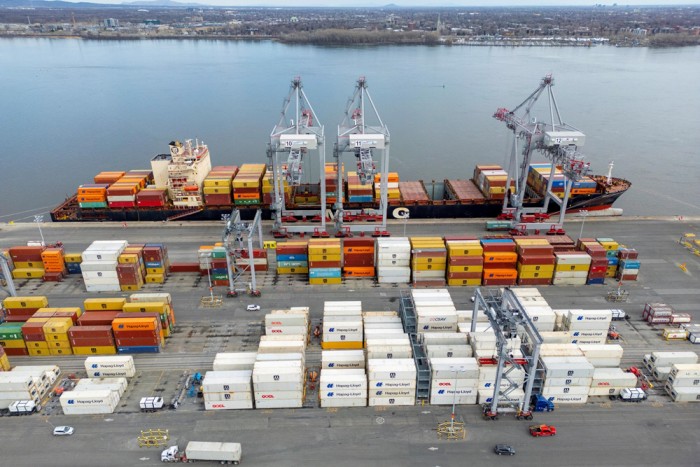 |
| Containers are stacked at the Port of Montreal in Quebec, Canada, on April 14 last year (local time). / Reuters, Yonhap |
U.S. President Donald Trump announced on August 18 (local time), a day before a 50% tariff on Canada was set to take effect, that he would temporarily suspend the measure.
President Trump stated on his social media platform Truth Social that day, "We are delaying the implementation of the 50% tariff on Canada, scheduled to take effect tomorrow morning, for three days, as Canada and the U.S. have reached an agreement subject to the signing of final documents."
He added, "The Keystone XL Pipeline, long ago killed by Sleepy Joe Biden, may also be revived."
The Keystone XL Pipeline project is a major pipeline construction project to transport Canadian crude oil to the U.S. Midwest. It was pursued during the first Trump administration but was halted in 2021 when the Biden administration revoked its operating permit.
According to the Office of the U.S. Trade Representative (USTR), the tariffs were expected to affect approximately $20 billion (around 28 trillion won) worth of U.S. imports from Canada.
The items subject to the levies ranged from hockey sticks to certain construction materials, alcoholic beverages, and specific apparel.
The two countries have reportedly been conducting trade negotiations for more than a week. Canadian Prime Minister Mark Carney said on August 17 regarding the talks with the U.S. that they were "very sensitive and intense," though he did not disclose specific details.
The Canadian Prime Minister's Office told NBC News that President Trump and Prime Minister Carney spoke by phone late that afternoon and again the following day.
Earlier, Prime Minister Carney criticized the tariff policy as a direct violation of the United States-Mexico-Canada Agreement (USMCA), which was signed during President Trump's first term.
The U.S. Chamber of Commerce warned in a statement on August 18, "In the absence of a deal, the introduction of higher tariffs will harm both economies, raise costs for American families, disrupt critical supply chains, and threaten 13 million U.S. jobs that depend on North American trade agreements."
The planned tariffs would have marked the first application of Section 338 of the Tariff Act of 1930.
The provision stipulates that the White House may impose tariffs of up to 50% on foreign trading partners that discriminate against U.S. commerce.
During the negotiations, Canada sought not only a full withdrawal of tariffs under Section 338 but also reductions in tariffs under Section 232 of the Trade Expansion Act, which apply to industrial products including steel and aluminum, Bloomberg reported.
In particular, Canada requested that the 25% tariff on Canadian automobiles be reduced to below 15%, but U.S. authorities reportedly did not accept the request.
Kim Hyun-min
Most Read
-
1
Alteogen secures European patent for Keytruda SC,..

-
2
Trump shares map on social media labeling Strait o..

-
3
Celltrion seeks rheumatoid arthritis indication ex..

-
4
Kia Sportage outperforms Mazda CX-5 in German auto..

-
5
Chinese e-commerce giants AliExpress, Temu and She..

-
6
China expels No. 2 military official Zhang Youxia..

-
7
U.S. deploys carrier, 10,000 more troops to Middle..

PEOPLE







-
Address : In-Young Bldg., 34, Uisadang-daero 1-gil, Yeongdeungpo-gu, Seoul
Copyright by ASIATODAY CO., LTD. All rights resereved