



OpenAI Launches ChatGPT for Teens
Aug 19, 2026, 10:04 am


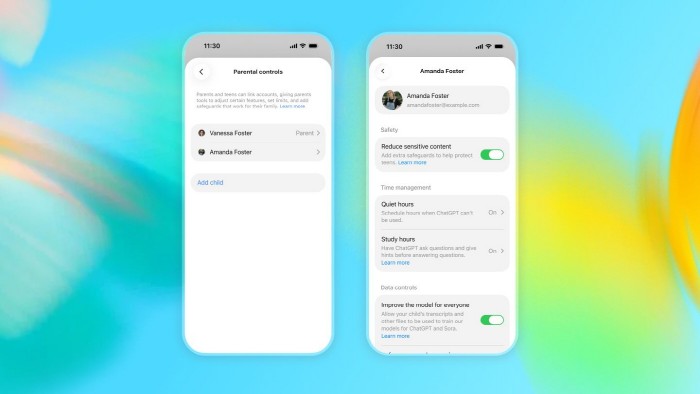 |
| A feature in "ChatGPT for Teens" that lets parents manage usage time limits and certain settings. / OpenAI |
OpenAI announced on the 19th that it is launching "ChatGPT for Teens."
This teen-focused version of ChatGPT is designed to help young people use AI for learning while reducing the risk of emotional dependence. It applies automatically when the system estimates a user is under 18, or when a user identifies their age as 13-17.
In particular, the design focuses on helping teens understand and work through problems on their own, rather than simply getting quick answers. A student preparing for an exam can ask for explanations of unfamiliar concepts, work through practice problems step by step, and check whether they've truly understood the material.
If a user appears to be trying to get a direct answer to an assignment, ChatGPT redirects them into Study Mode, guiding them to engage with the problem-solving process instead. Other learning features include "responsible homework nudges," which steer users who seem to be trying to skip an assignment back toward working through the problem, along with quizzes and study visualizations. A new "Study Hours" feature lets teens or parents set specific times during which Study Mode turns on by default.
Study Mode was designed in collaboration with teachers, scientists, and education experts. It uses guiding questions, step-by-step learning support, prompts that help students check their own thinking, and comprehension checks to help students work through problems themselves rather than simply receiving answers. OpenAI said the product was designed around the principle that AI should support learning outside the classroom, while teachers should lead how AI is used in actual instruction.
Age-appropriate safeguards are applied by default for teen users. Protections at both the model and product level have been strengthened to reduce exposure to harmful or developmentally inappropriate content in high-risk areas such as violence, eating disorders, dangerous behavior, and explicit sexual or violent content. These standards are based on OpenAI's "Under-18 Principles," which draw on developmental science research and expert input. In teen accounts linked to a parent, parents can set usage limits ("Quiet Hours") and manage certain settings, and parents receive notifications in limited high-risk situations.
Features to support healthy, balanced use are also included. After a certain period of use, the system prompts users to take a break, and it continually reminds users that ChatGPT is an AI, to prevent them from mistaking it for a person. Under the model guidelines for users under 18, ChatGPT is designed not to express romantic feelings toward teens or encourage emotional dependence, and not to speak as though it has emotions or consciousness of its own.
The system also prompts caution before uploading sensitive images, reminding users not to share photos containing personal information, and introduces learning and safety features during initial onboarding for teen users. While simple customization options like accent colors and voice are available, OpenAI said the product was designed to keep the line clear between a useful tool and a human relationship.
Kim Young-jin
Most Read
-
1
Alteogen secures European patent for Keytruda SC,..

-
2
Trump shares map on social media labeling Strait o..

-
3
Celltrion seeks rheumatoid arthritis indication ex..

-
4
Kia Sportage outperforms Mazda CX-5 in German auto..

-
5
Chinese e-commerce giants AliExpress, Temu and She..

-
6
China expels No. 2 military official Zhang Youxia..

-
7
Trump rejects Iran's offer to open Strait of Hormu..

PEOPLE






-
Address : In-Young Bldg., 34, Uisadang-daero 1-gil, Yeongdeungpo-gu, Seoul
Copyright by ASIATODAY CO., LTD. All rights resereved