



Firefighters scramble amid erratic weather
Aug 19, 2026, 09:36 am


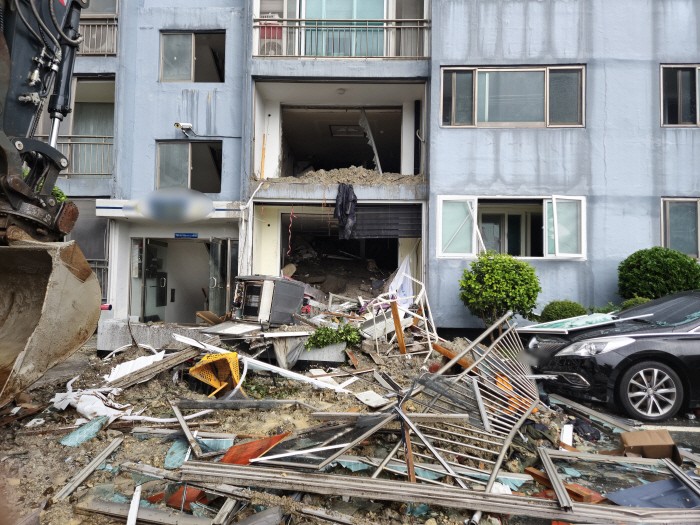 |
| Landslide debris flows into a Gangseo-gu apartment building in Okpo-dong, Geoje, South Gyeongsang Province, damaging furniture and interior fixtures, on the morning of the 17th. / Yonhap |
Firefighting resources that had been dispatched to South Gyeongsang Province just days earlier to deliver water amid a severe drought have now shifted to responding to record-breaking rainfall damage. As two opposite disasters — drought and torrential rain — triggered back-to-back national firefighting mobilization orders, firefighters' mission shifted rapidly from water supply support to rescue and drainage operations.
According to the National Fire Agency on the 18th, fire authorities issued a national firefighting mobilization order at 6 a.m. that day in response to the concentrated heavy rain damage in Geoje and Tongyeong, South Gyeongsang Province. As of 6 p.m., 981 personnel and 162 pieces of equipment had been deployed for rescue and drainage operations. The National 119 Rescue Headquarters also separately deployed 47 personnel and 13 pieces of equipment to support rescue and recovery work.
Geoje and Tongyeong, where the damage was concentrated, saw the heaviest rainfall on record. Geoje recorded 638.7mm of rain in a single day through 6 p.m. on the 17th, the highest daily rainfall since observation began in 1972. Tongyeong recorded 453.7mm over the same period, also breaking its previous daily rainfall record. Over the three days from the 15th to the 17th, cumulative rainfall reached 898.4mm in Geoje and 743.4mm in Tongyeong. The concentrated downpour triggered landslides and flooding of roads and homes in quick succession.
Emergency calls related to the heavy rain in Geoje and Tongyeong totaled 1,947. Fire authorities carried out 20 rescue operations, saving 136 people. In Geoje, a landslide swept debris into a residential building, killing one person and injuring two, while a landslide in Tongyeong also injured one person.
A fire official said, "About 2,000 reports were received in Geoje and Tongyeong alone from the heavy rain the day before," adding, "With flooding of roads and facilities and landslides all occurring simultaneously, drainage and rescue operations are continuing."
With damage occurring simultaneously across multiple sites, specialized equipment was also deployed. Firefighters brought in rescue boats and large-capacity water discharge systems to flooded areas. Ten off-road pump trucks were also urgently mobilized from Busan, Daegu, North Gyeongsang, and Changwon. Drainage work using large-capacity discharge systems is also underway at underground parking facilities in Geoje.
Just days earlier, conditions had been the exact opposite. South Gyeongsang Province had been suffering from a shortage of agricultural and household water due to prolonged heat and drought. The National Fire Agency issued a national firefighting mobilization order at 8 p.m. on the 11th, sending firefighting resources from across the country to the province. Over four days, from the 12th to the 15th, nationally mobilized water tanker trucks made 2,585 trips, supplying 18,495 tons of water.
Initially, 200 water tanker trucks and 400 firefighting personnel were mobilized from 16 cities and provinces nationwide, with resources distributed across 14 areas in South Gyeongsang Province, including Jinju, Tongyeong, Sacheon, Gimhae, Miryang, and Geoje. The mobilization was later scaled down to 100 water tanker trucks from 12 cities and provinces, continuing water supply support focused on the hardest-hit drought areas, including Miryang, Uiryeong, Haman, Changnyeong, and Geoje.
Geoje, now directly hit by this latest downpour, had also been a major recipient of water supply support during the drought. In other words, just days after fire trucks gathered from across the country to deliver water to the region for drought relief, the same area now found itself needing water pumped out and residents rescued.
A fire official said, "During the drought, response was led by the Heatwave Response Headquarters, while this time, the Emergency Rescue Control Group has been activated," adding, "Though the responsible departments and response systems differ, national firefighting mobilization orders were issued back-to-back within just days, for two completely opposite disasters — drought and torrential rain."
Lee Ha-eun
Most Read
-
1
Celltrion nears additional contract with major U.S..

-
2
Putin proposes trilateral U.S.-China-Russia summit..

-
3
U.S. weighs dropping MOAB, world's most powerful n..

-
4
"Aren't those foreigners on welfare?": M..

-
5
Attention centers on APEC for possible Trump-Xi-Pu..

-
6
Saudi Arabia, Iran hold first diplomatic talks to..

-
7
China tightens grip on boosting domestic demand an..

PEOPLE






-
Address : In-Young Bldg., 34, Uisadang-daero 1-gil, Yeongdeungpo-gu, Seoul
Copyright by ASIATODAY CO., LTD. All rights resereved