



24,000 cases surge in a month, sparking fears of investigation paralysis before prosecution office abolition
Aug 19, 2026, 09:32 am


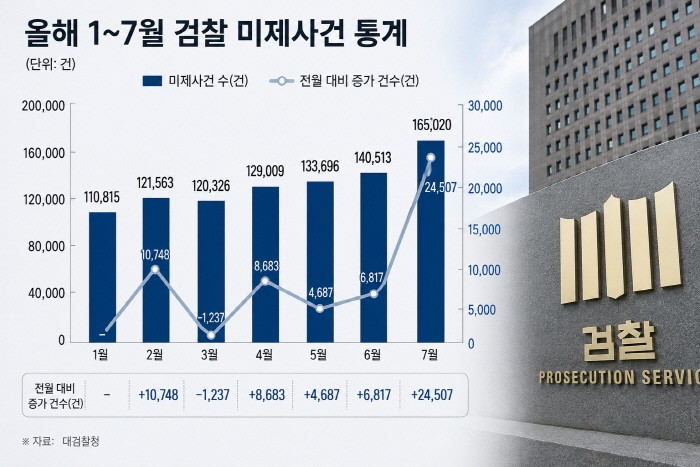 |
| Prosecutors' backlog statistics. / AI-generated image |
Prosecutors' backlog of unresolved cases has grown by more than 24,000 in just the past month, marking the sharpest monthly increase so far this year. This is attributed to the combined effect of senior prosecutors resigning ahead of the October 2 abolition of the prosecutors' office system, along with frontline investigative staff being pulled away for various special counsel assignments. With additional personnel expected to be drawn away soon for a newly launching "Election Commission Special Counsel" team as well, concerns are growing that the case backlog could deepen further.
According to the Ministry of Justice and the Supreme Prosecutors' Office on the 18th, unresolved cases across prosecutors' offices nationwide totaled 165,020 as of the end of last month, up 24,507 (17.4%) from June — the largest monthly increase recorded this year.
The backlog rose from 110,815 at the end of January to 121,563 in February, then dipped slightly to 120,326 in March, before climbing steadily again — to 129,009 in April, 133,696 in May, and 140,513 in June — and has since surged sharply.
Within the prosecution, the "gap in investigative staffing" at frontline offices is cited as the main driver of the growing backlog. As of the 10th, 87 prosecutors had left the prosecution service, including 69 with 11 or more years of experience. Beyond a simple decline in headcount, the departures are concentrated among mid-to-senior prosecutors capable of directing and investigating complex cases, placing an even heavier burden on frontline offices.
Special counsel assignments are also affecting investigative staffing. Currently, more than 50 prosecutors — comparable to the entire staff of the Uijeongbu District Prosecutors' Office — have been assigned to special counsel teams investigating matters including the insurrection case, the Kim Keon-hee case, the Marine's death case, and a second comprehensive special counsel probe. While these assigned prosecutors remain counted under their original office's staffing quota, they're effectively removed from handling actual frontline cases, inevitably concentrating the caseload on remaining prosecutors. A department head prosecutor at a Seoul-area district office said a single prosecutor used to handle around 100 cases a month on average, but now handles more than 150 in order to work through the accumulated backlog, adding that since cases nearing their statute of limitations are prioritized, relatively less urgent cases inevitably get pushed back.
Further staff drawdowns are also on the horizon. A new "Election Commission Special Counsel," tasked with investigating the ballot shortage controversy from the June 3 local elections, is set to launch soon and will require additional prosecutor assignments. With existing special counsel assignments already ongoing, another wave of investigative staff being pulled away would further shrink the pool of available personnel at frontline offices.
Another challenge prosecutors face is having to clear the accumulated backlog of unresolved cases while simultaneously transitioning to a public prosecution office system on October 2. Frontline offices are expected to accelerate case processing in the time remaining — deciding whether to indict cases referred by police and special judicial police, or returning cases requiring further investigation through requests for supplementary investigation. However, with cases piling up to the point where even reviewing case files in time has become difficult, observers say it will be challenging to sufficiently clear more than 160,000 unresolved cases within the remaining two months.
A Supreme Prosecutors' Office official said, "To reduce the backlog, prosecutor staffing needs to be expanded and working conditions need to be improved," adding, "Amid growing negative public perception of prosecutors, there's simply no motivation left for prosecutors to keep grinding themselves down, physically and mentally, to get the work done."
Jeong Min-hoon
Most Read
-
1
Celltrion nears additional contract with major U.S..

-
2
Putin proposes trilateral U.S.-China-Russia summit..

-
3
U.S. weighs dropping MOAB, world's most powerful n..

-
4
"Aren't those foreigners on welfare?": M..

-
5
Attention centers on APEC for possible Trump-Xi-Pu..

-
6
Saudi Arabia, Iran hold first diplomatic talks to..

-
7
China tightens grip on boosting domestic demand an..

PEOPLE







-
Address : In-Young Bldg., 34, Uisadang-daero 1-gil, Yeongdeungpo-gu, Seoul
Copyright by ASIATODAY CO., LTD. All rights resereved