



Wang Yi's visit to Korea draws attention amid Trump's expressed displeasure toward S. Korea
Aug 18, 2026, 04:27 pm


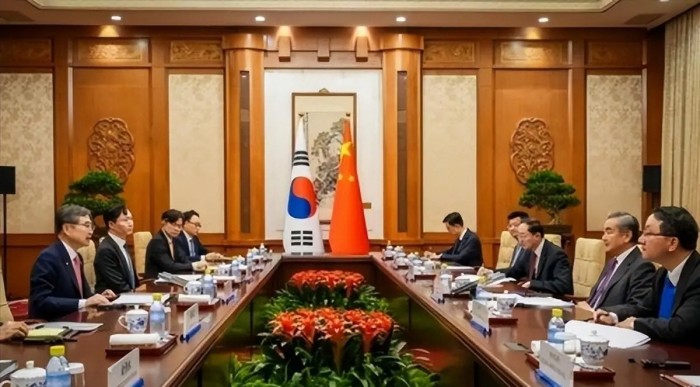 |
| South Korea-China Foreign Ministers' Meeting held in Beijing on September 17 last year. The talks are set to resume on the 19th for the first time in about a year, expected to cover pending bilateral issues. / People's Daily |
With President Trump expressing goodwill toward North Korea and displeasure toward South Korea around the 17th (local time), attention is turning to Wang Yi — a member of China's Politburo and foreign minister who also heads the Office of the Central Commission for Foreign Affairs — set to visit Korea for two days starting on the 19th. Depending on how his visit unfolds, it could potentially trigger significant shifts in the broader Northeast Asian security landscape, including on the Korean Peninsula.
According to Beijing diplomatic sources familiar with global affairs on the 18th, Trump, in a Q&A with reporters following an event at the White House on the 17th, claimed that North Korean leader Kim Jong-un had responded to his offer of dialogue, calling the response "very positive." The day before, he had also written on Truth Social that he and Kim have a "very good relationship" — openly signaling considerable goodwill toward North Korea and its leader.
In contrast, Trump displayed open displeasure toward ally South Korea and President Lee Jae-myung. This is evident in his claim that he recently called President Lee and offered, "We don't need your help on the Iran issue, but if you're willing, lend us a hand," only for Lee to respond, "No, I'll pass."
This contrast in Trump's stance can be seen as welcome news for China. Many Chinese state media outlets reported approvingly that "Trump made a conciliatory gesture toward North Korea while holding South Korea accountable" — a reaction that lends weight to this assessment. A Renmin University professor surnamed Zhang, speaking on condition of anonymity, said China wants to pry South Korea away from the United States, and that Trump, by targeting and angering South Korea, has done exactly what China wants — adding that General Secretary and President Xi Jinping is likely quite pleased privately, a claim that isn't without basis.
Against this backdrop, Wang, making his first visit to Korea in five years since September 2021, is expected to discuss various pending issues with Korea in a relatively relaxed position. Above all, he is expected to actively engage in coordinating the multilateral talks President Lee proposed in his Liberation Day address, aimed at formally ending the Korean War. Specifically, discussions are likely to focus heavily on holding four-party talks involving South and North Korea, the U.S., and China.
For its part, South Korea, which desperately needs China's help to establish lasting peace on the peninsula, is likely to ask Wang to play a constructive role in bringing North Korea back to inter-Korean dialogue. With Trump having directly raised the possibility of renewed U.S.-North Korea talks by expressing warmth toward Kim, China too has ample justification to actively engage.
Beyond this, normalizing bilateral relations — strained for more than a decade over the THAAD (Terminal High Altitude Area Defense) dispute — is also likely to come up for discussion, something China strongly desires as it seeks to somehow pry South Korea away from the trilateral Korea-U.S.-Japan alliance framework that puts considerable pressure on Beijing. In that scenario, China's so-called "Hallyu ban" (restrictions on Korean cultural content) could quietly be lifted. Trump's recent remarks appear set to have genuinely significant ripple effects on the Korean Peninsula.
Hong Soon-do
Most Read
-
1
Celltrion nears additional contract with major U.S..

-
2
Putin proposes trilateral U.S.-China-Russia summit..

-
3
U.S. weighs dropping MOAB, world's most powerful n..

-
4
"Aren't those foreigners on welfare?": M..

-
5
Attention centers on APEC for possible Trump-Xi-Pu..

-
6
Saudi Arabia, Iran hold first diplomatic talks to..

-
7
China tightens grip on boosting domestic demand an..

PEOPLE






-
Address : In-Young Bldg., 34, Uisadang-daero 1-gil, Yeongdeungpo-gu, Seoul
Copyright by ASIATODAY CO., LTD. All rights resereved