



Signs of Microsoft's full withdrawal from China spark fears of domino effect
Aug 18, 2026, 10:25 am


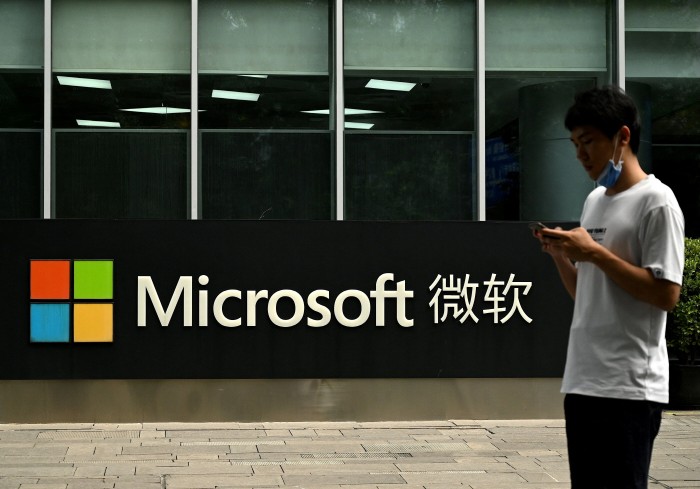 |
| A Microsoft billboard hangs along Chang'an Avenue, central Beijing's main thoroughfare — one that may not be there much longer. / Xinjing Bao |
Microsoft, one of the world's most established global tech giants, is showing clear signs of a full withdrawal from the Chinese market. As the U.S.-China AI industry rivalry intensifies further, this move appears likely to have a significant ripple effect on U.S. and other global tech companies already struggling to operate in China.
Microsoft's notably diminished standing and recent moves in China make this outcome seem quite plausible. According to Beijing sources familiar with ICT industry matters on the 17th, Microsoft had previously invested considerable effort in cracking the Chinese market — enough said, given that it once released a separate "Windows 10 China Government Edition" to meet Beijing's requirements. Founder Bill Gates's frequent visits to China clearly weren't without purpose.
But it didn't take long for Microsoft's ambitions to falter. Above all, starting in 2017, China's government threw cold water on Microsoft's hopes by significantly expanding adoption of domestically made software across government agencies and state-owned enterprises, citing security and technological self-reliance. This is evident in the fact that of six procurement guidelines for government computing systems released between December 2023 and May of this year, five did not actively recommend Microsoft products — clear evidence that, contrary to its stated position, the Chinese government has not been particularly favorable toward Microsoft's products.
Microsoft's disappointing revenue from the Chinese market, far below expectations, is another factor worth noting. This becomes clear when considering that China has never accounted for more than 2% of Microsoft's total global revenue over the past three years, since 2023 — more than enough to demonstrate that Microsoft's ambitions in China amounted to little more than an overly naive, rosy blueprint.
As results continued to disappoint, Microsoft reportedly even considered the drastic option of fully withdrawing from the Chinese market back in 2023. That plan naturally still appears to be on the table, given that the company has closed at least 15 branch offices and joint ventures over the past five years — including Wicresoft, Microsoft's first joint venture in China and a partnership with the Shanghai municipal government.
Beyond poor performance, several other factors are driving these clear signs of a potential full withdrawal, including geopolitical risk, mounting regulatory burdens, and U.S. controls on advanced technology exports to China — headwinds difficult even for a company as formidable as Microsoft to weather.
Of course, there's also a view that rather than fully withdrawing, Microsoft may instead scale back its operations and try to hold on as long as possible, taking a long-term view while waiting for conditions to improve. Still, the weakness it has already shown carries significant implications for American and other global tech companies. It seems quite likely that a considerable number of firms will look to Microsoft as a benchmark. It would be fair to say that a potential domino effect of global tech giants withdrawing from the Chinese market wouldn't simply be a butterfly effect stemming from Microsoft's declining standing in China.
Hong Soon-do
Most Read
-
1
Celltrion nears additional contract with major U.S..

-
2
Putin proposes trilateral U.S.-China-Russia summit..

-
3
U.S. weighs dropping MOAB, world's most powerful n..

-
4
"Aren't those foreigners on welfare?": M..

-
5
Attention centers on APEC for possible Trump-Xi-Pu..

-
6
Saudi Arabia, Iran hold first diplomatic talks to..

-
7
China tightens grip on boosting domestic demand an..

PEOPLE







-
Address : In-Young Bldg., 34, Uisadang-daero 1-gil, Yeongdeungpo-gu, Seoul
Copyright by ASIATODAY CO., LTD. All rights resereved