



Committee investigating pro-Japanese collaborators' assets revived after 16 years
Aug 18, 2026, 09:26 am


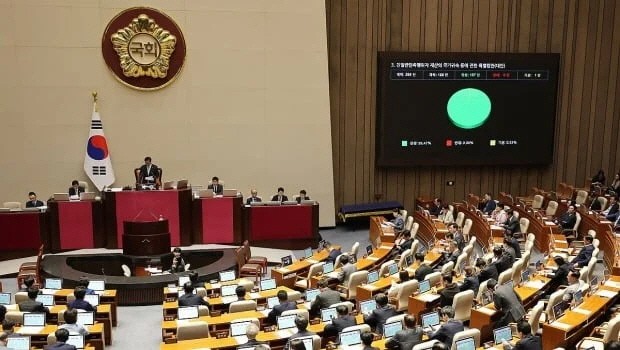 |
| Special Law for the Return of the Properties of Japanese Collaborators, passed at the National Assembly plenary session. / Yonhap |
The Committee to Investigate Pro-Japanese Collaborators' Property, disbanded in 2010, will resume operations after 16 years. With a special law set to take effect in December, the investigation and government confiscation of assets belonging to pro-Japanese collaborators — halted since there was no dedicated body to conduct such probes — is expected to resume. The legal basis has also been strengthened to allow recovery of proceeds from previously sold pro-Japanese assets.
According to legal circles on the 16th, the "Special Act on National Confiscation of Property from Pro-Japanese Anti-National Collaborators" will take effect on December 3. The law was drafted to address the gap left since the first Committee to Investigate Pro-Japanese Collaborators' Property was disbanded in 2010, after which there was no dedicated body to investigate newly discovered pro-Japanese assets.
A key feature of the new special law is its expanded scope for recovering assets that have been concealed or sold off. The law now explicitly allows the proceeds to be recovered even when descendants of pro-Japanese collaborators have already sold off the relevant property. A new reward system has also been established to compensate people who identify and report such assets.
Through its earlier activities, the committee had already brought a substantial amount of pro-Japanese property under state ownership. According to the Ministry of Justice and an official white paper, the first committee, launched in July 2006, ruled to confiscate 2,359 parcels of land owned by 168 pro-Japanese collaborators over four years, through July 2010 — valued at 237.3 billion won at the time.
Some properties had already been sold off by the time of investigation. The first committee issued confirmation rulings identifying pro-Japanese assets for 24 descendants who had sold such property to third parties. After the committee disbanded, the Ministry of Justice continued pursuing related lawsuits based on its earlier findings.
A prime example is a lawsuit filed last October against descendants of pro-Japanese collaborator Lee Hae-seung. The Ministry of Justice filed an unjust enrichment claim seeking to have the descendants return 7.8 billion won they received from selling 31 parcels of land in Howon-dong, Uijeongbu, Gyeonggi Province, to the state.
Preparations to launch the new committee have already begun. A preparatory task force was formed on June 22, staffed with 11 personnel from relevant agencies including the Ministry of Justice, the Ministry of the Interior and Safety, the Ministry of Patriots and Veterans Affairs, and the Korea Forest Service. Prosecutor Lee Young-chang (33rd class, Judicial Research and Training Institute) heads the task force, which will finalize related regulations and prepare a detailed investigation plan before the new committee launches in December.
Recovered assets will be used to support programs for independence movement figures. A Ministry of Justice official said that pro-Japanese property confiscated by the state will be prioritized for use in the fund supporting fallen patriots and independence activists.
Lee Seo-yeon
Most Read
-
1
Alteogen secures European patent for Keytruda SC,..

-
2
Trump shares map on social media labeling Strait o..

-
3
Celltrion seeks rheumatoid arthritis indication ex..

-
4
Kia Sportage outperforms Mazda CX-5 in German auto..

-
5
Chinese e-commerce giants AliExpress, Temu and She..

-
6
China expels No. 2 military official Zhang Youxia..

-
7
U.S. deploys carrier, 10,000 more troops to Middle..

PEOPLE







-
Address : In-Young Bldg., 34, Uisadang-daero 1-gil, Yeongdeungpo-gu, Seoul
Copyright by ASIATODAY CO., LTD. All rights resereved