



Xi consolidates power by elevating Jiang Zemin's legacy
Aug 18, 2026, 10:26 am


Chinese General Secretary and President Xi Jinping is seen as pursuing a strategy of consolidating his own power by elevating the legacy of former President Jiang Zemin, using it to underscore the legitimacy of the current leadership. This approach seems likely to prove quite effective.
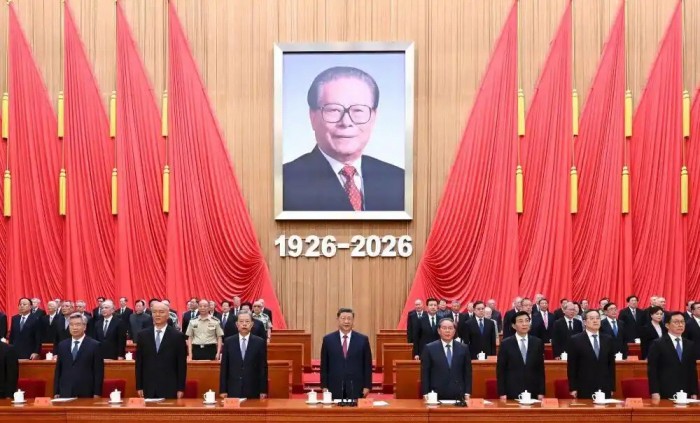 |
| A ceremony marking the 100th anniversary of Jiang Zemin's birth was held at the Great Hall of the People in Beijing on the morning of the 17th. In his address that day, General Secretary and President Xi Jinping stressed the legitimacy of his own leadership by elevating Jiang's legacy — a strategy seen as consolidating his hold on power. / People's Daily |
According to Beijing sources familiar with cross-strait affairs on the 17th, President Xi said in his address that morning at a ceremony marking the 100th anniversary of Jiang Zemin's birth, held at the Great Hall of the People in Beijing, that the party must learn from Jiang's profound strategic thinking and far-sighted vision, citing Jiang's forceful campaign against "Taiwan independence" as well as his role in achieving the smooth handovers of Hong Kong and Macau.
Xi went on to describe Jiang as broad-visioned and adept at accurately reading the times, saying he was skilled at observing and reasoning through problems based on China's and the world's development trends and the party and state's overall work, driving forward the party and state's development through a series of major, forward-looking decisions.
Xi credited Jiang with contributing significantly to China's development through deepening reform and expanding opening-up. In particular, Xi said Jiang led the smooth return of Hong Kong and Macau and helped facilitate the two sides of the strait reaching the "1992 Consensus" — a verbal understanding built around the "One China" principle, under which both sides affirm one China while each side expresses this in its own way — arguing this represented a major struggle against separatism and "Taiwan independence."
Xi also cited Jiang's remark that the Chinese nation would achieve great rejuvenation on the foundation of completing national reunification and building a prosperous, democratic, and culturally advanced socialist modern country, expressing optimism that a bright future for the great rejuvenation of the Chinese nation now lies ahead.
Xi further said the party should learn from Jiang's spirit of keeping pace with the times through innovation, praising his role in pursuing reform and opening-up and successfully securing China's accession to the World Trade Organization (WTO).
He also said the party should learn from Jiang's firm and decisive extraordinary resolve, citing his success in fending off the fallout from the Asian financial crisis as another achievement.
Notably, in his address that day, Xi used the phrase "the severe political turmoil that occurred in China during the spring-summer transition," an unusual reference to the 1989 Tiananmen incident. This appears to be because the Tiananmen episode is unavoidable if one is to elevate Jiang's legacy in full. It suggests just how persistent Xi's effort to consolidate power through elevating Jiang truly is.
Hong Soon-do
Most Read
-
1
Celltrion nears additional contract with major U.S..

-
2
Putin proposes trilateral U.S.-China-Russia summit..

-
3
U.S. weighs dropping MOAB, world's most powerful n..

-
4
"Aren't those foreigners on welfare?": M..

-
5
Attention centers on APEC for possible Trump-Xi-Pu..

-
6
Saudi Arabia, Iran hold first diplomatic talks to..

-
7
China tightens grip on boosting domestic demand an..

PEOPLE







-
Address : In-Young Bldg., 34, Uisadang-daero 1-gil, Yeongdeungpo-gu, Seoul
Copyright by ASIATODAY CO., LTD. All rights resereved