



Government eases redevelopment rules, construction firms welcome move
Aug 18, 2026, 10:20 am


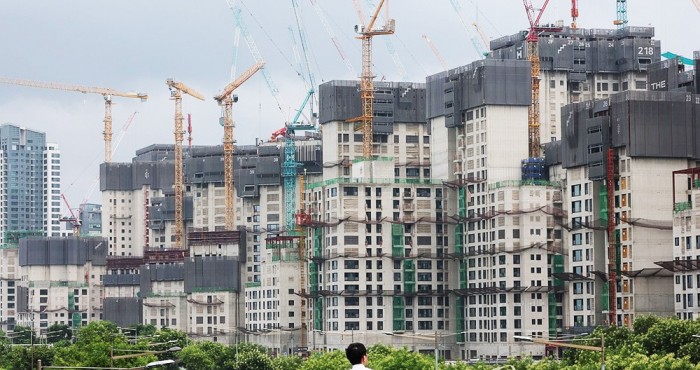 |
| Apartment reconstruction site in Seoul. / Yonhap |
The government's stance on real estate policy appears to be shifting away from moderating the pace of redevelopment and reconstruction projects toward reactivating them, after unveiling a package of measures on the 13th that substantially strengthens financial and administrative support for such projects. While the Ministry of Land, Infrastructure and Transport, the ministry overseeing the policy, has made clear that this doesn't contradict the president's earlier remarks, the construction industry is largely treating the move as, in effect, a signal to revitalize redevelopment and reconstruction activity.
According to industry sources on the 17th, the government, through its "Comprehensive Financial Package to Stabilize the Real Estate Market" announced on the 13th, expanded financial support for housing supply from 26.3 trillion won to more than 47.8 trillion won, and doubled this year's target for household debt growth from 1.5% to 3%. This is expected to free up roughly 30 trillion won in additional lending capacity, which will be directed first toward supporting genuine demand — including relocation loans for redevelopment and reconstruction sites and interim/settlement loans for newly built complexes.
Alongside the financial support, the government also decided to overhaul a range of on-the-ground regulations that have slowed the pace of redevelopment projects. It will lower the consent threshold for forming redevelopment associations to match the level used for reconstruction, easing the required consent rate among landowners from 75% to 70%. For public redevelopment and reconstruction projects, the consent rate required to designate a project operator will also drop from 67% to 60%. Procedures for selecting construction contractors will be simplified as well — for instance, when a general competitive bid draws only a single bidder and fails, the deadline for submitting bids after a re-announcement will be shortened, among other procedural changes aimed at reducing delays in contractor selection.
Some had interpreted this expanded support as potentially contradicting President Lee Jae-myung's earlier remarks on redevelopment projects. Speaking at a public forum on real estate policy on July 23, President Lee had said that redevelopment and reconstruction can require displacing existing residents, potentially reducing the total number of households, and that redevelopment alone doesn't have a large supply effect.
As speculation grew that the government had turned lukewarm on redevelopment projects, Land Minister Kim Yun-deok explained the intent behind the president's remarks at a press briefing on the 14th. Minister Kim said the point was simply that redevelopment and reconstruction have limited supply effects given their structure of demolishing existing homes and building new ones, not that the government intends to stop pursuing such projects. He added that since public and private supply in Seoul runs at roughly a 1-to-9 ratio, private redevelopment projects — which account for the larger share — cannot be excluded, and that the government would move quickly to support projects wherever it could accelerate the process, including through operating a permitting support center for redevelopment projects.
As a result, with the shortened procedures from eased consent thresholds combining with expanded relocation, interim, and settlement loans, expectations are spreading within the industry that the redevelopment market — where competition for Seoul contracts has been concentrated among major construction firms — could heat up once again. With large builders continuing to compete for contracts in high-value reconstruction complexes in areas like Gangnam and along the Han River, observers suggest that lowering both the barrier to forming associations and the barrier to securing financing at the same time could accelerate the pace of projects moving from relocation to groundbreaking.
Still, some point out that it remains to be seen whether this support package can address the more fundamental erosion of strength in the redevelopment industry. Structural problems facing the construction industry — rising construction costs, worsening profitability, and financial cost burdens — remain unresolved. Lee Ji-hye, a research fellow at the Korea Research Institute for Construction Policy, assessed that the simultaneous deterioration across profitability, stability, growth, and activity indicators in the construction industry is a signal that goes beyond short-term economic response, calling for a redesign of business structures, financial structures, and overall contracting and risk-sharing practices. She added that on the profitability side, securing appropriate margins requires improving the effectiveness of price adjustment mechanisms, refining construction cost calculation standards, and clarifying risk allocation rules, while on the stability side, improving the structure for timely payment and collection of construction costs and strengthening ties with financial support are needed.
Kim Da-bin
Most Read
-
1
Celltrion nears additional contract with major U.S..

-
2
Putin proposes trilateral U.S.-China-Russia summit..

-
3
U.S. weighs dropping MOAB, world's most powerful n..

-
4
"Aren't those foreigners on welfare?": M..

-
5
Attention centers on APEC for possible Trump-Xi-Pu..

-
6
Saudi Arabia, Iran hold first diplomatic talks to..

-
7
China tightens grip on boosting domestic demand an..

PEOPLE







-
Address : In-Young Bldg., 34, Uisadang-daero 1-gil, Yeongdeungpo-gu, Seoul
Copyright by ASIATODAY CO., LTD. All rights resereved