



22 science high schools nationwide to select record 1,858 students
Aug 18, 2026, 09:42 am


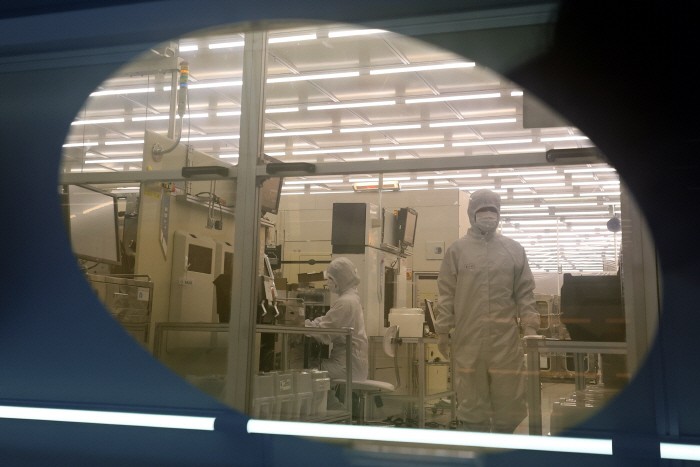 |
| The interior of a semiconductor fab is reflected in a wafer display at the Nano-Convergence Technology Institute in Yuseong-gu, Daejeon, on July 30. As science high school graduates increasingly enroll in science and engineering programs at institutions like KAIST, both KAIST and Sungkyunkwan University now host Samsung Electronics-sponsored semiconductor departments. / Yonhap |
Science high schools nationwide will select a record 1,858 new students for the 2027 academic year. With two new science high schools opening in Gyeonggi Province, alongside the expansion of semiconductor-sponsored university departments and the introduction of a regional doctor quota system, attention is turning to how top-performing students will choose their career paths.
According to Jongro Academy on the 17th, 22 science high schools nationwide plan to admit 1,858 new students for the 2027 academic year, up 216 (13.2%) from 1,642 students at 20 schools the previous year — the largest intake since science high schools were first established in 1983.
The increase is largely driven by the opening of two new schools in Gyeonggi Province, Bucheon Science High School and Bundang Central Science High School, each admitting 100 students. Of the 80 students admitted through the general track, up to 20 at each school will be separately selected from Bucheon and Seongnam, respectively. Jeonbuk Science High School also increased its intake from 80 to 96 students.
By region, two schools in Seoul and three in Gyeonggi will each admit 300 students combined, two schools in Incheon will admit 160, and 15 schools outside the greater metropolitan area will admit 1,098. By individual school, Sejong Science High School will admit the most students at 160, followed by Hansung Science High School at 140, and Gyeonggi Bukbu Science High School, Bucheon Science High School, Bundang Central Science High School, and Gyeongnam Science High School each admitting 100.
Science high school graduates' enrollment in science and engineering universities has also been notable. For the 2026 academic year, 449 graduates enrolled at the Korea Advanced Institute of Science and Technology (KAIST), the highest figure in six years, followed by 193 at Sungkyunkwan University, 131 at POSTECH, 110 at Seoul National University, and 85 at Korea University. Both KAIST and Sungkyunkwan University host Samsung Electronics-sponsored semiconductor departments, and the number of science high school graduates enrolling at KAIST has remained in the 400s since the 2023 academic year, when the sponsored department was introduced.
Meanwhile, with the introduction of a regional doctor quota system starting in the 2027 academic year, attention is also turning to how top-performing students considering medical school will respond, since science high school students who wish to pursue medicine or pharmacy face disadvantages, such as being excluded from college advisory support and being advised to transfer to a general high school.
Lim Sung-ho, CEO of Jongro Academy, said that science high schools' math and science curricula can be advantageous for admission to specialized science and engineering universities like KAIST, but added that students need to make their decision fully aware that preparing for the CSAT while enrolled is practically impossible.
Applications for the 2027 academic year at science high schools will be accepted from the 18th through September 3. Interviews will take place from November 13-28, with admissions results announced between November 25 and December 2.
Kim Bo-young
Most Read
-
1
Alteogen secures European patent for Keytruda SC,..

-
2
Trump shares map on social media labeling Strait o..

-
3
Celltrion seeks rheumatoid arthritis indication ex..

-
4
Kia Sportage outperforms Mazda CX-5 in German auto..

-
5
Chinese e-commerce giants AliExpress, Temu and She..

-
6
China expels No. 2 military official Zhang Youxia..

-
7
U.S. deploys carrier, 10,000 more troops to Middle..

PEOPLE






-
Address : In-Young Bldg., 34, Uisadang-daero 1-gil, Yeongdeungpo-gu, Seoul
Copyright by ASIATODAY CO., LTD. All rights resereved