



Government pushes legal foundation, R&D support for gene-therapy-based regenerative medicine
Aug 18, 2026, 09:18 am


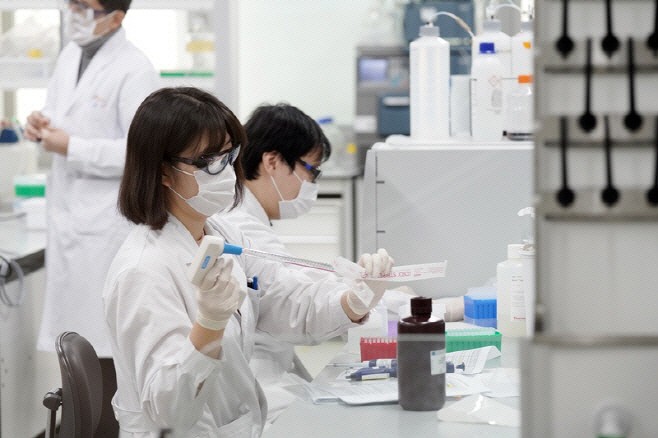 |
| Researchers work on developing treatments. / Yonhap |
With advanced regenerative medicine — a next-generation medical technology — poised for rapid growth, the government is moving to build competitiveness in gene therapy, seen as a core capability in the field. Authorities plan to establish a legal foundation for in vivo treatments using genetic material, while continuing R&D support to secure core technologies.
According to the Ministry of Health and Welfare on the 17th, a legislative notice for a partial amendment to the enforcement decree of the "Act on Safety of and Support for Advanced Regenerative Medicine and Advanced Biological Medicine" will run through September 23. The proposed amendment defines the specific scope of genetic material included under the definition of human cells and other biological materials. Specifically, it includes genetic material — such as nucleic acids or components containing nucleic acids — used to express genes or to regulate, control, or edit gene expression, within the scope of human cells and related materials.
This amendment is described as a follow-up measure to the revised Act, promulgated on May 26. The revised Act, set to take effect November 27, adds genetic material to the definition of human cells and other materials, expanding the scope of advanced regenerative medicine — previously limited to ex vivo (outside-the-body) methods — to include in vivo (inside-the-body) approaches as well.
A Ministry of Health and Welfare official said that establishing this legal foundation will enable stable support for clinical research in advanced regenerative medicine, adding that this is expected to boost clinical research activity and improve patients' access to treatment.
According to the ministry, the global regenerative medicine market, valued at $23.2 billion in 2024, is projected to grow to $62.1 billion (about 88 trillion won) by 2030. Within that, gene therapy is expected to post the fastest growth in the field, with an average annual growth rate of 19.1%. Global competition is also intensifying — between 2020 and 2025, the U.S. approved more than 20 cell and gene therapy products, while Japan and the EU approved 13 and 11, respectively, over the same period.
In step with this trend, the Korean government is also focused on strengthening its competitiveness in advanced regenerative medicine, including gene therapy. On the 21st of last month, the Ministry of Health and Welfare, together with the Ministry of Food and Drug Safety, deliberated and adopted the "Second Master Plan for Advanced Regenerative Medicine and Advanced Biological Medicines." The plan outlines three strategies — expanding patient access, rationalizing regulation, and strengthening technology and industry competitiveness — and sets goals of approving more than 150 clinical studies and treatments by 2030, and expanding annual national R&D investment to over 200 billion won.
To boost gene therapy clinical research specifically, the plan calls for forming consortiums between researchers and cell processing facilities, and supporting the development of processing procedures needed to produce clinical samples, as well as joint research projects.
In addition, the ministry will work with the Ministry of Science and ICT to support R&D for core materials and foundational technologies in advanced regenerative medicine — including gene editing, control, and restoration, and gene delivery vehicles — to strengthen the foundation for overcoming rare and intractable diseases. As part of this effort, gene therapy development has begun this year, with work on securing gene delivery vehicles and delivery technology, and developing gene editing, control, and restoration technology, to continue through 2027.
Seo Byung-ju
Most Read
-
1
Celltrion nears additional contract with major U.S..

-
2
"Aren't those foreigners on welfare?": M..

-
3
U.S. weighs dropping MOAB, world's most powerful n..

-
4
Houthis launch successive attacks on Saudi airport..

-
5
Saudi Arabia, Iran hold first diplomatic talks to..

-
6
Saudi airport in Riyadh struck again, leaving at l..

-
7
Five ASEAN countries welcome Myanmar coup leader

PEOPLE






HEADLINE NEWS

-
Address : In-Young Bldg., 34, Uisadang-daero 1-gil, Yeongdeungpo-gu, Seoul
Copyright by ASIATODAY CO., LTD. All rights resereved