



Multilateral talks to end the war loom as pivotal test for diplomacy
Aug 18, 2026, 09:13 am


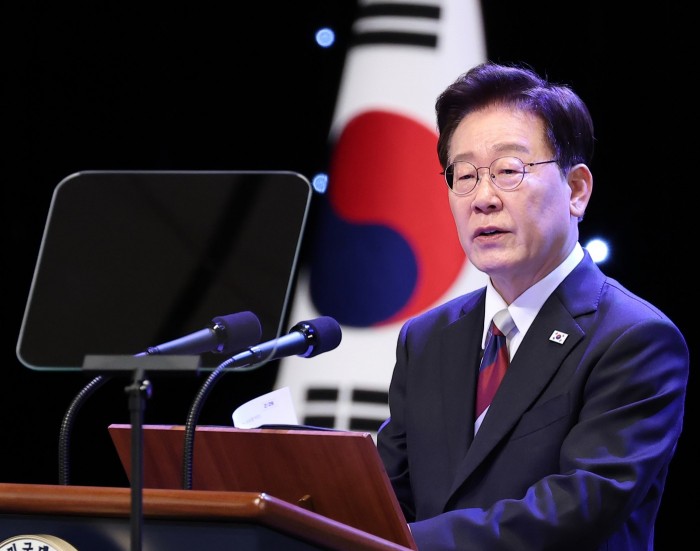 |
| President Lee Jae-myung delivers his address at the 81st Liberation Day ceremony, held at Sejong Center for the Performing Arts in Jongno-gu, Seoul, on the 15th. / Yonhap |
President Lee Jae-myung's Liberation Day address, which put forward the concept of "discussions to end the war" as a way to bring closure to the armistice from the Korean War, has drawn attention to whether talks on transitioning to a peace regime on the Korean Peninsula will now move forward in earnest. With inter-Korean dialogue currently stalled, the key question is whether multilateral talks involving the U.S., China, and other neighboring countries can create a breakthrough to halt North Korea's advancing nuclear capabilities and pave the way toward a peace regime.
According to the presidential office on the 17th, President Lee proposed in his 81st Liberation Day address that "the parties involved begin discussions to bring an end to this very old war." While last year's address focused mainly on laying out the government's principles toward North Korea, this year's speech proposed concrete discussions to the relevant parties aimed at converting the armistice system into a peace regime.
The presidential office views this as a "practical initiative for transitioning to a Korean Peninsula peace regime." Rather than simply waiting for inter-Korean dialogue to resume, the aim is to draw in neighboring countries like the U.S. and China to create space for North Korea to engage.
One notable point is that the term "denuclearization" did not appear prominently in the address. Instead, President Lee said that during discussions to end the war, effective measures to halt the advancement of North Korea's nuclear capabilities could also be discussed. Since it remains difficult to draw North Korea into denuclearization negotiations immediately, this is interpreted as a phased approach that begins by putting a freeze on further advancement of North Korea's nuclear and missile capabilities on the negotiating table.
Still, the presidential office explained that this does not mean abandoning denuclearization as the ultimate goal. This is reflected in President Lee's description of peace on the Korean Peninsula as "a milestone toward a world without nuclear weapons." The idea is to first pursue a halt to North Korea's nuclear advancement and discussions on a peace regime, while gradually broadening common ground on denuclearization over the longer term.
Whether President Lee's initiative to discuss ending the war succeeds is likely to depend on how much support can be drawn from neighboring countries like the U.S. and China. This year's UN General Assembly, U.S.-China summit diplomacy, and the Asia-Pacific Economic Cooperation (APEC) summit are expected to serve as key diplomatic venues in the second half of the year. Above all, China — a party to the armistice agreement that still maintains diplomatic channels with North Korea — is seen as a critical variable in drawing Pyongyang into multilateral talks.
Park Young-hoon
Most Read
-
1
Celltrion nears additional contract with major U.S..

-
2
Putin proposes trilateral U.S.-China-Russia summit..

-
3
U.S. weighs dropping MOAB, world's most powerful n..

-
4
"Aren't those foreigners on welfare?": M..

-
5
Attention centers on APEC for possible Trump-Xi-Pu..

-
6
Saudi Arabia, Iran hold first diplomatic talks to..

-
7
China tightens grip on boosting domestic demand an..

PEOPLE







-
Address : In-Young Bldg., 34, Uisadang-daero 1-gil, Yeongdeungpo-gu, Seoul
Copyright by ASIATODAY CO., LTD. All rights resereved