



N. Korea's silence emerges as variable for enforcing "two-state" theory
Aug 18, 2026, 09:11 am


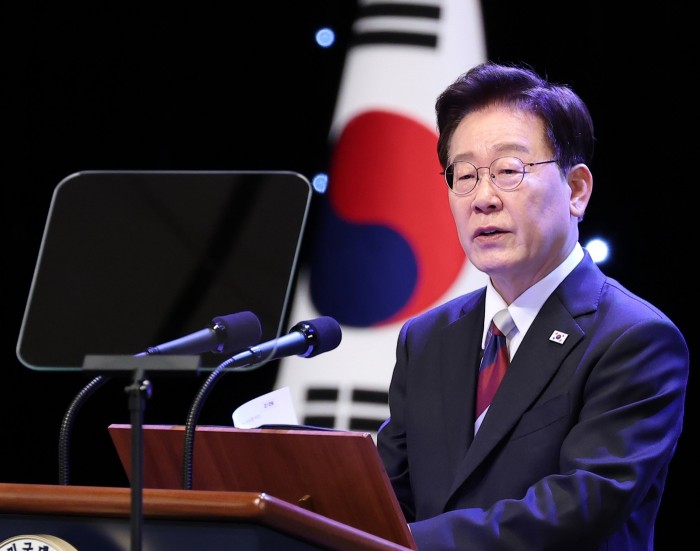 |
| President Lee Jae-myung delivers his address at the 81st Liberation Day ceremony, held at Sejong Center for the Performing Arts in Jongno-gu, Seoul, on the 15th. / Yonhap |
North Korea has maintained silence for a second day following President Lee Jae-myung's Liberation Day proposals for "inter-Korean dialogue" and "multilateral discussions to formally end the war." Analysts suggest that, with President Trump's directive to scale back Korea-U.S. joint military exercises also factoring in, North Korea appears to be weighing how its second-half foreign policy stance should be shaped before deciding how to respond.
Through the 17th, North Korean state media had said nothing about President Lee's Liberation Day address, instead running coverage of North Korean leader Kim Jong-un attending a circus performance with his daughter Ju-ae to mark the holiday. Experts believe North Korea may show more interest in multilateral talks to formally end the war — involving the U.S. and China, among others — than in inter-Korean dialogue itself, seeing a chance to use a multilateral framework involving Washington and Beijing as diplomatic leverage to press for recognition as a nuclear state, sanctions relief, and formal acknowledgment of its "two-state" theory.
In that scenario, the goals of the South Korean government — using multilateral talks as a breakthrough for denuclearization and improved inter-Korean relations — could diverge sharply from North Korea's intentions. Regardless of any actual agreement, North Korea could still tout the mere act of sitting at the same table as the U.S., China, and other major powers as a diplomatic achievement, both domestically and internationally.
Cho Han-bum, a distinguished research fellow at the Korea Institute for National Unification, said that if North Korea participates in multilateral talks, it will likely try to interpret the South Korean government's proposal for a declaration to end the war as validation of its "two-state" theory, and interpret any halt in advancing its nuclear capabilities as recognition of its status as a nuclear state, adding that North Korea's continued silence so far likely reflects deliberation over how to factor in Trump's directive to scale back joint exercises into its future policy.
The problem is that if a multilateral framework does get off the ground, it won't be easy for South Korea to secure control over the negotiations. North Korea reiterated its stance on maintaining a relationship of "hostile two states" through a Foreign Ministry spokesperson's statement on the 14th, suggesting it may seek to limit South Korea's role going forward.
Mok Yong-jae
Most Read
-
1
Celltrion nears additional contract with major U.S..

-
2
Putin proposes trilateral U.S.-China-Russia summit..

-
3
U.S. weighs dropping MOAB, world's most powerful n..

-
4
"Aren't those foreigners on welfare?": M..

-
5
Attention centers on APEC for possible Trump-Xi-Pu..

-
6
Saudi Arabia, Iran hold first diplomatic talks to..

-
7
China tightens grip on boosting domestic demand an..

PEOPLE







-
Address : In-Young Bldg., 34, Uisadang-daero 1-gil, Yeongdeungpo-gu, Seoul
Copyright by ASIATODAY CO., LTD. All rights resereved