



U.S. sets drone tariffs at up to 100%, S. Korea gets 15% rate
Aug 14, 2026, 04:49 pm


 |
| / This image was generated by AI. |
The U.S. government is imposing steep tariffs of up to 100% on unmanned aircraft systems (UAS, or drones) and key components. However, Korean-made products will receive preferential treatment, ensuring the total tariff rate does not exceed 15% if certain requirements are met.
According to the Ministry of Trade, Industry and Energy on the 14th, the White House issued a proclamation on the 13th (local time) imposing tariffs on UAS under Section 232 of the Trade Expansion Act. The U.S. government explained the measure is aimed at reducing dependence on foreign supply chains, addressing cybersecurity vulnerabilities, and expanding domestic UAS and component production capacity.
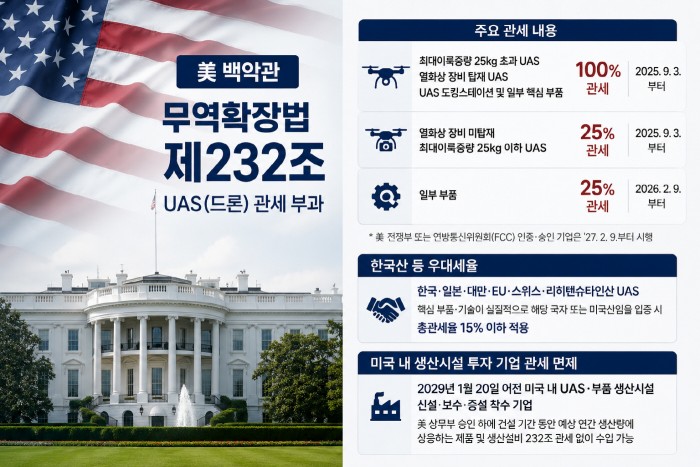
Under the proclamation, starting September 3, the U.S. will impose a 100% tariff on UAS with a maximum takeoff weight exceeding 25 kg, UAS equipped with thermal imaging equipment, UAS docking stations, and certain key components.
UAS with a maximum takeoff weight of 25 kg or less that are not equipped with thermal imaging equipment will face a 25% tariff. A 25% tariff will also apply to certain components starting February 9 next year.
Korean-made products, however, will receive a preferential rate. UAS from South Korea, as well as Japan, Taiwan, the European Union, Switzerland, and Liechtenstein, will face a total tariff rate of 15% or below, provided they can demonstrate that core components and technology substantially originate from those countries or the U.S.
The proclamation also includes a tariff exemption to encourage investment in U.S. production facilities. Companies that build new UAS or component production facilities in the U.S., or repair or expand existing ones, before January 20, 2029, can import products and production equipment corresponding to their expected annual output during the construction period without Section 232 tariffs, subject to approval from the U.S. Department of Commerce.
The government plans to closely coordinate with U.S. counterparts on unresolved details, such as the specific certification standards and scope of application for the preferential rate on Korean products, while working with relevant ministries to closely monitor the impact on industry.
Kim So-young
Most Read
-
1
Alteogen secures European patent for Keytruda SC,..

-
2
Trump shares map on social media labeling Strait o..

-
3
Celltrion seeks rheumatoid arthritis indication ex..

-
4
Chinese e-commerce giants AliExpress, Temu and She..

-
5
China expels No. 2 military official Zhang Youxia..

-
6
Houthi rebels release video claiming downing of Sa..

-
7
Trump rejects Iran's offer to open Strait of Hormu..

PEOPLE







-
Address : In-Young Bldg., 34, Uisadang-daero 1-gil, Yeongdeungpo-gu, Seoul
Copyright by ASIATODAY CO., LTD. All rights resereved