



SKT, KT CapEx takes double-digit hit amid financial strain
Aug 14, 2026, 10:12 am


 |
Korea's telecom industry showed a clear divergence in capital expenditure (CapEx) in the first half of this year. SK Telecom and KT saw double-digit percentage declines in their CapEx from a year earlier, while LG Uplus posted growth. As the fallout from last year's personal data breach drove up one-time costs and heightened the need for cost efficiency, the two carriers appear to have tightened their spending. Now in the eighth year since 5G's commercial launch, critics point out that infrastructure challenges — such as network quality issues that still need addressing — are being pushed aside as CapEx shrinks.
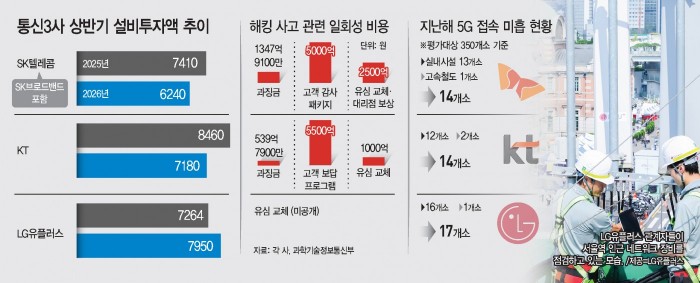
According to the three telecom carriers' earnings reports released on the 13th, first-half CapEx this year came to 624 billion won for SK Telecom (including SK Broadband), 718 billion won for KT, and 795 billion won for LG Uplus. SK Telecom and KT posted year-on-year declines of 15.7% and 15.1%, respectively, while LG Uplus rose 9.4%. Telecom industry CapEx typically concentrates in the second half of the year, but this year's steeper decline is attributed largely to the heavier financial burden from one-time costs tied to last year's hacking incident.
SK Telecom was fined 134.791 billion won by the Personal Information Protection Commission (PIPC) last year and spent 250 billion won on subscriber SIM card replacements and retailer compensation. It also incurred 500 billion won in costs implementing its "customer appreciation package," including telecom fee discounts. KT was similarly fined 53.979 billion won by the PIPC recently, and spent roughly 550 billion won on customer appreciation programs and SIM card replacements. LG Uplus, which suffered relatively less financial damage, appears to have focused its spending on investments such as transitioning to 5G standalone (SA) mode.
While first-half CapEx diverged this year, all three carriers have generally shown a declining trend year over year. Last year's annual CapEx totaled 2.129 trillion won for SK Telecom, 2.144 trillion won for KT, and 1.75 trillion won for LG Uplus — down 10.9%, 7%, and 8.9%, respectively, from the previous year. This marks a substantial gap compared to 2019, the first year of 5G's commercial launch, when the three carriers' combined annual CapEx stood at around 8.8 trillion won. Operators explain that with 5G base station installation largely complete across most of the country and the telecom market reaching saturation, investment in new revenue drivers such as AI and data centers has grown more important.
The problem is that users' complaints about network quality persist. While 5G handsets now account for more than 80% of devices across the three carriers, quality remains inadequate at some indoor facilities. Indeed, according to the "Telecom Service Coverage and Quality Assessment" released last year by the Ministry of Science and ICT, among 350 major facilities surveyed nationwide, the 5G connectivity rate fell below 90% at 14 SK Telecom sites, 14 KT sites, and 17 LG Uplus sites. For LTE (4G), quality shortfalls were also identified at 30 SK Telecom sites, 24 KT sites, and 11 LG Uplus sites out of 600 locations surveyed.
This is part of why concerns are emerging over the commercialization of 5G SA amid declining CapEx. 5G SA refers to a network built entirely on dedicated 5G equipment across every segment, with no reliance on legacy 4G infrastructure. Among the three carriers, KT began commercializing SA in 2021, while SK Telecom and LG Uplus — both still running 5G non-standalone (NSA) mode — have set a goal of transitioning within this year. Since building a dedicated core network requires substantial investment, there's speculation that the trend of shrinking CapEx could delay that timeline. An industry official said that AI and data centers, seen as future growth drivers, ultimately depend on a solid telecom network as their foundation, adding that CapEx with a medium- to long-term perspective needs to be sustained.
Yeon Chan-mo
Most Read
-
1
Alteogen secures European patent for Keytruda SC,..

-
2
Trump shares map on social media labeling Strait o..

-
3
Celltrion seeks rheumatoid arthritis indication ex..

-
4
Chinese e-commerce giants AliExpress, Temu and She..

-
5
China expels No. 2 military official Zhang Youxia..

-
6
Houthi rebels release video claiming downing of Sa..

-
7
Trump rejects Iran's offer to open Strait of Hormu..

PEOPLE






-
Address : In-Young Bldg., 34, Uisadang-daero 1-gil, Yeongdeungpo-gu, Seoul
Copyright by ASIATODAY CO., LTD. All rights resereved