



Safety regulations added to nuclear export push
Aug 14, 2026, 10:09 am


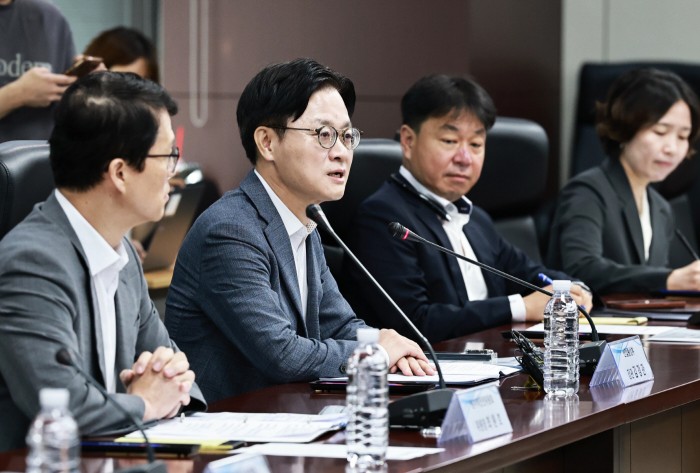 |
| Trade, Industry and Energy Minister Kim Jung-kwan speaks at a consultative meeting between the Ministry of Trade, Industry and Energy and the Nuclear Safety and Security Commission, held at the Korea Trade Insurance Corporation in Jongno-gu, Seoul. / Ministry of Trade, Industry and Energy |
The government has built a cross-government cooperation framework linking export support with nuclear safety regulatory cooperation, aimed at strengthening the competitiveness of Korea's nuclear power exports. Since countries pursuing new nuclear power plants require not only construction but also the establishment of their own safety regulatory systems and licensing capacity, the plan is to provide packaged support that includes regulatory cooperation from the early stages of export deals.
The Ministry of Trade, Industry and Energy and the Nuclear Safety and Security Commission signed a memorandum of understanding titled "Cooperation for the Successful Overseas Expansion of Korean Nuclear Power Plants" at the Korea Trade Insurance Corporation's main conference room in Seoul on the 13th.
As global instability persists — driven by the Russia-Ukraine war and the blockade of the Strait of Hormuz — and climate action emerges as a pressing international challenge, nuclear power is once again drawing attention as a source of stable energy supply that can contribute to carbon neutrality. Countries across the U.S. and Europe, as well as Southeast Asian nations such as Vietnam and the Philippines, are reviewing or pursuing new nuclear power projects.
In particular, countries adopting new nuclear power must simultaneously build out their regulatory foundation alongside plant construction — including relevant laws, licensing systems, technical standards, regulatory agency expertise, and nuclear safety and security personnel. In the process of exporting new nuclear plants, it's important to offer not just technical capability but also Korea's accumulated experience and expertise in safety regulation.
Under the agreement, the two ministries will regularly share updates on overseas nuclear projects, country-specific regulatory conditions, and cooperation needs. The plan is to draw on Korea's regulatory experience accumulated across the entire nuclear plant lifecycle — design, construction, and operation — to tailor support to each target country's conditions and project stage.
Alongside this agreement, Korea Electric Power Corporation (KEPCO), Korea Hydro & Nuclear Power (KHNP), the Korea Nuclear Export Industry Association, the Korea Institute of Nuclear Safety, and the Korea Institute of Nuclear Nonproliferation and Control also signed a separate agreement. This establishes a framework in which the two ministries set the government-level direction for cooperation while relevant institutions carry out concrete cooperation projects tailored to each country's needs.
At the consultative meeting between the two agencies held after the signing, participants shared updates on major export projects in Vietnam, the Czech Republic, and the Philippines, along with case studies of regulatory cooperation with the UAE and the Czech Republic, and discussed export and regulatory cooperation strategies tailored to conditions in each country.
New nuclear power plant adoption is accelerating not just in the U.S. and Europe, but also in Southeast Asian countries such as Vietnam and the Philippines. In response to these market shifts, the government is actively pursuing exports, focusing on promising Southeast Asian markets like Vietnam.
In particular, countries adopting new nuclear plants must build out their regulatory foundation alongside construction — including relevant laws, licensing procedures, technical standards, regulatory agency expertise, and nuclear safety and security personnel. This means that entering new nuclear markets requires comprehensive cooperation that leverages not just technical and project execution capability, but also Korea's accumulated regulatory experience and expertise across the entire nuclear plant lifecycle.
Minister Kim Jung-kwan said, "This agreement is significant in that it systematically links nuclear exports with regulatory cooperation and establishes a formal cooperation framework that pools the expertise of both ministries and related institutions," adding, "Going forward, we will treat the Nuclear Safety and Security Commission, the Korea Institute of Nuclear Safety, and the Korea Institute of Nuclear Nonproliferation and Control as core partners of 'Team Korea,' comprehensively responding to the diverse cooperation needs of countries adopting new nuclear power, such as Vietnam."
Choi Won-ho, chairman of the Nuclear Safety and Security Commission, said, "We will work closely with the Ministry of Trade, Industry and Energy and nuclear export companies to pursue regulatory cooperation tailored to the conditions and needs of target export countries, drawing on Korea's accumulated regulatory experience and expertise, and will play an active role in advancing our country's nuclear power exports abroad."
Kim So-young
Most Read
-
1
Celltrion nears additional contract with major U.S..

-
2
Putin proposes trilateral U.S.-China-Russia summit..

-
3
U.S. weighs dropping MOAB, world's most powerful n..

-
4
"Aren't those foreigners on welfare?": M..

-
5
Attention centers on APEC for possible Trump-Xi-Pu..

-
6
Saudi Arabia, Iran hold first diplomatic talks to..

-
7
China tightens grip on boosting domestic demand an..

PEOPLE






-
Address : In-Young Bldg., 34, Uisadang-daero 1-gil, Yeongdeungpo-gu, Seoul
Copyright by ASIATODAY CO., LTD. All rights resereved