



Heatwave gives momentum to K League's autumn-to-spring season debate
Aug 14, 2026, 09:36 am


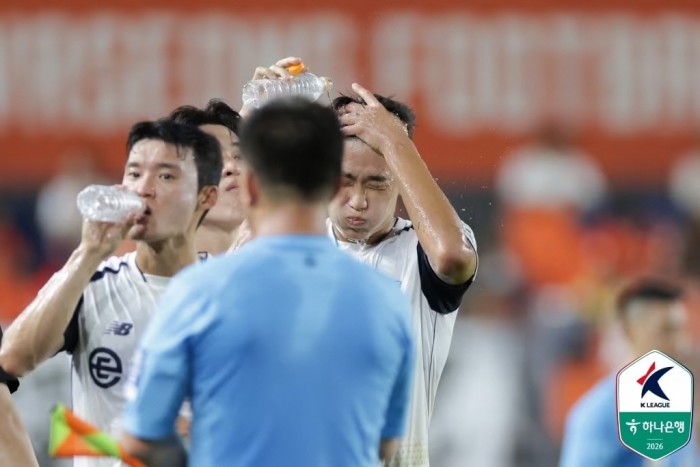 |
| Players from Hwaseong FC and Seoul E-Land FC cool off during a hydration break at the 2026 Hana Bank K League 2 Round 21 match on the 7th. The Korean Professional Footballers' Association urged on the 13th that K League should also move to adopt a fall-to-spring season format to prepare for extreme heat. / Courtesy of the Korea Professional Football League |
Discussion over changing K League's season format has gathered momentum, as the Korean Professional Footballers' Association calls for a shift to a fall-to-spring calendar to protect players from recurring extreme summer heat. The argument goes beyond simply pushing back match times in summer, calling instead for an overhaul of the league's entire operating structure to match changing climate conditions. The association issued a statement on the 13th strongly advocating for the switch.
Under a fall-to-spring format, a season begins in autumn and finishes the following spring — the structure most European leagues use. Asian leagues that traditionally play through midsummer are also increasingly moving toward this format. The Asian Football Confederation (AFC) shifted its Champions League to a fall-to-spring calendar starting with the 2023-2024 season.
As Asian club competitions have adopted a European-style calendar, domestic professional leagues across Asia are undergoing major changes as well. A prime example is Japan's J-League, which has confirmed a switch to the fall-to-spring format starting with the 2026-2027 season. With the new schedule beginning this August, the league will play matches in the dead of winter for the first time. However, the league plans to take a break during January's harshest cold, resuming in late February and wrapping up in late May. Since many parts of Japan see heavy snowfall, the league opted for a roughly two-month winter break.
Discussion of adopting the fall-to-spring format has also caught fire in South Korea. As record-breaking heat forced the complete cancellation of the entire professional baseball schedule for the first time this year, that same debate has spread to the K League. This summer, the K League pushed back match start times to 8 p.m. And as the players' association pointed out, arguments are gaining traction that running both the league and cup competitions simultaneously through extreme heat is too harsh on players.
Still, the fall-to-spring format isn't a cure-all. Given that Far East Asia's climate runs considerably colder than Europe's, holding outdoor matches in January and February is extremely limited. There's also much to consider regarding cold snaps, heavy snow, and pitch maintenance. A decline in attendance due to the cold is another serious drawback. Gangwon FC, in particular, would likely have most of its winter home matches effectively played away, raising potential fairness concerns. Building a domed stadium, as in baseball, isn't a realistic option either. The cost of overhauling infrastructure — heating systems, hybrid turf, and the like — would also be considerable.
Concerns are growing that the K League risks falling behind the international trend toward protecting players from summer heat, maintaining international competitiveness, and shifting to a fall-to-spring calendar amid climate change. The impact of the AFC Champions League schedule on the domestic league calendar also can't be ignored. With Japan — already a strong performer on the AFC stage — having decided to adopt the fall-to-spring format, the K League, exposed to a similar climate, appears likely to move toward a more concrete review of the switch as well.
Cheon Hyun-bin
Most Read
-
1
Celltrion nears additional contract with major U.S..

-
2
Putin proposes trilateral U.S.-China-Russia summit..

-
3
U.S. weighs dropping MOAB, world's most powerful n..

-
4
"Aren't those foreigners on welfare?": M..

-
5
Attention centers on APEC for possible Trump-Xi-Pu..

-
6
Saudi Arabia, Iran hold first diplomatic talks to..

-
7
China tightens grip on boosting domestic demand an..

PEOPLE






-
Address : In-Young Bldg., 34, Uisadang-daero 1-gil, Yeongdeungpo-gu, Seoul
Copyright by ASIATODAY CO., LTD. All rights resereved